
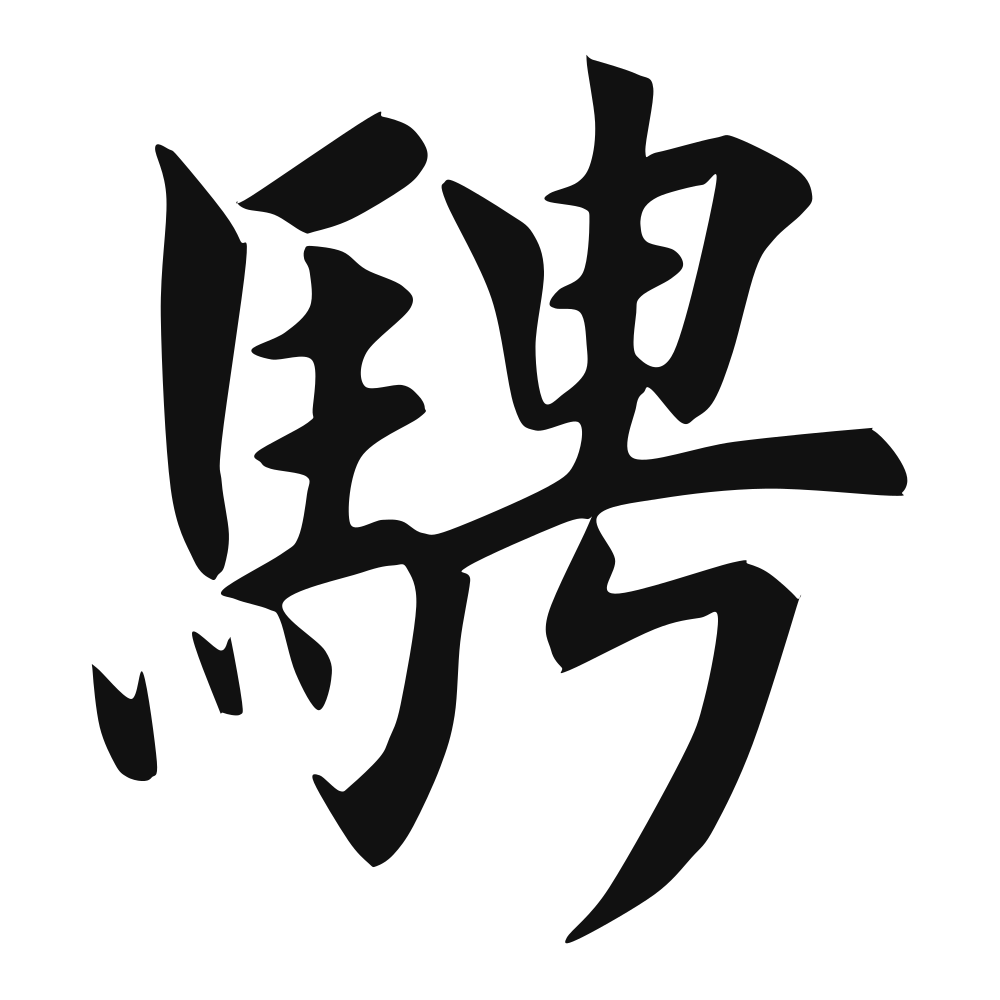
骋
to hasten; to run; to open up; to gallop
Closest English meanings
to gallop·to roam·indulge
The Calligrapher — Hè Zhīzhāng 贺知章
Tang poet-calligrapher celebrated for his cursive inscriptions.
Tang calligrapher (659–744), master of cursive script — known for 《孝经》. Tang dynasty
Cultural Story
骋 places 马 with 甹 and is glossed in the 《説文解字》 直驰也, "to gallop straight ahead." It pictured an unbroken run, and from the motion of a horse at full stretch it widened to roaming freely in body or mind.
Common words & phrases
- 驰骋 to gallop · to range
- 骋目 to look into the distance
- 骋怀 give free rein to feelings
Read the story behind the character
We 驰骋 across plains in imagination and in sport. 骋目 is to let the eyes range into the distance from a hilltop; 骋怀 is to give free rein to one's feelings, as writers do when their thoughts run unbridled. The word suits travelers, dreamers, and open roads alike.
Why this character belongs on skin
There is a word for what a horse does when it is finally given its head — the reins slack, the road open, the whole animal turned into a single act of motion. 骋 is that word: to gallop, to give rein, and by extension to let the mind run where it wants. Chinese uses it for unbridled imagination, 骋怀, the heart turned loose on a clear autumn day, which is exactly what the calligrapher Wang Xizhi gathered his friends to do at the Orchid Pavilion — wine floating downstream, minds racing the current. The horse radical does the work here; freedom, in this character, is something ridden, not merely wished for. Tattoo 骋 when you have decided that the year will not be spent standing in a field. Put it down the side of the ribs or the length of the thigh, the long muscles, the ones built for covering ground.
Own this character
Purchase delivers the original SVG of this glyph, brushed by Hè Zhīzhāng 贺知章, ready to place on skin, paper, or screen.