
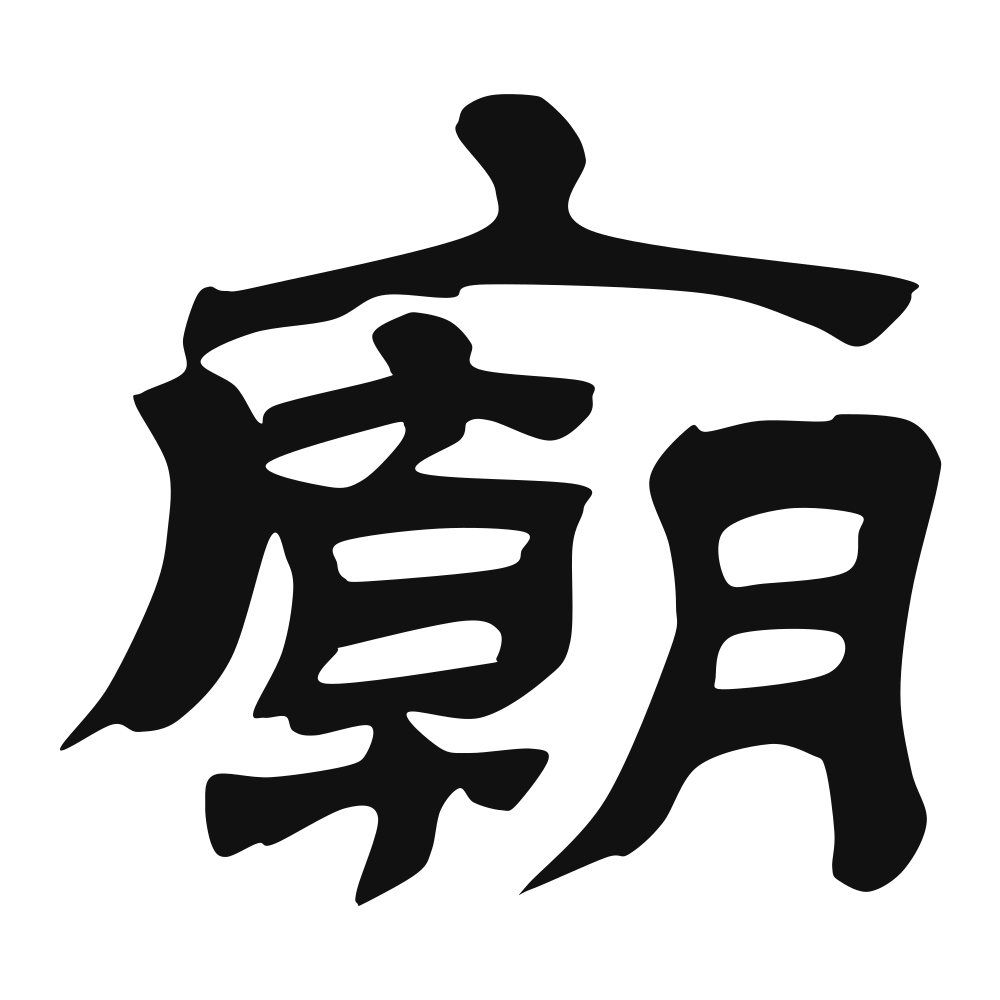
庙
temple; ancestral shrine; temple fair; great imperial hall; imperial
Closest English meanings
temple·shrine·altar·sanctuary
The Calligrapher — Jīn Nóng 金农
Qing 'Eight Eccentrics' master of archaic clerical script.
Qing calligrapher (), master of clerical script/regular script — Qing lacquer-script original, blunt brush, unmistakable. Qing dynasty
Etymology & Meaning · 字义溯源
2 · The Character: 庙 Miào (4th tone). The Shuowen defines 廟 as 「尊先祖皃也。从广朝聲」 — the place that honours the face of the forefathers; the graph joins the roof-radical with 朝 (court). The Er-ya says 「室有東西廂曰廟」 (a hall with east and west wings is a 廟), and the Classics use 廟 to mean the ancestral temple, then by extension the court itself (廟堂). 庙 means temple, ancestral hall. It is NOT a free-standing 'feel-good' char: it is sacred and civic, not a personal mood word. Grade caution — it suits someone claiming lineage, devotion, or public service; pair it (如 宗廟, 廟堂) rather than wearing it alone as a vague symbol. Disclosures: 庙 is the simplified 廟 (Kangxi 15); and 廟 also means 'court / government' (廟算). Naming tables assign Water (水) — verify, as the 廣-family is often Wood.
Cultural Story
廟 held the tablet of the dead — first ancestors, then gods. 宗廟 kept the royal line's spirits; 孔廟 in Qufu honors the teacher with daily rites. And the 廟會 turned the courtyard into a fair, lanterns and noodle stalls spilling past the threshold the spirits were supposed to keep quiet.
Where a Western reader can stand: Where a Western reader can stand: 'temple / ancestral hall' — 宗廟 honours the forefathers, 廟堂 is the court itself. Honest caveat: 庙 is sacred/civic, not a personal mood word — pair it (宗廟, 廟堂) and state your intent (lineage, devotion, service). Jin Nong's lacquer script makes it deliberately odd.
Common words & phrases
- 寺庙 temple · monastery
- 庙会 temple fair · religious fair
- 孔庙 Confucius temple
- 神庙 shrine · temple · sanctuary
- 宗庙 ancestral temple · shrine
Read the story behind the character
庙会 is the winter fair where 北京's 地坛 fills with sugar figurines and fried dough, 寺庙 the working temple a tourist pays to enter, and 孔庙 now a UNESCO stop. The spirits have thinned; the stalls and the selfies have not. The roof still stands, the purpose has drifted toward the snack cart.
Why this character belongs on skin
Incense rises and the rafters hold a silence older than the village below. 庙 is the temple—the ancestral shrine, the roof raised over memory so the dead would have a place to return. The character sets a dwelling above the honored face; it meant the hall where a family kept its ghosts and its gods in the same breath. The Confucians made 庙 the measure of a lineage, the proof a people had not forgotten where they came from. To wear 庙 is to carry your own sacred architecture—the inner room you keep for what matters, the quiet you return to when the market gets loud. It is the threshold you cross barefoot, the small lit space no one else can see. Let it mark your breastbone, the doorpost of the self. Some build walls; this mark builds a sanctuary. Wear the temple and you carry a holy place that walks wherever you go.
Own this character
Purchase delivers the original SVG of this glyph, brushed by Jīn Nóng 金农, ready to place on skin, paper, or screen.