
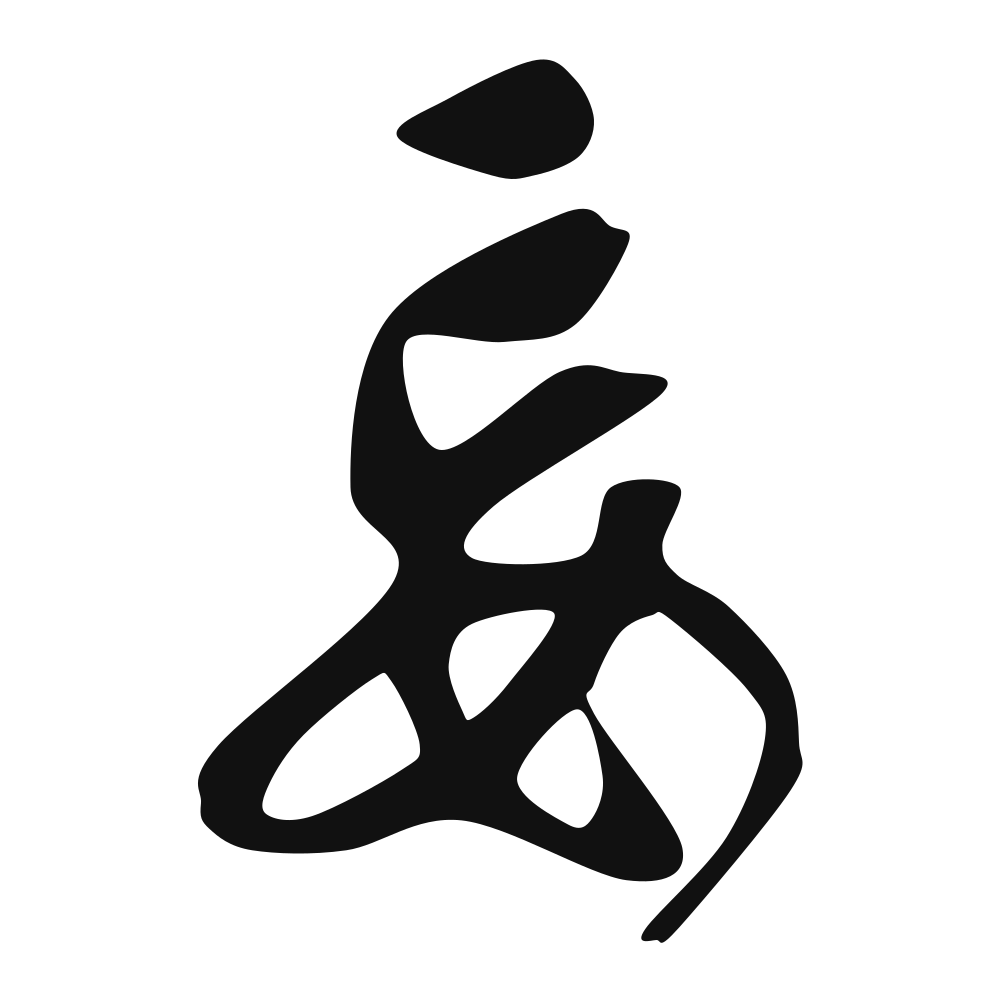
妄
妄 (wàng) — reckless, wild, false. Woman 女 + 亡 (lose): unbridled — extended to 'false, reckless'. Classical life: 妄想 — delusion (Buddhist); 妄 is the mind off its leash. Grammar: free morpheme — also: absurd; fantastic; presumptuous; rash
Closest English meanings
absurd·reckless·false·deluded·wild
The Calligrapher — Kānglǐ Náonáo 康里巎巎
Yuan cursive master of Kipchak origin, paired with Zhao Mengfu as 'North-Nao, South-Zhao.'
Yuan calligrapher (1295–1345), master of cursive script — known for 《谪龙说》. Yuan dynasty
Etymology & Meaning · 字义溯源
2 · The Character: 妄 妄 (wàng, 4th tone) — do not ink this alone. Shuowen Jiezi: 妄,亂也。从女亡聲 — 'disorder; from 女, with 亡 as phonetic.' Note the phonetic itself: 亡 means to be lost, to perish. Every downstream word is negative: 妄想 (delusion), 妄言 (reckless falsehood), 狂妄 (arrogant), 妄自菲薄 (to belittle oneself groundlessly), 輕舉妄動 (to act rashly). Zhuangzi uses it self-mockingly: 《莊子·齊物論》 '予嘗為女妄言之,女以妄聽之' — let me speak of it wildly, and you listen wildly. Its one honourable home is negated: 《易·無妄》 (hexagram 25) '無妄,元亨利貞,其匪正有眚' — Without Falsehood: primordial success, but whoever is not upright will meet calamity. That is the crucial fact for a tattoo: the character is good only with 無 in front of it. Honest disclosure: standalone 妄 reads to any literate Chinese speaker as 'delusional, presumptuous, reckless.' It is a diagnosis, not a virtue.
Cultural Story
The Shuowen gives 妄 as 亂, disordered and wild, a character of woman (女) and 亡, 'lost' — speech or action that has lost its footing. The Classics warn against 妄言, reckless words that bring trouble, and the Daoists prize a mind free of 妄, the false stirring of desire. Buddhism deepened it into 妄想, the deluded thoughts that bind us to suffering. To call a thing 妄 was to say it had strayed from the true and the measured — the lie, the daydream, the boast too big for the world.
Where a Western reader can stand: Where a Western reader can stand: 'without falsehood' — but only ever as 無妄 (hexagram 25); a standalone 妄 reads 'deluded, reckless, presumptuous' and must never be inked alone. Kangli Naonao, the Yuan prince-calligrapher ranked with Zhao Mengfu, is paired as the paragon of the negation.
Energy Reading
Fire (火)
Comparative symbology, not fortune-telling.
Common words & phrases
- 妄想 delusion · vain hope · wishful thinking
- 狂妄 arrogant · presumptuous · conceited
- 妄图 vainly attempt · presume · try in vain
- 妄言 reckless talk · wild words · false speech
- 虚妄 false · baseless · illusory · unreal
Read the story behind the character
A lonely man holds a 妄想 (delusion, vain hope) of winning the lottery; a 狂妄 (arrogant, presumptuous) boss insults his team and loses respect. A criminal 妄圖 (vainly attempts, tries in vain) to escape, and a rumormonger spreads 妄言 (reckless talk, wild words). A philosopher calls fame 虛妄 (false, baseless, illusory), and a friend laughs off a 妄想. 妄 is the modern word for what is false and overreached — the daydream, the boast, and the lie we should not believe.
Why this character belongs on skin
The line between a vision and a delusion is drawn by cowards, and 妄 lives right on it. It means the wild thought, the presumptuous hope, the thing you were told not to want. The old scribes loaded it with warnings about desire that overreaches. But every life worth tattooing began as someone's 妄—the impossible love, the move across an ocean, the art no one commissioned. Reason is a good servant and a terrible god. To wear this character is to honor the part of you that refuses the small map. Not madness for its own sake, but the sacred overreach, the ambition that embarrasses prudent people. Let it be your permission. Want the unreasonable thing, and let the ink keep the secret.
Own this character
Purchase delivers the original SVG of this glyph, brushed by Kānglǐ Náonáo 康里巎巎, ready to place on skin, paper, or screen.