
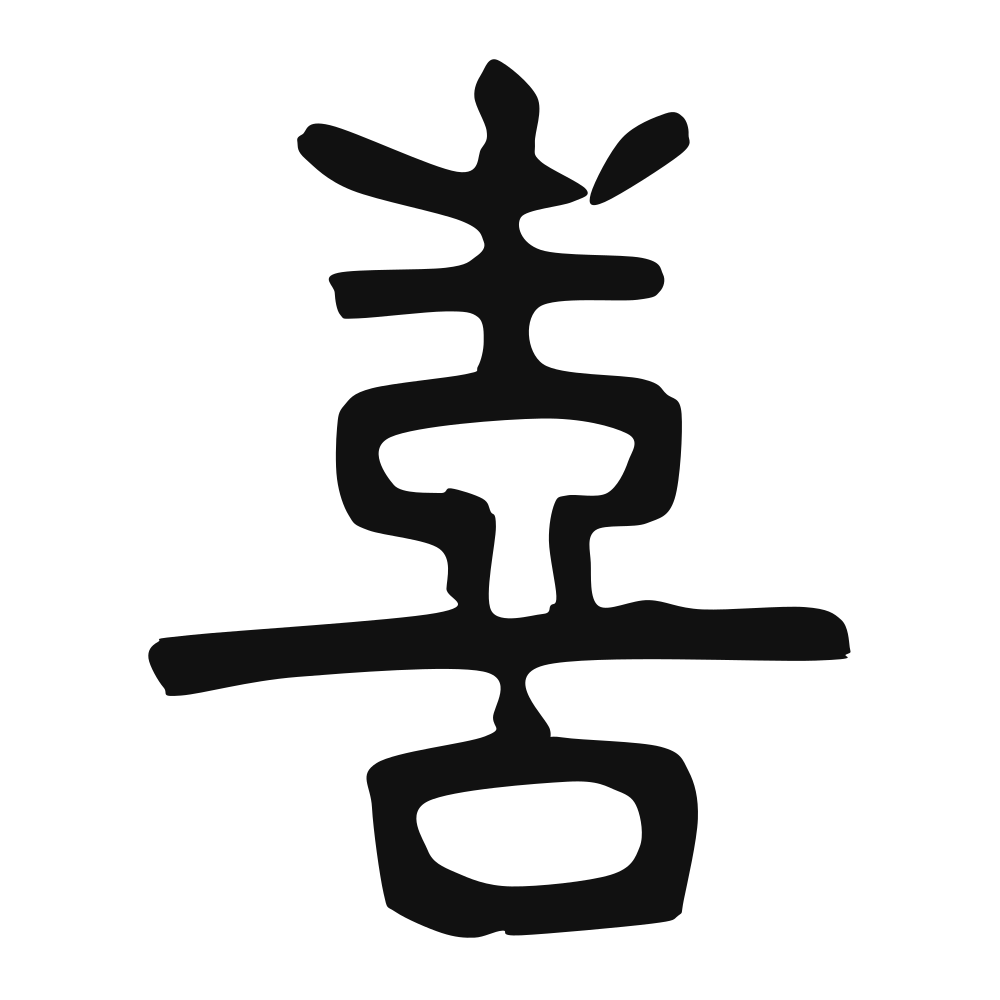
喜
to be fond of; to like; to enjoy; to be happy; to feel pleased; happiness; delight; glad
Closest English meanings
joy·happy·like·delight
The Calligrapher — Lǐ Dōngyáng 李东阳
Ming statesman and literatus of refined seal and regular script.
Ming calligrapher (), master of seal script/regular script — known for 茶陵派. Ming dynasty
Etymology & Meaning · 字义溯源
2 · The Character: 喜 Xǐ (3rd tone). 《说文·壴部》: 「喜,乐也。从壴从口。」 — 'joy; from 壴 (a drum on its stand) and 口 (mouth).' Joy is built as percussion plus voice: it is not a private mood but a noise other people can hear. 《诗经·郑风·风雨》 gives the most quoted line: 「既见君子,云胡不喜」 — now that I have seen him, how could I not be glad. 《诗经·小雅·菁菁者莪》 repeats the formula 「既见君子,我心则喜」. Du Fu titled a poem 《春夜喜雨》 — 「好雨知时节,当春乃发生」 — joy at rain that knows the season. 喜 is a fully free, positive morpheme: 欢喜, 喜悦, 喜爱, 恭喜. Honest disclosure: 有喜 ('to have joy') is the common euphemism for pregnancy; the doubled 囍 is strictly a wedding glyph and signals 'married'; and 白喜事 ('a white joy') is the polite name for an elder's funeral — the compound, not the single character, carries that.
Cultural Story
The Shuowen reads 喜 as 樂也, joy, and the character itself shows a drum 壴 beneath a mouth 口 — someone beating a drum and singing for gladness. On Shang oracle bones 喜 already marked festive occasions, and the Shi Jing celebrates 喜 at feasts and weddings. Confucius counted 喜 among the natural feelings to be tempered by ritual, while the Laozi warns that 'great 喜 brings great sorrow.' Across the tradition 喜 was the bright face of human feeling, to be enjoyed and yet kept in measure.
Where a Western reader can stand: Drum and voice at the same time: 喜 is joy made audible, in the stately hand of the Ming minister-poet. Western readers should know 囍 is the wedding character and 有喜 means pregnant.
Common words & phrases
- 喜欢 like · love · enjoy
- 喜悦 joy · delight
- 喜事 happy event · joyful occasion
- 欢喜 joyful · delighted
- 欣喜 glad · joyful
- 喜庆 festive · celebration
Read the story behind the character
A teenager texts 喜歡 (like, love, enjoy) under a friend's photo; a family plans a 喜事 (happy event, joyful occasion) — a wedding or a newborn — and hangs red 喜慶 (festive, celebration) banners. Grandma watches her grandchild and feels 歡喜 (joyful, delighted); a student gets exam results and texts 欣喜 (glad, joyful) to his parents. From a thumbs-up to a banquet hall, 喜 names the everyday happiness Chinese families celebrate out loud.
Why this character belongs on skin
Doubled at weddings into 囍, this character is the only one the Chinese invite to multiply — two joys pressed together, ringing the doorframe like laughter that won't leave the house. But 喜 alone is lighter than that, more fleeting: the sudden lift when good news lands, the small combustion of delight before the mind catches up. The Daoists knew joy was not a destination but a weather — passing, returning, never owned. We in the West build entire lives to trap it behind glass. This mark asks for less and grants more: to be the kind of person joy visits, not the kind who chases it away with grasping. Ink it near the heart and you practice a beautiful heresy — that happiness is not earned, only noticed, and that the door, kept open, stays warm.
Own this character
Purchase delivers the original SVG of this glyph, brushed by Lǐ Dōngyáng 李东阳, ready to place on skin, paper, or screen.