
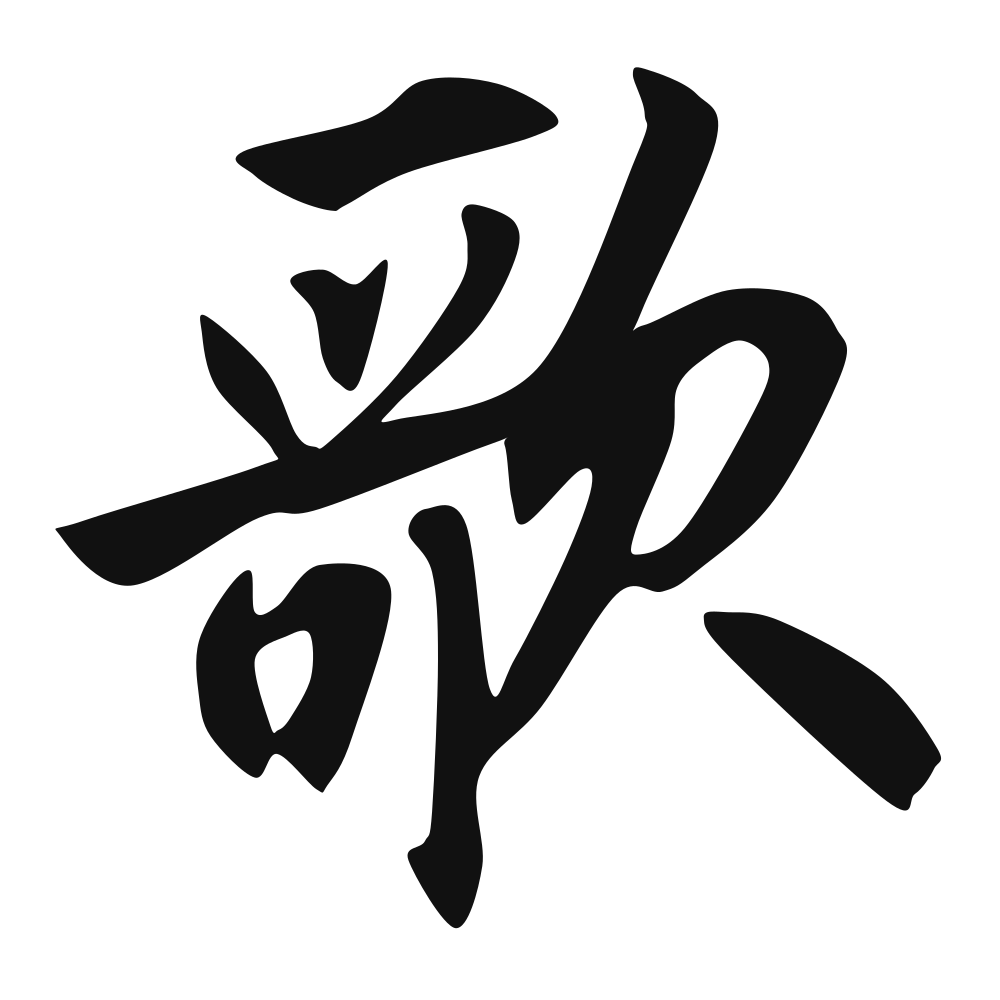
歌
song (CL:首[shou3],支[zhi1]); (bound form) to sing
Closest English meanings
song·sing·chant
The Calligrapher — Lǐ Liúfāng 李流芳
Ming literatus and calligrapher; one of the Four Masters of Jiading famed for running script.
Ming calligrapher (), master of running script — known for 《西湖诗》. Ming dynasty
Cultural Story
歌 was song and the act of singing what the heart could not speak plainly. The Book of Songs said poetry gives voice to intent and 歌 prolongs the words in melody, so 歌 and 诗 were twin arts. From court hymns to riverside ballads, to 歌颂 was to praise a ruler or a season, and 歌词 were the words a whole village could hum.
Common words & phrases
- 歌曲 song
- 唱歌 sing
- 歌词 lyrics
- 国歌 national anthem
- 歌颂 praise · eulogize
- 诗歌 poetry · verse
Read the story behind the character
Today 歌 fills every screen: we 唱歌 sing in a karaoke room, stream a favourite 歌曲 song, and read the 歌词 lyrics on our phones. Schools teach the 国歌 national anthem, poets are studied as 诗歌 poetry, and a fan 歌颂 praises an idol online. From a child's lullaby to a stadium anthem, 歌 is still how Chinese people turn feeling into sound.
Why this character belongs on skin
歌 is the oldest technology of joy: 欠, an open mouth, breathing over 哥, a word that was once the picture of song itself—sound prolonged and pleased. The Shijing's farmers sang it while weeding; the 渔夫 sang it to Confucius to tell him the age was hopeless and the water still beautiful; slaves sang it in fields where speech was forbidden, which is why every freedom movement is eventually a playlist. Singing is breath made public, the soul's yes given a melody. You cannot 歌 with your teeth closed. The Chinese knew the holy version too—梵呗, monks chanting scripture at dawn until the temple itself seems to hum. Wear the character where the breath begins. It is a small permanent permission: that whatever happens, the mouth stays open, the note keeps climbing, and the life—whatever else it is—remains singable.
Own this character
Purchase delivers the original SVG of this glyph, brushed by Lǐ Liúfāng 李流芳, ready to place on skin, paper, or screen.