
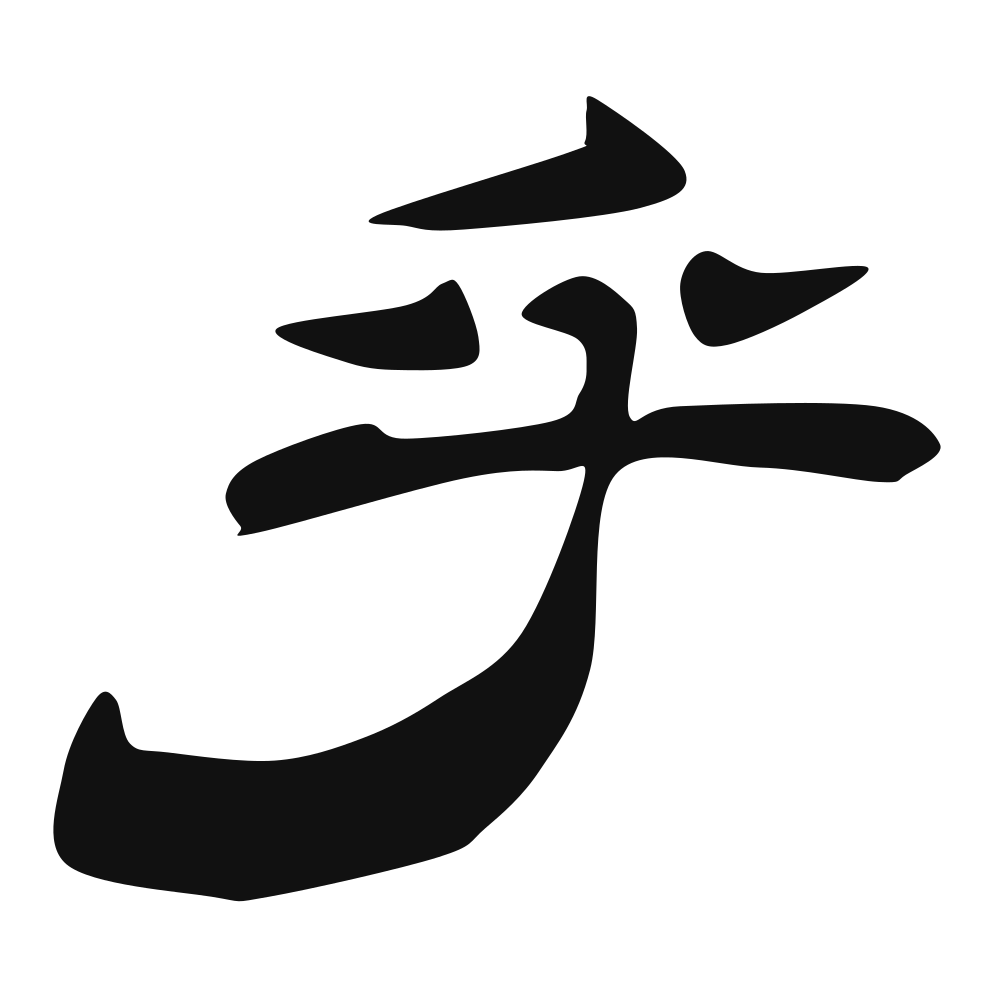
乎
(classical particle similar to 於|于[yu2]) in; at; from; because; than; (classical final particle similar to 嗎|吗[ma5], 吧[ba5], 呢[ne5], expressing question, doubt or astonishment)
Closest English meanings
(particle)·at·from
The Calligrapher — Lǐ Lóngjī 李隆基
Tang Emperor Xuanzong who wrote the Shitai Xiaojing in eight-division clerical script (bafen).
Tang calligrapher (), master of 八分/regular script — known for 唐玄宗,《石台孝经》. Tang dynasty
Etymology & Meaning · 字义溯源
2 · The Character: 乎 乎 (hū, 1st tone) is breath made visible. The Shuowen Jiezi: 語之餘也。从兮,象聲上越揚之形 — 'the remainder of speech; from 兮, depicting the sound rising and carrying upward.' The three strokes above the stem are literally drawn air. It is classical Chinese's great final particle: 不亦说乎 ('is it not a delight?', Lunyu, Xue'er 1.1); 胡为乎中露 ('why then am I out in the dew?', Shijing, Beifeng, Shiwei); 长铗归来乎 ('long sword, let us go home!', Zhanguo Ce, Qi); 技盖至此乎 ('how has your skill reached this?', Zhuangzi, Yangshengzhu). It also works as a preposition equivalent to 于, as in 异乎寻常, and as an adverbial suffix (巍巍乎, 郁郁乎). Kangxi: 5 strokes, 丿部. Honest disclosure: 乎 carries no lexical meaning of its own — it is tone, not content. Tattooed alone it reads to a Chinese speaker roughly like inking a question mark: charming, deliberate, but empty unless paired.
Cultural Story
乎 is the breathy particle that gave classical questions their rise at the end, 不亦说乎, is it not a joy. The 論語 leans on it; it is the spoken punctuation of Confucius's classroom, the lift in the voice before the student answers. Originally it meant at or from; it softened into the sound of inquiry itself, the tongue rounding a thought into a question.
Where a Western reader can stand: Where a Western reader can stand: imagine the exclamation that closes the first line of the King James Bible — 'Blessed are the poor in spirit: for theirs is the kingdom of heaven' — rendered not as words but as the very breath of the sentence. Emperor Xuanzong was the Sun King of Tang China, who wrote as a monarch and ruled as a patron of the arts, and his 乎 is that closing breath given imperial splendour. So a 乎 from his hand is grammar as majesty: the rising tone of a question or delight, cut with the confidence of a golden age. For the Western wearer it is the elegant curl at the end of a Latin inscription — a witty, deliberate silence, closed by an emperor whose own greatness carried a tragic undertow.
Common words & phrases
- 在乎 care about · mind
- 几乎 almost · nearly
- 似乎 seem · as if
- 关乎 concern · bear on
- 近乎 nearly · close to
- 出乎 beyond · exceed
Read the story behind the character
在乎 is whether you care, 我不在乎, I do not. 几乎 is the missed train by seconds; 似乎 the doubt you couch. 关乎 is what the policy brief says is at stake; 近乎 the line you are crossing. 出乎 is the surprise beyond expectation. The particle sense is gone from speech, but the character lives in these compounds, the register of nearness, doubt, and concern, the breath behind the words.
Own this character
Purchase delivers the original SVG of this glyph, brushed by Lǐ Lóngjī 李隆基, ready to place on skin, paper, or screen.