
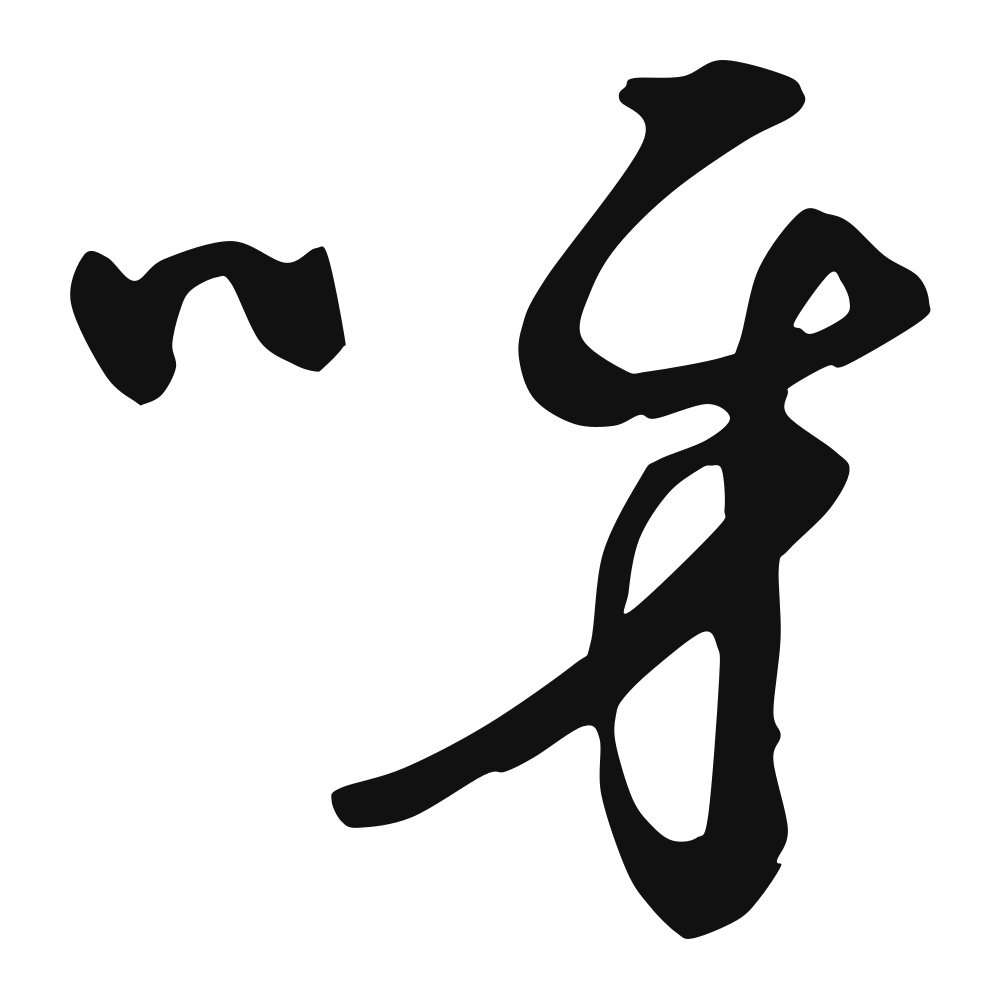
呀
ah (used to express surprise); (onom.) creaking; (particle equivalent to 啊 after a vowel, expressing surprise or doubt)
Closest English meanings
(particle)·ah·oh
The Calligrapher — Lǐ Lóngjī 李隆基
Tang Emperor Xuanzong who wrote the Shitai Xiaojing in eight-division clerical script (bafen).
Tang calligrapher (), master of 八分/regular script — known for 唐玄宗,《石台孝经》. Tang dynasty
Cultural Story
呀 is onomatopoeic and exclamatory, the mouth radical with 牙 (tooth, a phonetic). It did not carry weight in the classics; rather it is the spontaneous cry—surprise, dismay, the 呀 of a sudden opening. 哎呀 (oh my/alas) is the sound of bumped shins and dropped bowls, while 呀呀 mimics a baby's first babble. The character is the unplanned voice, older than grammar, younger than thought itself in the mouth.
Common words & phrases
- 哎呀 oh my · alas
- 呀呀 cry of baby · yah
Read the story behind the character
Someone drops a phone and cries 哎呀 (oh my/alas), and a baby goes 呀呀 (yah) at a toy. Text messages end with 呀 to sound surprised or cute—"你来呀!" A kid 呀 in delight at snow, and a friend 呀 in mock horror at the bill. The character punctuates modern surprise and play, the small cry that turns a flat message into a felt moment, from group chats to nursery floors.
Own this character
Purchase delivers the original SVG of this glyph, brushed by Lǐ Lóngjī 李隆基, ready to place on skin, paper, or screen.