
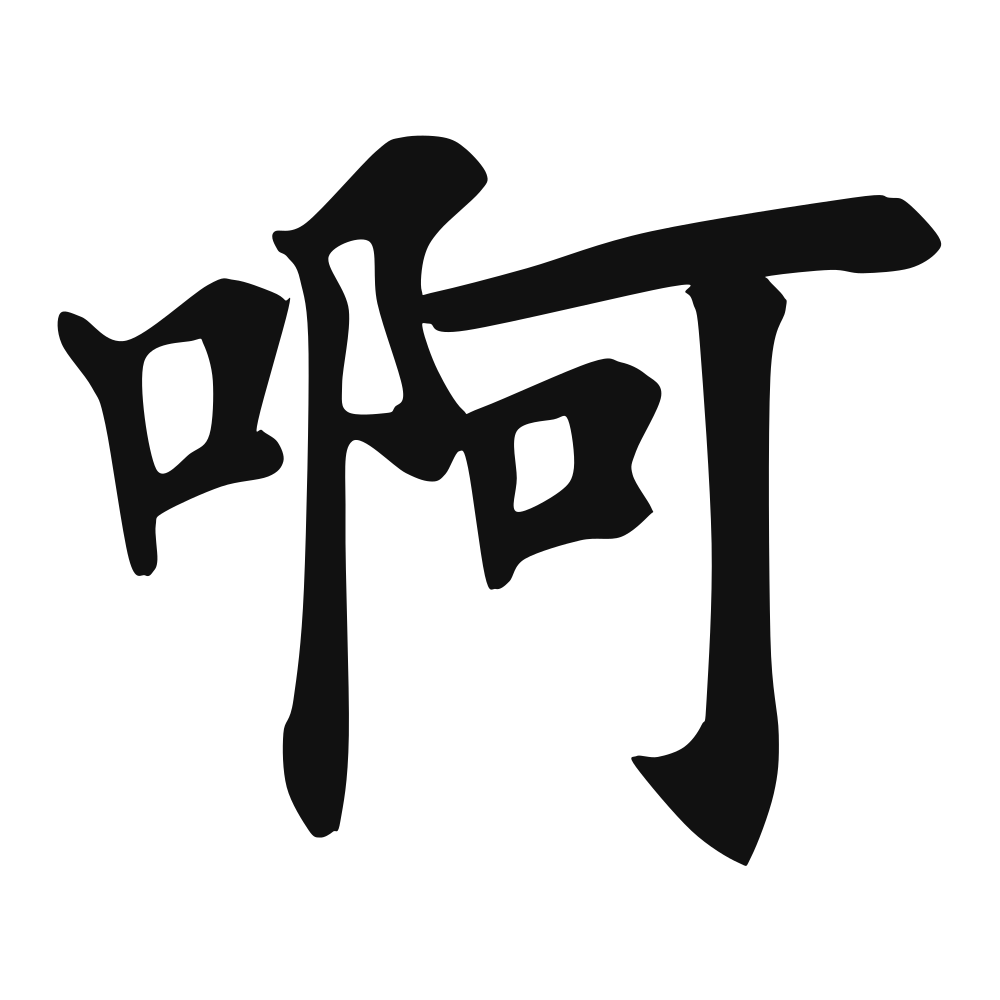
啊
interjection of surprise; Ah!; Oh!; interjection expressing doubt or requiring answer; Eh?; what?; interjection of surprise or doubt; My!; what's up?; interjection or grunt of agreement; uhm; Ah, OK; expression of recognition; Oh, it's you!; modal particle ending sentence, showing affirmation, approval, or consent
Closest English meanings
(interjection)·ah·oh
The Calligrapher — Lǐ Lóngjī 李隆基
Tang Emperor Xuanzong who wrote the Shitai Xiaojing in eight-division clerical script (bafen).
Tang calligrapher (), master of 八分/regular script — known for 唐玄宗,《石台孝经》. Tang dynasty
Cultural Story
In the classical tradition: 啊 is a late spoken interjection, the most common 'ah' and 'oh' of the living tongue, absent from the Shuowen. It opens surprise, realization, and a call: 啊呀, oh dear, at a spill; 啊哈, aha, at a solved riddle; 啊喲, oh, at a stubbed toe. Drama and folk song leaned on 啊 to stretch a feeling across a line, the bare breath of recognition before words form.
Common words & phrases
- 啊呀 oh dear · alas
- 啊哈 aha
- 啊哟 oh · ouch
Read the story behind the character
In the modern world: You say 啊 — ah, oh — when the answer finally clicks, and 啊哈, aha, when you find the lost key. A kid yelps 啊喲, oh and ouch, after a fall, and mom cries 啊呀, oh dear, at the broken vase. In texts 啊 stretches a sentence with feeling — shock, love, or complaint — the universal vowel of spontaneous reaction in every Chinese conversation.
Own this character
Purchase delivers the original SVG of this glyph, brushed by Lǐ Lóngjī 李隆基, ready to place on skin, paper, or screen.