
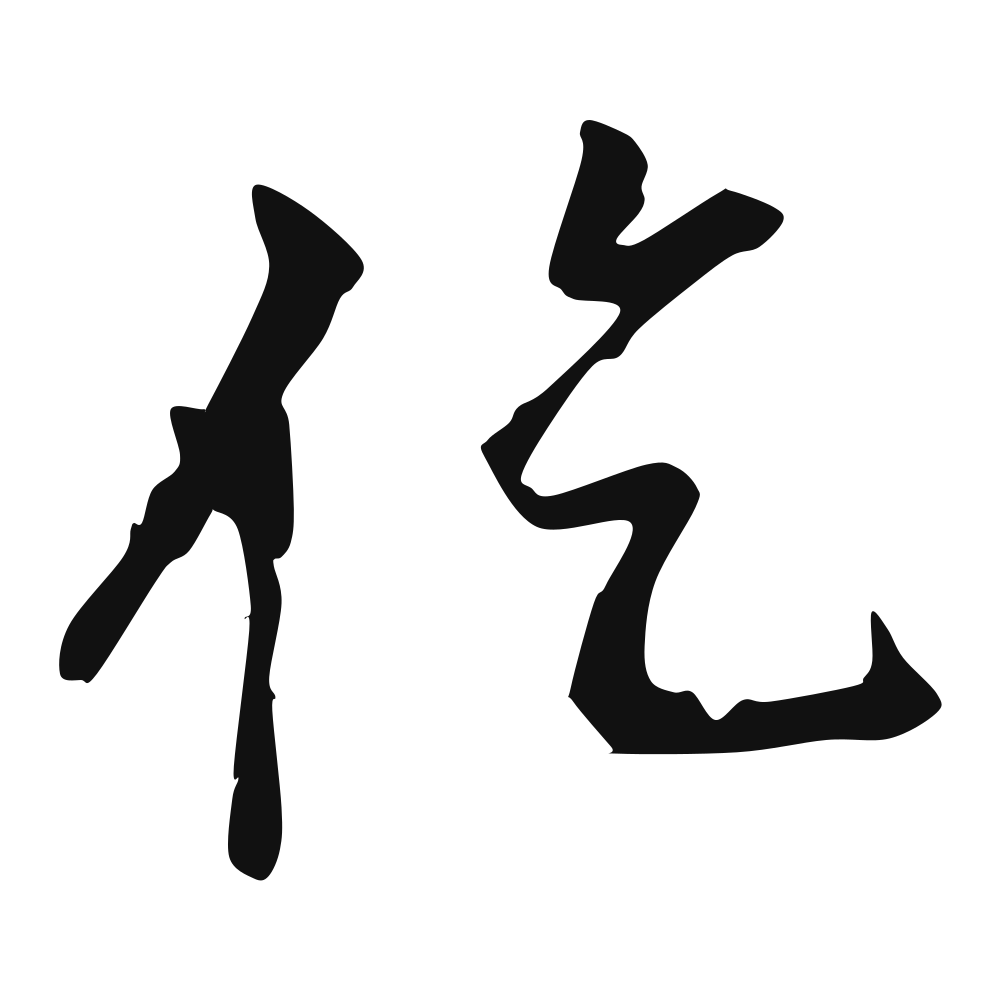
仡
Taiwan pr. [qi4]; strong; brave
Closest English meanings
robust·upright·tall
The Calligrapher — Lǐ Yōng 李邕
Tang running-script master famed for his stele inscriptions.
Tang calligrapher (678–747), master of running script — known for 《麓山寺碑》(李北海). Tang dynasty
Cultural Story
仡 is a rare and sturdy character, 人 with 乞, the 說文 reads it as the robust, the upright, and in the 詩經 a 仡仡 wall is the solid one that holds. 仡仡 also means bold. A second, minor sense, 仡栗, is to tremble. The character is the strong standing firm, the wall and the man that do not buckle, a word of the classics, not the market.
Common words & phrases
- 仡仡 tall and strong · bold
- 仡栗 trembling
Read the story behind the character
仡 appears chiefly in the literary 仡仡, tall, strong, bold, and in the ethnicity name 仡佬族, the Gelao people of Guizhou. Outside those, it is inert; you will not hear it in a sentence of daily life. It is a museum-graph, the robust wall of the 詩經 and a minority name, the upright stroke that stands for strength without ever standing in common speech.
Why this character belongs on skin
仡 is a character of standing—ancient texts use it for the towering, the mighty, the mountain of a man who seems carved rather than born. In 仡佬, it names one of China's oldest mountain peoples, keepers of terraced valleys and secret crafts. The visual is elemental: a person beside a bending blade, the human form leaning into its own strength. Classical poets wrote 仡 with awe—warriors whose posture alone was a fortress, whose stillness had more menace than motion. There is such a thing as presence, and it can be trained: shoulders back, jaw level, the body declaring before the mouth does. Stoics called it constancy; the samurai simply stood. To choose 仡 for ink is to commit to that verticality—not arrogance, but the refusal to fold. Put it on the upper arm or the long line of the calf, where muscle rises. Let it say what you mean when you say: I do not bow.
Own this character
Purchase delivers the original SVG of this glyph, brushed by Lǐ Yōng 李邕, ready to place on skin, paper, or screen.