
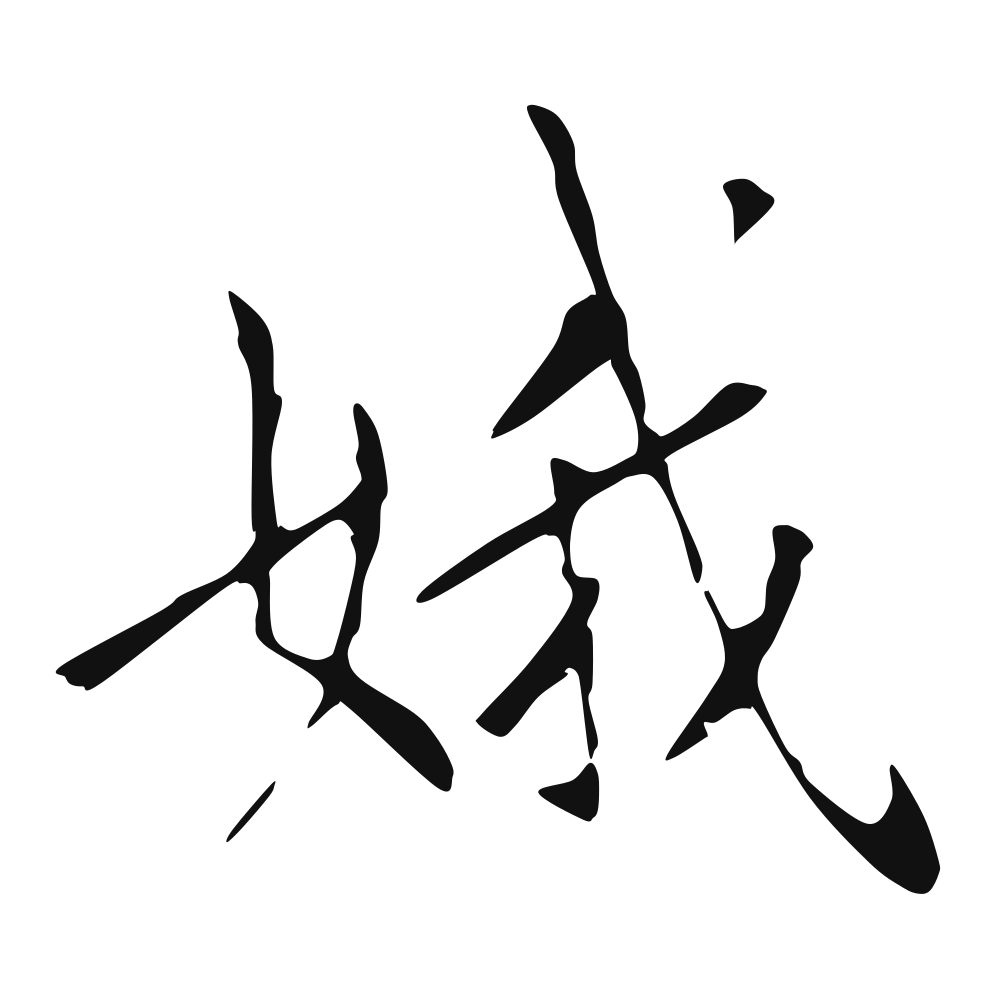
娥
good; beautiful
Closest English meanings
beautiful woman·graceful
The Calligrapher — Lǐ Yōng 李邕
Tang running-script master famed for his stele inscriptions.
Tang calligrapher (678–747), master of running script — known for 《麓山寺碑》(李北海). Tang dynasty
Cultural Story
In the classical tradition 娥 means a beautiful woman, and most gloriously 嫦娥, the moon goddess who drank the elixir and flew to the moon, leaving her 宮娥 — palace maids — behind. Her tale, told since the 淮南子, makes 娥 the face of longing and the silver disc above us.
Common words & phrases
- 嫦娥 Chang'e (moon goddess)
- 宫娥 palace maid
Read the story behind the character
In the modern world 嫦娥 still rides the Mid-Autumn sky; the lunar probe named 嫦娥 carries her myth into space. A costume drama fills a court with 宫娥 in flowing robes, and a poem calls the moon 娥. The character bridges an ancient goddess, palace beauty, and a very modern rocket.
Why this character belongs on skin
She drank the elixir and rose, leaving the warm earth for the cold silver, and so the moon has worn a woman's name ever since. This is the beautiful one ascended, Chang'e, who traded a husband's company for immortality and solitude both. There is a loneliness in every ascent, the warrior's cost of becoming more than mortal. The myth does not say she was happy; it says she was transformed, and transformation is its own country. To wear her name is to honor the part of you that left the ordinary behind, that chose the distant light over the easy fire. Let it rest on your skin like frost on a window, remote, luminous, and entirely your own. Some of us are meant for the high place, even if no one climbs with us.
Own this character
Purchase delivers the original SVG of this glyph, brushed by Lǐ Yōng 李邕, ready to place on skin, paper, or screen.