
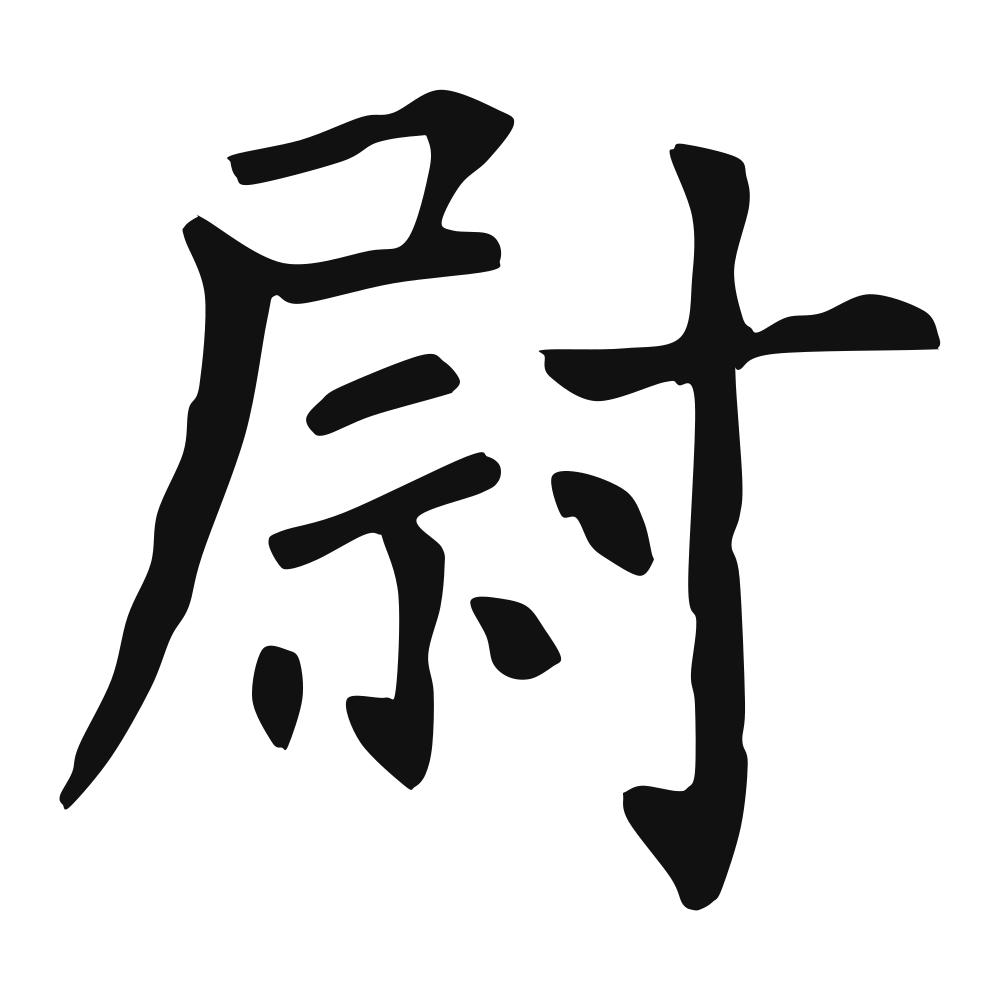
尉
surname Wei; military officer
Closest English meanings
officer·calm
The Calligrapher — Liǔ Gōngquán 柳公权
Tang regular-script master famed for 'bones' of strength; rival to Yan Zhenqing.
Tang calligrapher (778–865), master of regular script — Tang master of bone-strength regular script, paired forever with Yan Zhenqing as 'Yan sinew, Liu bone'. Tang dynasty
Etymology & Meaning · 字义溯源
### Soundwèi — wèi (4th tone); yù in 尉遲 (surname) and 尉犁 (place). Often a bound morpheme — needs a partner word ### Original meaningWèi (4th tone); also yù in the surname 尉遲 and the place-name 尉犁. The Shuowen Jiezi defines it as 「从上按下也。从𡰥从火,从又持火,所以㷉繒也」 — 'to press down from above', the graph showing a hand (又) holding fire to smooth and stretch silk — 尉 is the original character for 熨, the iron. The Kangxi keeps both parts of the definition: 《說文》「从上按其下也…从又持火,所以㷉繒也」, and adds the official sense with the etymology that explains it — 應劭曰「自上按下曰尉,武官悉以為稱」, 'pressing down from above is called wei, and all military officers took it as their title'. A military officer is the one who presses the disordered flat. The greatest line in the word's history is about justice, not war: 《史記·張釋之傳》「廷尉,天下之平也」 — the Commandant of Justice is the level of the empire. Earlier offices: 《左傳·襄二十一年》「將歸死於尉氏」; 《淮南子·時則》「八月官尉」; later, 太尉 (the Qin-Han commander-in-chief), 縣尉 (the county officer), and today the military rank below 校 (上尉, 中尉, 少尉). One more thread worth knowing: 尉 is also the old graph for 慰, to comfort — 《漢書·胡建傳》「所以尉薦走卒」, 'the means by which the soldiers are comforted'. ### The structure (會意 · 从𡰥从火,从又持火 — the hand (又) holding fire (火) to smooth silk (㷉繒); 尉 is the ancient graph of 熨, and was borrowed for the office that 'presses down from above')①又yòuhandthe hand doing the pressing②火huǒfirethe heat that smooths the cloth③熨yùnto iron, to pressthe later character 尉 gave birth to④尉wèiofficer應劭: 自上按下曰尉,武官悉以為稱 ### In use todayItemReading / meaningNoteReadingwèi (4th); yù in 尉遲 / 尉犁two readingsCore sensemilitary officer; to press leveloriginally the smoothing ironGrammaroffice-noun and rank; surname太尉, 廷尉, 县尉, 上尉, 少尉, 尉迟Tattoo fitcaution — reads as a rank or a surnameits deeper sense, pressing things level, is real and good ### Closest words in English — and what each misses - Guard / Protect — 衛 holds 'to guard'; 尉 is the officer and the presser-down — the two are routinely confused, and they are different characters - Warrior — 武/勇士 hold warrior; 尉 is an office and a rank, with the authority to keep order rather than the glory of fighting - Comfort — 慰 holds 'to comfort'; 尉 was its old graph in Han times, but today the two have separated - Iron (the tool) — 熨 holds the smoothing iron; 尉 is its ancient form, the sense buried under two thousand years of office-holdingAn honest note on grammar. Noun of office and rank (太尉, 廷尉, 縣尉, 上尉); also a surname and place-name element; in Han texts it serves as the old graph of 慰, 'to comfort'Where a Western reader can stand: 尉 (wèi) is the c
Cultural Story
尉 shows a hand pressing down with fire — to calm or pacify — and became a military rank: 上尉 (captain), 中尉 (lieutenant), 太尉 (grand commandant). The Han 太尉 commanded the army, and 尉官 (junior officers) kept order in the camps. The graph also carried a sense of soothing, like pressing a wound closed.
Where a Western reader can stand: 尉 (wèi) has a surprising root: Xu Shen defines it as 'to press down from above', with a graph showing a hand holding fire to smooth silk — it is the original character for 熨, the iron. Military titles grew straight out of that motion, because an officer is the one who presses disorder flat. Its most famous classical line is about justice: 廷尉,天下之平也, the Commandant of Justice is the level of the empire. Today it mostly reads as a rank — lieutenant/captain — or as a surname.
Common words & phrases
- 上尉 captain
- 中尉 lieutenant
- 太尉 grand commandant
- 尉官 junior officer
Read the story behind the character
A navy 上尉 (captain) salutes on the news, and a 中尉 (lieutenant) leads the drill. History class mentions the 太尉 (grand commandant) who ran the war, while 尉官 (junior officers) handle the daily grind. The rank system still sorts soldiers by stripes, from fresh 尉官 to seasoned commanders.
Why this character belongs on skin
Someone must keep the fire steady while the others sleep. In the old camp this was the officer, the one who walks the perimeter at midnight, who calms the recruit and settles the quarrel before it spreads. The character means both the military rank and the act of soothing, of pressing the heat down into something useful. Christ washed feet; the Confucian gentleman governed by his own composure. Authority, the ancients knew, is not the loud voice but the steady one that makes a room safe. You are that presence for someone — the friend who answers at 2 a.m., the one others instinctively turn toward in the storm. To wear this word is to accept the quiet burden of being depended upon. Let it sit on your skin like a captain's insignia earned not by rank but by steadiness. The fire stays lit because you stayed awake.
Own this character
Purchase delivers the original SVG of this glyph, brushed by Liǔ Gōngquán 柳公权, ready to place on skin, paper, or screen.