
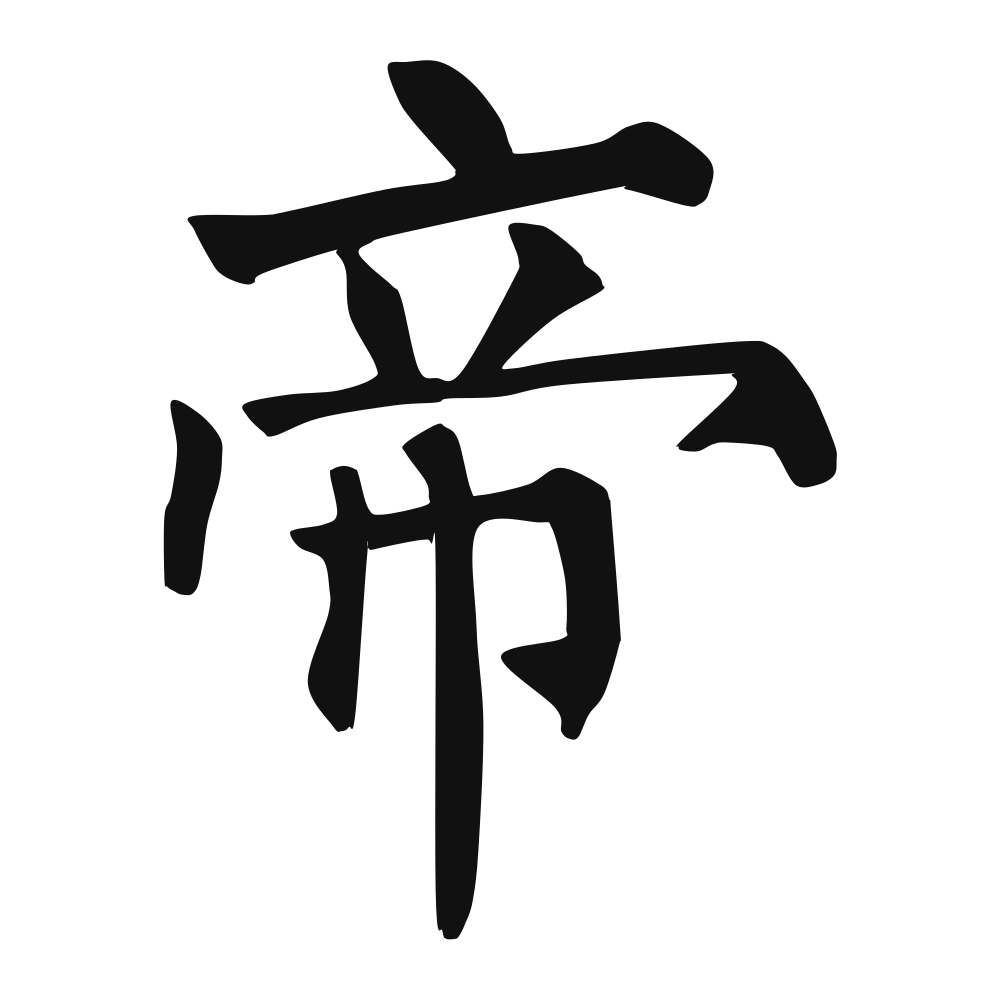
帝
(bound form) emperor; sovereign; supreme deity
Closest English meanings
emperor·god·sovereign·ruler·imperial
The Calligrapher — Liǔ Gōngquán 柳公权
Tang regular-script master famed for 'bones' of strength; rival to Yan Zhenqing.
Tang calligrapher (778–865), master of regular script — Tang master of bone-strength regular script, paired forever with Yan Zhenqing as 'Yan sinew, Liu bone'. Tang dynasty
Etymology & Meaning · 字义溯源
2 · The Character: 帝 Dì (4th tone). The Shuowen Jiezi opens its very first chapter with 帝: 「帝,谛也。王天下之号也。从丄朿声」 — 'to examine truly; the title of one who reigns over all under heaven', built on 丄 (the ancient 'above'). The word begins as the high god, not the man. 《诗经·大雅·皇矣》 「皇矣上帝,临下有赫」 — 'august is the Lord on High, looking down in majesty'; 《诗经·大雅·文王》 「文王在上,於昭于天」 sets a dead king beside him. The Changes make the deity move: 《易·说卦》 「帝出乎震」 — 'the Lord comes forth in Zhen', the thunder-trigram of spring; 《易·益》 六二 「王用享于帝,吉」 — the king offers to the Lord, fortune. Caution alone: worn on a body, 帝 says 'Emperor' or 'God', which reads as grandiose or comic to Chinese eyes; 上帝 is also the standard Chinese word for the Christian God. Element tables assign Fire (火).
Cultural Story
帝 began as 上帝, the supreme ancestral god of the Shang, and the oracle bones show a figure of sacred authority. The Shuowen reads 帝 as 'he who examines all under heaven.' The First Emperor fused 帝 with 皇 to claim 皇帝, Son of Heaven, and Daoist myth kept 天帝 as lord of the skies. Whether as high god or mortal ruler, 帝 names the peak of power - the one from whom command flows downward.
Where a Western reader can stand: Where a Western reader can stand: 帝 opens the Shuowen's very first chapter — 王天下之号也, the title of one who reigns over all under heaven — and begins as the high god, not the man; 《易·說卦》 has 帝出乎震, the Lord comes forth in the thunder-trigram of spring. Liu Gongquan's 笔谏, remonstrance by brush, is the honest counterweight: he wrote for emperors and told them to straighten their hearts. Honest caveat, and it is large: a lone 帝 on skin reads as 'Emperor' — self-coronation, or a joke, the way gothic 'KING' reads in English — and 上帝 is the standard Chinese word for the Christian God, so it may be taken as a religious claim. Use 王 or 君 for dignity without the crown.
Common words & phrases
- 皇帝 emperor · monarch · sovereign
- 帝国 empire · imperial state · imperial realm
- 上帝 God · the Lord · Supreme Being
- 帝王 emperor · monarch · ruler
- 帝都 imperial capital · capital of the empire · imperial city
- 天帝 Heavenly Emperor · God of Heaven · Lord of Heaven
Read the story behind the character
History class speaks of the 皇帝, the emperor, and of 帝国, an empire, that once ruled the land. Many still say 上帝 for God when translating the Bible, and 天帝 survives in myths as the heavenly ruler. A capital is called an 帝都, an imperial city, and a 帝王, an emperor-king, fills costume dramas. From the Shang's high god to a streaming series, 帝 marks the top of every hierarchy.
Why this character belongs on skin
He who commands the rivers to yield and they do not—this is the sovereign, the high one enthroned above the weather of lesser men. The ancient character shows the tied offerings raised to heaven, the lord who mediates between the human and the divine; later it crowned the emperors who ruled all beneath. Yet the truest sovereign may be the one within, the ruling temper that governs the unruly heart when the world offers its bribes. The Confucian served his emperor; the wise man became his own. To ink this character is to claim a throne no one can grant or take—the seat of your own assent. It is the tattoo of one who answers to no lesser authority. Let it rest at the center of the chest, above the beating that needs no permission. Wear it as a coronation you performed yourself, proof that you are ruled by nothing outside the court you carry—and that this, finally, is the only empire worth wearing.
Own this character
Purchase delivers the original SVG of this glyph, brushed by Liǔ Gōngquán 柳公权, ready to place on skin, paper, or screen.