
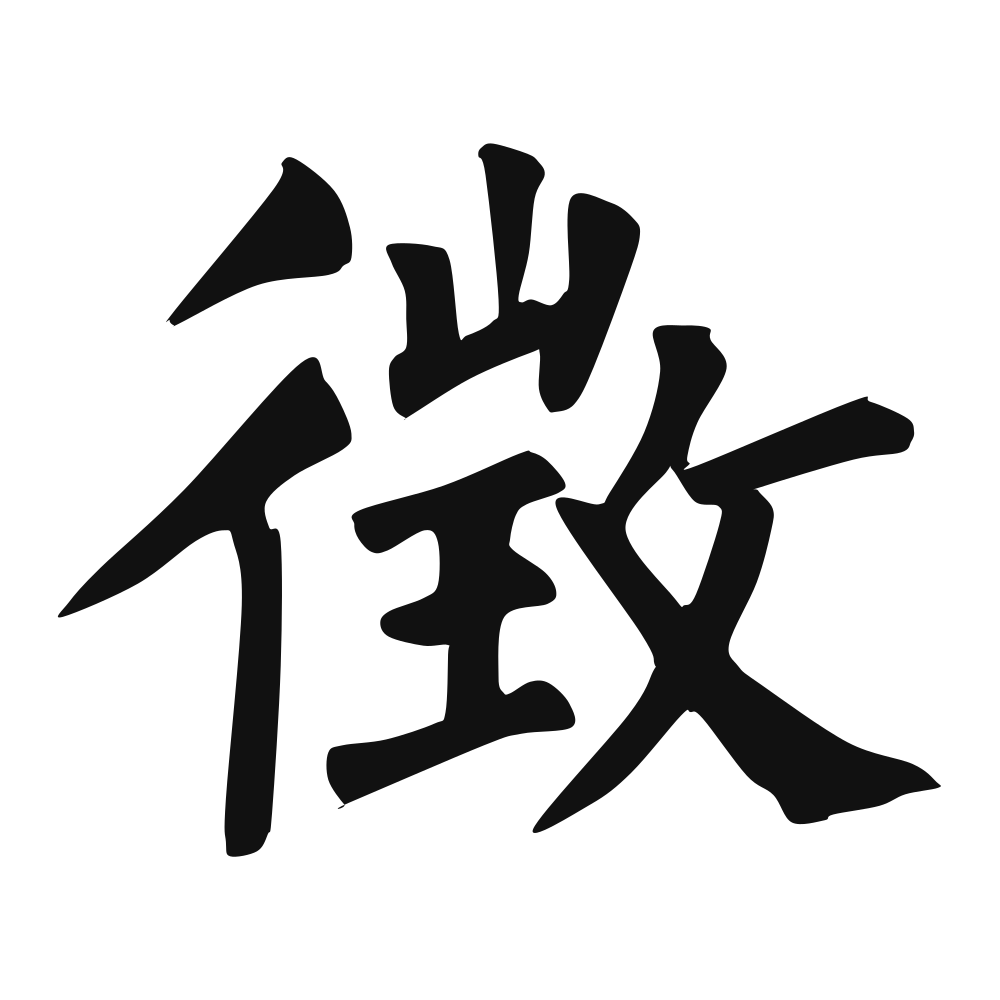
徵
to invite; to recruit; to levy (taxes); to draft (troops); phenomenon; symptom; characteristic sign (used as proof); evidence; 4th note in the ancient Chinese pentatonic scale 五音[wu3 yin1], corresponding to sol
Closest English meanings
sign·summon·levy
The Calligrapher — Liǔ Gōngquán 柳公权
Tang regular-script master famed for 'bones' of strength; rival to Yan Zhenqing.
Tang calligrapher (778–865), master of regular script — Tang master of bone-strength regular script, paired forever with Yan Zhenqing as 'Yan sinew, Liu bone'. Tang dynasty
Etymology & Meaning · 字义溯源
### Soundzhēng / zhǐ — zhēng (1st tone) / zhǐ (3rd tone, the musical note). Free-standing morpheme ### Original meaningTwo readings, and the buyer must choose: zhēng (1st tone) and zhǐ (3rd tone). The Shuowen Jiezi defines it as 「召也。从微省,壬爲徵。行於微而文達者,卽徵之」 — 'to summon'; the analysis is that it is built from 微 abbreviated, and Xu Shen adds the principle: 'that which moves in the minute and yet reaches outward in pattern — that is 徵.' A sign that begins small and becomes visible: this is the root of the whole family of meanings — summons, evidence, omen, levy. The classical record bears it out: 《周禮·天官·宰夫》「掌百官府之徵令」 (the officer who keeps the summoning-orders of the hundred bureaus); 《書·洪範》「念用庶徵」 (the many signs by which the ruler reads the state of things); 《左傳·僖四年》「寡人是徵」 ('it is this I ask about'); 《儀禮·士昏禮》「納徵」, where 徵 is glossed 成 — the sending of bride-price that completes the marriage. The second reading, zhǐ, belongs to music: 徵 is the fourth of the five pentatonic notes 宮商角徵羽, roughly sol (5 in numbered notation). The ritual calendars fix it to a season and a phase: 《禮·月令》「孟夏之月,其音徵」, and the 樂書 says 「徵,火也,其性烈而善燭」 — 'Zhi is fire, fierce by nature and good at illuminating'. 《禮記·樂記》「徵爲事」 pairs it with affairs, and 《風俗通》 gives it 「祉也,物盛大而繁祉也」 — abundance. Honest disclosure, and it matters for a tattoo: in simplified Chinese nearly all the everyday senses of 徵 are now written 征 (征召, 征收, 征兆), and 徵 survives mainly for the musical note (zhǐ) and in proper names and classical texts (文徵明, 柳诒徵). Many Chinese readers will therefore read 徵 as 征 — campaign, conquest, levy — which is a meaning the character itself never owned in this form. Kangxi stroke count 15 (彳部 + 12). Wuxing: Earth (土) in the naming tables, but Fire (火) by the classical five-phase mapping of the pentatonic notes and of summer — the two schools conflict (verify). ### The structure (會意兼形聲 · 从微省,壬爲徵 — the Shuowen's analysis: 微 abbreviated ('minute'), with 壬 as the marker; 'that which moves in the minute and yet reaches outward in pattern' (行於微而文達者,卽徵之))①微wēiminute / faintthe Shuowen builds 徵 from 微省 — it starts small②壬rénthe bearing markerthe element Xu Shen says makes it 徵 — what carries the small outward③召zhàoto summonthe Shuowen gloss: 召也④宮商角徵羽gōng shāng jué zhǐ yǔthe five noteswhere zhǐ lives: the fourth note, the voice of summer ### In use todayItemReading / meaningNoteReadingzhēng / zhǐtwo readings with different meaningsCore senseto summon; sign, evidence; (zhǐ) the note solin simplified Chinese most senses are written 征Grammarfree morpheme (classical)徵召 to summon, 徵兆 omen, 納徵 bride-price,
Cultural Story
徵 is the sign sent ahead and the tax gathered in. 徵兆 is the omen a careful man reads in the flight of birds, 象徵 the thing that stands for another, and 徵稅 the levy a court took because it could. The character is the signal and the claim, both reaching before the hand.
Where a Western reader can stand: 徵 (zhēng, or zhǐ) has two families of meaning. Read zhēng it is to summon, to levy, and — via Xu Shen's line about what 'moves in the minute and reaches outward in pattern' — a sign or omen, and the classical word for completing a betrothal (納徵). Read zhǐ it is the fourth note of the Chinese pentatonic scale, associated with early summer and called 'fire' by the music books. Note honestly that simplified Chinese now writes most of the first family as 征, so many readers will see 'campaign' instead.
Common words & phrases
- 特徵 characteristic · feature
- 象徵 symbol · symbolize
- 徵兆 omen · sign
- 徵求 solicit · seek
- 徵稅 levy tax
Read the story behind the character
特徵 is the trait a form asks for, 徵兆 the omen a headline dresses as data, 徵稅 the line the state draws from your wage. The birds are a chart now; the claim is real. We still read signs and still pay the reach, usually without noticing the old word doing both at once.
Why this character belongs on skin
Some words carry a chord inside them. Zhēng is at once the fifth note of the ancient Chinese pentatonic scale and the act of summoning—a sovereign calling evidence forward, a summons that cannot be ignored. In the old books it means to verify, to make true by bringing proof into the light. Think of that: a character where music and truth share one body. The note zhi was said to govern fire, summer, the heart's own frequency. To wear zhēng is to claim both senses at once—that your life has a tone, and that tone is testimony. You are not asking to be believed. You are resonating at a pitch that makes belief unnecessary. The truth has a sound. This is its name.
Own this character
Purchase delivers the original SVG of this glyph, brushed by Liǔ Gōngquán 柳公权, ready to place on skin, paper, or screen.