
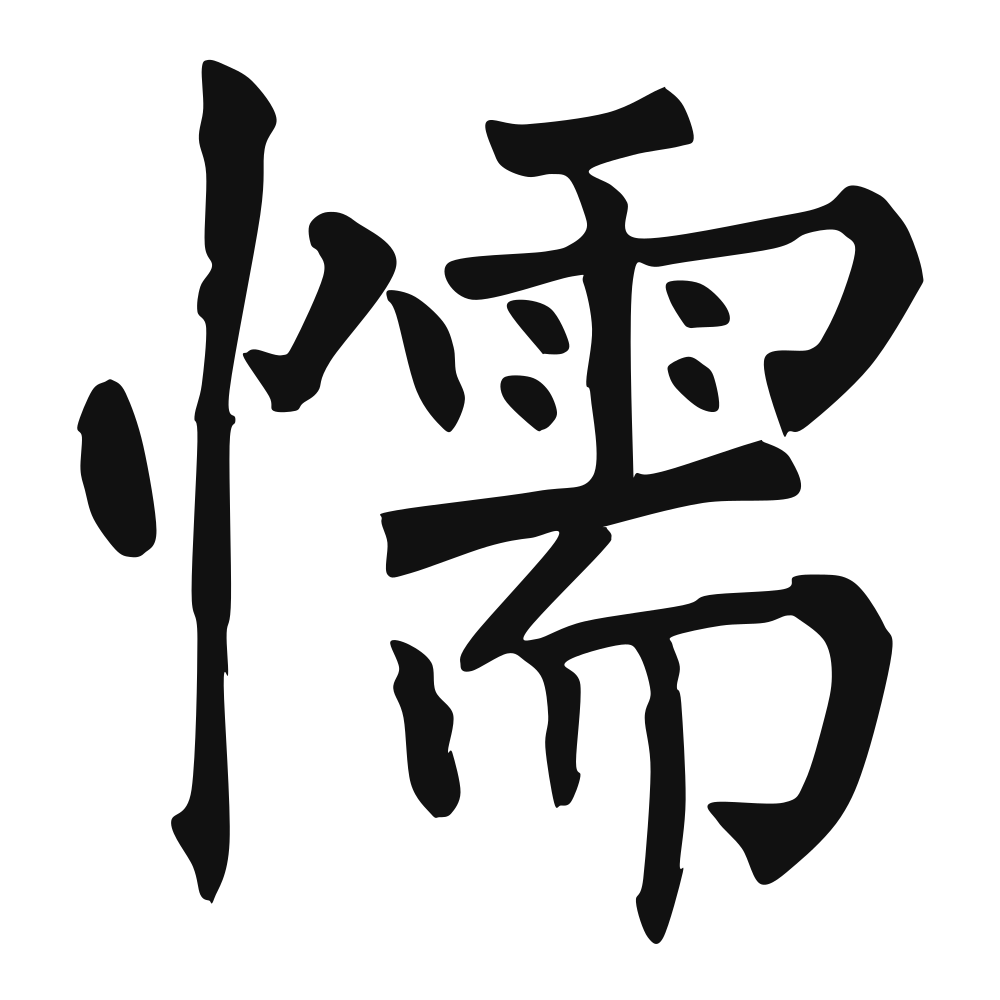
懦
(bound form) cowardly; faint-hearted
Closest English meanings
cowardly·weak
The Calligrapher — Liǔ Gōngquán 柳公权
Tang regular-script master famed for 'bones' of strength; rival to Yan Zhenqing.
Tang calligrapher (778–865), master of regular script — Tang master of bone-strength regular script, paired forever with Yan Zhenqing as 'Yan sinew, Liu bone'. Tang dynasty
Cultural Story
懦 is the softness that fails when pressed. The 論語 contrasts the 懦 man with the one who holds the line, and the military tales use 懦夫 for the soldier who breaks. The heart with 需, to wait, is a will that hesitates past the moment. It is the vice of the untested.
Common words & phrases
- 懦弱 cowardly · weak
- 怯懦 timid · cowardly
- 懦夫 coward
Read the story behind the character
懦 is the insult and the diagnosis: 懦弱 the excuse that wasn't brave enough, 怯懦 the witness who stays silent, 懦夫 the label no one wants. It names the failure of nerve, the collapse of resolve that history and the playground both punish.
Why this character belongs on skin
懦 is the heart-mind bent soft — a cowardice not of the legs but of the will, timidity lodged precisely where decisions are made. Confucius had little patience for it: an army's commander can be seized, he said, but no power on earth can seize the resolve of an ordinary man who has truly made up his mind. The inversion is the point. Strength was never about numbers or muscle; it lives in a room inside the chest, and that room is either defended or it is not. Everyone knows the small daily version of this battle — the word not spoken to the boss, the line not drawn with the friend who keeps taking, the truth swallowed at the dinner table. The character exists to be honest about that moment. To wear 懦 is a strange, bracing move: a public admission of your own softness, which — as any warrior tradition will tell you — is the first and necessary act of becoming brave.
Own this character
Purchase delivers the original SVG of this glyph, brushed by Liǔ Gōngquán 柳公权, ready to place on skin, paper, or screen.