
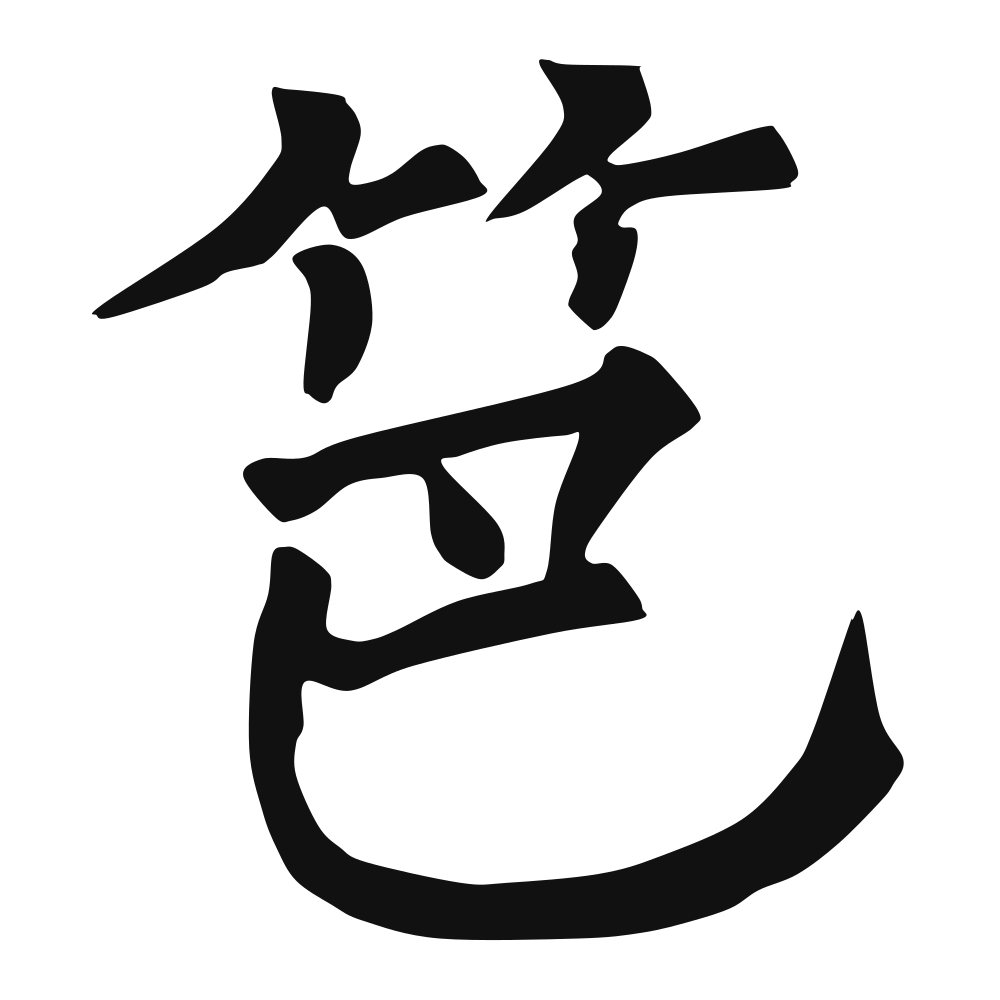
笆
an article made of bamboo strips; fence
Closest English meanings
(bamboo fence)
The Calligrapher — Liǔ Gōngquán 柳公权
Tang regular-script master famed for 'bones' of strength; rival to Yan Zhenqing.
Tang calligrapher (778–865), master of regular script — Tang master of bone-strength regular script, paired forever with Yan Zhenqing as 'Yan sinew, Liu bone'. Tang dynasty
Etymology & Meaning · 字义溯源
### Soundbā — bā (1st tone). Often a bound morpheme — needs a partner word ### Original meaningBā (1st tone). 笆 has no Shuowen entry, and the honest thing to say first is that there is no 說文 definition to quote — it is a post-Han coinage. The 康熙字典 gives two layers. First, a bamboo: 《廣韻》「竹名,出蜀」 and 《篇海》「竹有刺者」, with the 《竹譜》 describing it — 「棘竹駢深,一叢爲林,根若推輪,節若束針,亦曰笆竹」 (thorn bamboo grows packed and deep, a single clump becomes a wood, its roots like a pushed wheel, its joints bound with needles); 笆竹 is that thorny bamboo, and one note adds that eating its shoots makes the hair fall out. Second, and this is the living sense, a fence: 《廣韻》「有刺竹籬也」 (a thorny bamboo hedge) and 《史記索隱》「今江南謂葦籬曰笆籬」 — in the Jiangnan of the commentator a reed fence is called 笆籬. So 笆 is the woven barrier, the hedge of split bamboo or thorn, and in modern Chinese it survives only as a bound morpheme: 籬笆, 笆籬, 笆斗, 笆簍, 竹笆. Honest disclosure: this is a craft-object word — a fence, a basket, a thorny bamboo — with no citation in the Confucian canon and no moral or philosophical weight. It is a 二級字 and rare in names (naming sites rate it 中, and some score it 凶 by stroke-fortune). Wuxing: Wood (木) in the naming tables, via the 竹 radical; because the character post-dates the 說文, no classical element tradition exists for it. ### The structure (形聲 · 从竹,巴聲 — bamboo (竹) for the material, 巴 (bā) for the sound; a post-Han coinage, absent from 說文)①竹zhúbamboothe material it is made of②巴bāphonetic onlysound-bearing; the 'to cling' reading is folk etymology③笆竹bāzhúthorn bamboo《竹譜》: 棘竹…亦曰笆竹④籬笆líbathe fencethe modern word holding 笆's only living sense ### In use todayItemReading / meaningNoteReadingbā (1st tone)single syllable; not a surnameCore sensebamboo fence; woven barrier; thorn bambooa craft word, not a classical oneGrammarbound morpheme籬笆 · 笆籬 · 笆斗 · 笆簍Tattoo fitcaution — homely object word, no classical depthfine as 'fence', weak as calligraphy ### Closest words in English — and what each misses - Fence — 籬/樊 hold 'fence' plainly and older; 笆 survives only inside 籬笆 - Bamboo — 竹 holds bamboo; 笆 is one thorny kind, and more often the thing made from it - Basket — 籃/簍 hold 'basket'; 笆斗 / 笆簍 are regional names for one kind - Plantain — 芭 (bā) is the near-twin (芭蕉); same sound, no relationAn honest note on grammar. Bound morpheme — 籬笆 (fence), 笆籬, 笆斗 / 笆簍 (basket); not used alone as a sentence wordWhere a Western reader can stand: 笆 (bā) is a fence — specifically a hedge woven from split bamboo or thorn, the thing English would call wattling. It is also the name of a thorny bamboo so dense that one
Cultural Story
笆 is the humble bamboo or thorn fence that ringed farmyards and vegetable plots — 篱笆 woven slat by slat to keep chickens in and pigs out. Pastoral poems took it for granted: plum trees leaning over a low 笆 meant home, supper smoke, a dog barking, and safety.
Where a Western reader can stand: 笆 (bā) is a bamboo or thorn fence — a woven barrier, and by extension a basket of split strips. It is a post-Han craft word with no place in the Confucian classics. As a tattoo it reads as a quiet, rustic mark of enclosure, not a philosophy.
Common words & phrases
- 篱笆 fence · hedge
- 笆斗 bamboo basket
- 笆篱 fence
Read the story behind the character
In the countryside a 篱笆 (fence) still edges kitchen gardens, and travel vlogs frame tofu shops behind bamboo 篱笆 for rustic charm. The round woven 笆斗 (basket) survives in villages and antique stalls. Cities prefer metal railings, yet the word remains shorthand for cozy rural life.
Why this character belongs on skin
Every home begins the same way: woven branches, set in the earth, drawn around the door. This character is the rustic fence of the countryside—bamboo and twigs, the boundary a farmer builds before the house, the chicken coop, the life. Poets of reclusion loved it; the fence of brush by a chrysanthemum patch is one of the most beloved images in all Chinese verse, the place where Tao Yuanming, head bowed in the dusk, looked up at the southern mountain and finally felt at peace. A tattoo of this glyph is a declaration of the domestic sacred: that a life needs an edge to be a life, a woven line between the world's noise and what you tend. It suits the ankle, the wrist, the inside of the arm—a thin, humble border. Not a wall. A fence, wicker-soft, that the wind can sing through. What it protects is yours to grow: a garden, a child, a quiet mind.
Own this character
Purchase delivers the original SVG of this glyph, brushed by Liǔ Gōngquán 柳公权, ready to place on skin, paper, or screen.