
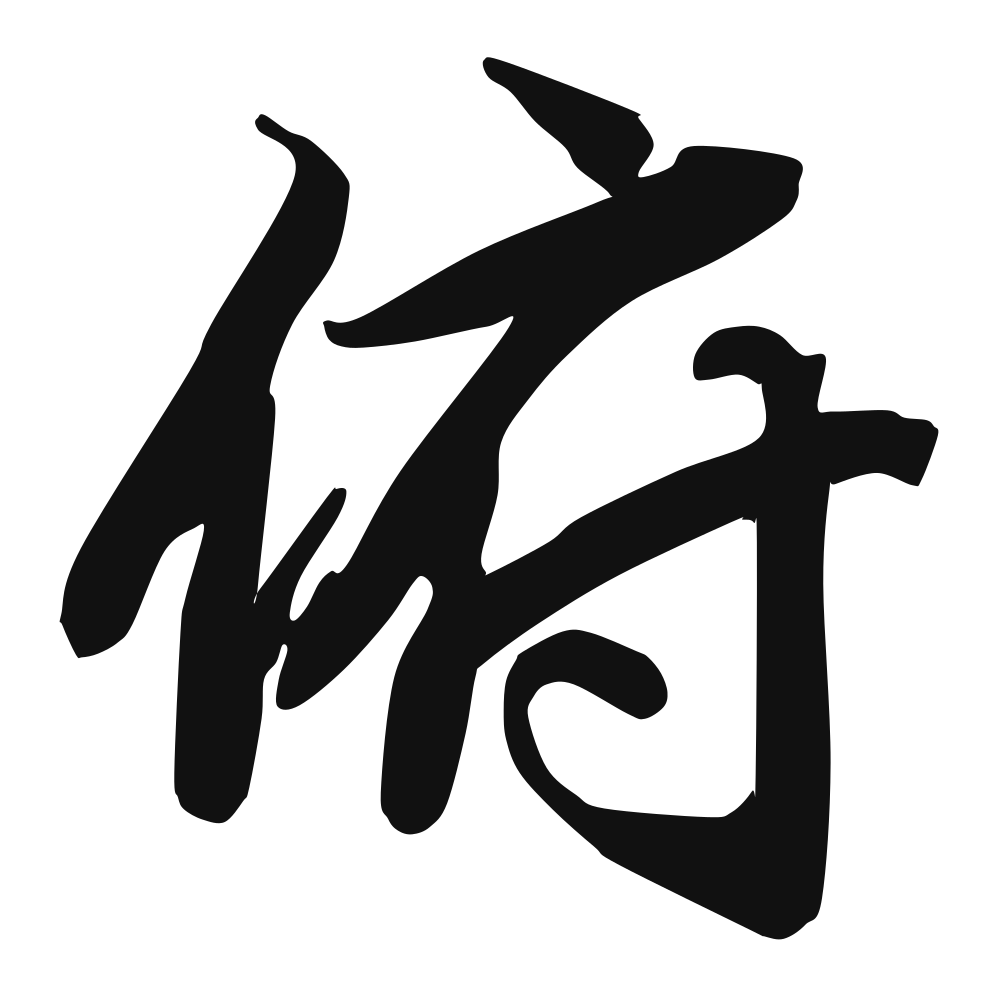
俯
to look down; to stoop
Closest English meanings
bend down·bow·stoop·lower
The Calligrapher — Lù Jiǎnzhī 陆柬之
Tang calligrapher and nephew of Yu Shinan; his running-script 'Essay on Literature' survives
Tang calligrapher (), master of running script — known for 《文赋》. Tang dynasty
Etymology & Meaning · 字义溯源
2 · The Character: 俯 俯 (fǔ, 3rd tone) means 'to bend down, to bow, to look downward' — the natural counterpart of 仰 (to look up). The Liji, Yueji gives the locus classicus: 执其干戚,习其俯仰诎伸 — 'grasping shield and axe, they practiced their bowing and rising, their bending and stretching.' The Shuowen treats it under 頫, 'lowering the head.' In the Laozi the posture becomes virtue — the lowered, yielding stance; the Zhuangzi's 俯仰 is a life spent bowing and lifting with the world. Confucius 俯身 — bowing in reverence. Honest disclosure: 俯 is a physical/attitudinal verb; standing alone it asks 'bow down to WHAT?' A lone 俯 may read as self-abasement without object. It pairs beautifully with its antonym 仰 (俯仰) to mean 'the whole arc of posture / a life's cadence.' Kangxi: 10 strokes, 人部; Wuxing: Water (水).
Cultural Story
俯 is to bend toward the earth. A Tang poem tells the scholar who 俯视 the river from the bridge; to 俯瞰 the capital was the emperor's wide look down. A hawk will 俯冲 on the field, and the mourner 俯首 at the grave. The character turns the body downward, in watch or in grief.
Where a Western reader can stand: Lu Jianzhi (陆柬之) was a Tang master of regular and running script, nephew of Yu Shinan and link in the Zhiyong–Wang Xizhi lineage, celebrated for his calm, poised copy of Lu Ji's Wen Fu. His restrained, elegant running-regular hand gives 俯 the feel of a serene, deliberate bow — reverence rather than collapse, the lowered head held with composure. For a Western client this is the literary Tang manner: a 俯 of humble yielding that stays dignified. Honest note: 俯 alone still begs the object ('bow to what?'); best read with 仰 (俯仰) so it means a life's cadence of bowing and rising.
Common words & phrases
- 俯视 look down · overlook · bird's-eye
- 俯瞰 overlook · look down from above
- 俯冲 dive · swoop down
- 俯卧 lie prone · face down
- 俯首 bow one's head · submit
Read the story behind the character
A drone 俯瞰 the square from above; a swimmer 俯冲 from the block at the gun. The nurse tends the patient who lies 俯卧, and a reader 俯首 over the open book. Looking down, diving, bowing — this word marks the downward turn of the eye and the body, from the screen to the start line.
Why this character belongs on skin
The sage does not climb to be tall; he bends, and from the low place sees the ant's city and the child's dropped coin and the small griefs the elevated miss entirely. The character is a person bowing his body downward, the downward gaze that is the beginning of both mercy and knowledge. Confucius bent to listen to the farmer; Christ washed the floor at the servants' feet. To look down is not to condescend but to draw near, to enter the scale where the overlooked actually live. Wear this as a correction to the habit of climbing, a vow to bend toward what is beneath you rather than rise above it. Let it rest where you might bow your head — a quiet emblem that your stature will be measured not by how high you stood but by how far down you were willing to look, and that the things worth saving are almost always below the line of pride.
Own this character
Purchase delivers the original SVG of this glyph, brushed by Lù Jiǎnzhī 陆柬之, ready to place on skin, paper, or screen.