
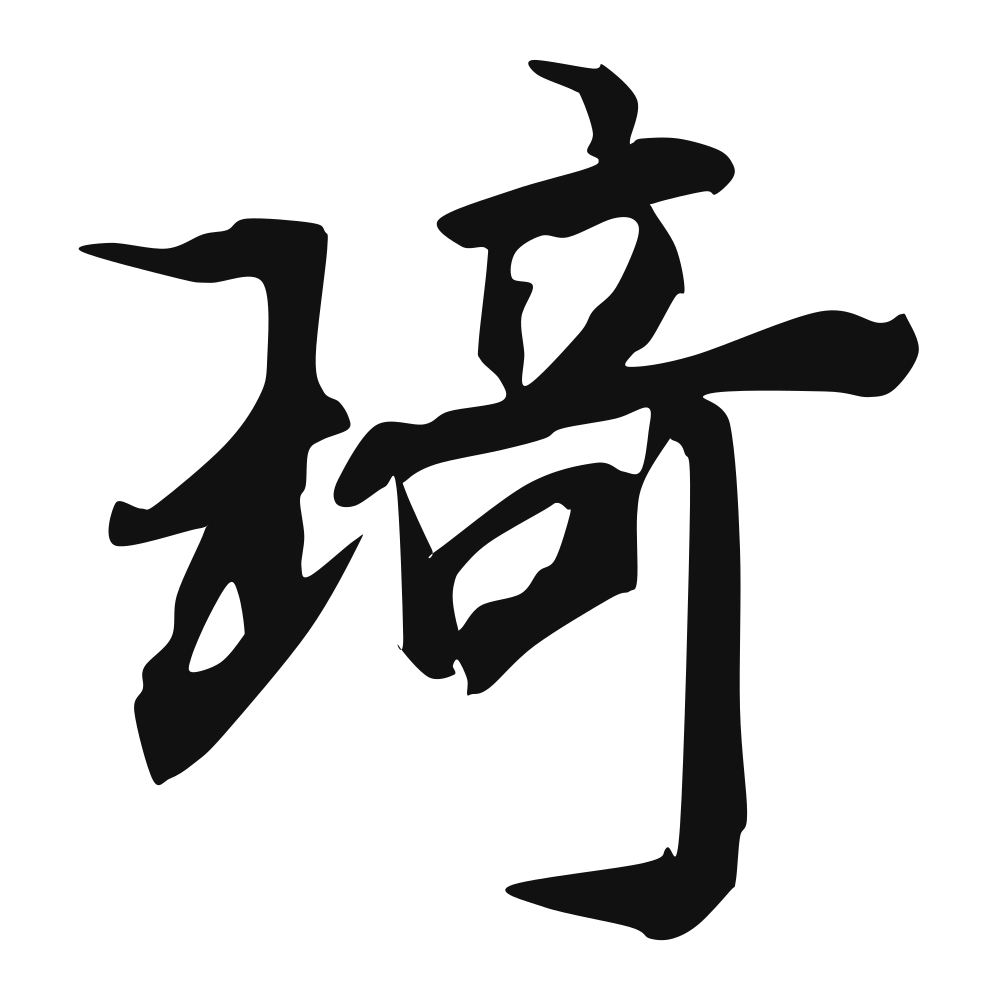
琦
(literary) fine jade
Closest English meanings
fine jade·extraordinary
The Calligrapher — Lù Jiǎnzhī 陆柬之
Tang calligrapher and nephew of Yu Shinan; his running-script 'Essay on Literature' survives
Tang calligrapher (), master of running script — known for 《文赋》. Tang dynasty
Cultural Story
Qi names a jade rarer and more splendid than common stones, the sort ancient writers invoked when ordinary praise felt too small. Han-dynasty eulogies used it for treasures beyond price, and by extension for character of the same quality: 琦行, conduct so noble it seemed carved from something precious.
Common words & phrases
- 琦玮 fine jade
- 琦行 noble conduct
Read the story behind the character
Today 琦 survives mostly in names and literary compounds, where it lends a person an air of the exceptional. Descriptions of a noble figure might speak of 琦玮, fine jade, or 琦行, noble conduct — words a teacher might use of an upright student.
Why this character belongs on skin
Every collection has one piece no one else owns. 琦 means precious, extraordinary jade—gem so uncommon it becomes a byword for the marvelous itself, for people too. The ancients called exceptional souls 琦士: rare jade persons, those whose oddity was their value. Heraclitus said the rarest thing is to find a man of worth; the Chinese said it with a stone. There is no flattery in this character, only an accounting. You have spent years learning which parts of yourself were flaws and which were simply unpolished—that edge the world kept complaining about was the veining in the gem, the proof it was real. 琦 does not apologize for scarcity. Wear it as a private thesis about yourself, inked where only the right people ever learn it exists: beauty that stays rare precisely by staying subtle.
Own this character
Purchase delivers the original SVG of this glyph, brushed by Lù Jiǎnzhī 陆柬之, ready to place on skin, paper, or screen.