
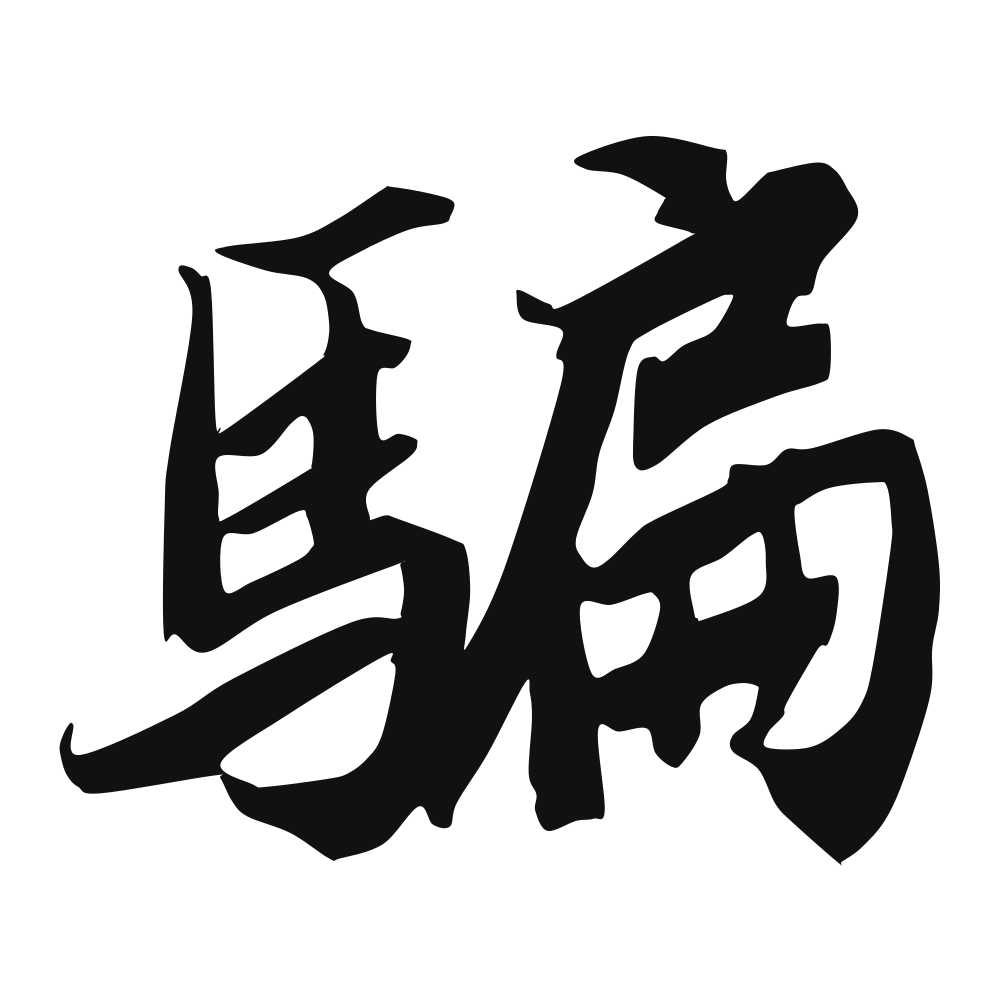
骗
to cheat; to swindle; to deceive; to get on (a horse etc) by swinging one leg over
Closest English meanings
cheat·deceive
The Calligrapher — Lù Jiǎnzhī 陆柬之
Tang calligrapher and nephew of Yu Shinan; his running-script 'Essay on Literature' survives
Tang calligrapher (), master of running script — known for 《文赋》. Tang dynasty
Cultural Story
骗 originally had nothing to do with lying. Old texts give it as 跃上马也, "to leap onto a horse"—mounting by swinging a leg over. The sense of "deceive" developed later, perhaps from tricking one's way aboard a steed.
Common words & phrases
- 欺骗 deceive · cheat · fraud
- 骗子 swindler · cheat
- 骗取 cheat to obtain
- 骗人 deceive people
- 拐骗 abduct and deceive
Read the story behind the character
Now 骗 means to cheat. Swindlers are 骗子; 欺骗 is to deceive, 骗人 to fool people, and 骗取 to cheat something away. Even 拐骗 joins abduction with deceit. The leap onto a horse has become the leap of a confidence trick played on trust.
Why this character belongs on skin
There is no innocence in this character, and that is its power. 骗 began in the horse corral — the old sense is of leaping astride a horse, and from that vaulting motion came the idea of mounting a lie, riding it hard until it carries you somewhere false. Every language knows the trick; the Greeks had their gods doing it before humans could even hold a grudge, Hermes and Odysseus and the wooden horse itself. But ink can be armor as much as ornament. To wear 骗 is not to celebrate the lie but to name the predator, to keep the scar where you can see it. Perhaps you were the deceived. Perhaps, more honestly, you were the deceiver once, and you carry that like a stone in the shoe. Either way, this character refuses flattery. It says: I know what falseness looks like now. It is the strangest warning label ever worn, and one of the most honest.
Own this character
Purchase delivers the original SVG of this glyph, brushed by Lù Jiǎnzhī 陆柬之, ready to place on skin, paper, or screen.