
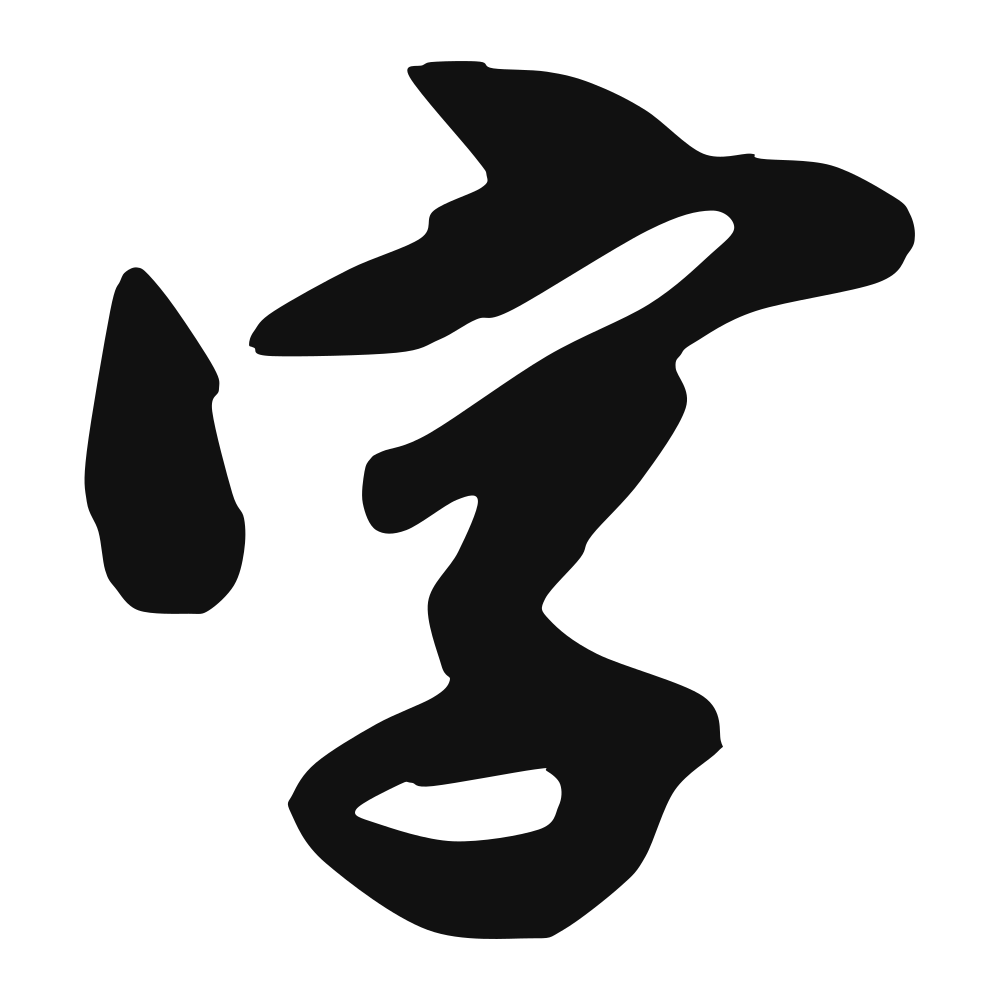
字
letter; symbol; character; word; courtesy or style name traditionally given to males aged 20 in dynastic China
Closest English meanings
character·word·letter
The Calligrapher — Mǐ Fú 米芾
Song eccentric genius of dynamic, 'flying' running script.
Song calligrapher (1051–1107), master of running script — Song eccentric genius ('crazy Zhang, idiot Mi') whose running script alternates discipline with glee. Song dynasty
Cultural Story
At the coming-of-age rite a man received his 字, a courtesy name distinct from his 名 — Yue Fei styled Pengju. Cangjie was said to have drawn the first 汉字, and Xu Shen's 'Explaining Graphs' catalogued them. 字幕 were the closing notes of a letter; the graph once meant both a name added and a mark made.
Common words & phrases
- 汉字 Chinese character
- 文字 writing · script
- 名字 name
- 字母 letter · alphabet
- 字典 dictionary
- 字幕 subtitle
Read the story behind the character
Language apps drill 汉字 stroke by stroke, and 字幕 scroll under every streamed drama. Phones carry 字典 in pocket, and ID cards print a 名字 in two scripts. The character that once marked a gentleman's second name now mostly means the little units a keyboard must render correctly.
Why this character belongs on skin
Before it meant the written word, 字 meant to bear a child, to give a son his name—the character itself was born from the act of bringing new life into language. A roof over a child: the house that names you, the mark that makes you legible to the world. We in the West christen, we sign, we tattoo—every culture needs a way to say this one matters, this one is written down. To carry 字 is to claim your own authorship, the right to name yourself and to be named. Your skin becomes the page. Let it mark you as one who refused to stay unwritten, who stepped into the characters and said: here, in ink that outlasts me, I am a word. The character is the child. The ink is the name that survives.
Own this character
Purchase delivers the original SVG of this glyph, brushed by Mǐ Fú 米芾, ready to place on skin, paper, or screen.