
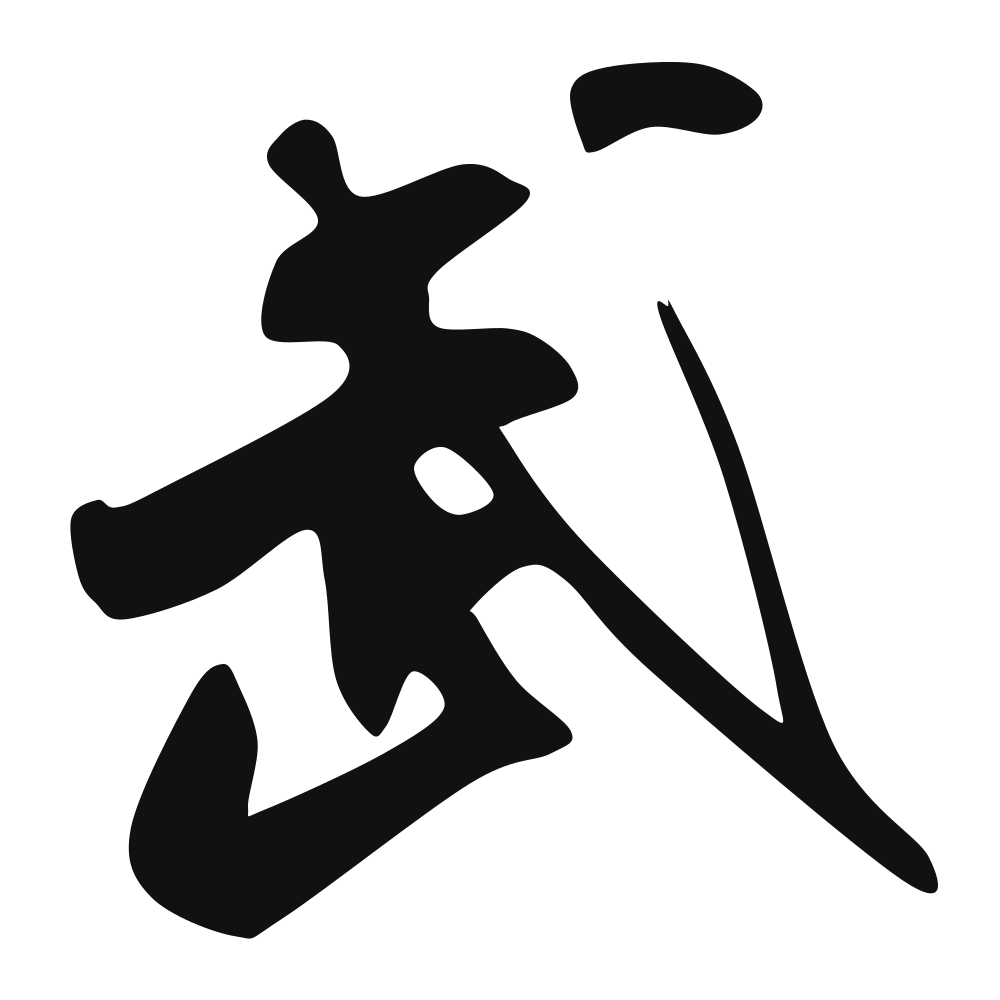
武
surname Wu; martial; military
Closest English meanings
martial·military·war
The Calligrapher — Mǐ Fú 米芾
Song eccentric genius of dynamic, 'flying' running script.
Song calligrapher (1051–1107), master of running script — Song eccentric genius ('crazy Zhang, idiot Mi') whose running script alternates discipline with glee. Song dynasty
Etymology & Meaning · 字义溯源
2 · The Character: 武 武 (wǔ, 3rd tone) carries one of the most famous glosses in the Shuowen Jiezi: 「楚莊王曰:夫武,定功戢兵。故止戈為武」 — King Zhuang of Chu said that 武 'settles merit and sheathes weapons', therefore 止 (stop) plus 戈 (dagger-axe) makes 武. Xu Shen is quoting 《左傳·宣公十二年》. Modern palaeography disputes the reading: on oracle bones 止 is a footprint, so the graph more likely shows a warrior striding with a halberd — martial motion, not pacifism (verify; both readings are worth carrying). The Book of Songs contains a whole hymn titled 《周頌·武》, and 《易·履》六三 warns 「武人為于大君」, the strongman in service to a ruler. 《孫子》 and the 文武 pairing make 武 one half of the complete person. Grammatically 武 is a free morpheme: martial, military, valorous. Honest disclosure: in modern Chinese 武 reads unambiguously as 'martial/military' and is also a surname (Wu). It signals force under discipline, not peace — 止戈 is a Han-era moral pun, not the original picture.
Cultural Story
武 meant martial and the arts of war. The Shuowen records King Zhuang of Chu's saying that true 武 is to halt weapons and settle merit — the character is said to join 止 and 戈, stopping the spear. Yet it also named the soldier's path: 武器 weapons, 武装 arms, and the ideal of 文武 the civil and martial together. To be 武 was strength held in balance with restraint.
Common words & phrases
- 武术 martial arts · kung fu
- 武器 weapon · arms
- 武装 arm · military
- 武功 martial skill
- 武士 warrior · samurai
- 文武 civil and military
Read the story behind the character
Today 武 is woven into popular culture: kids learn 武术 martial arts and kung fu, a soldier carries 武器 weapons, and a nation 武装 arms its forces. We admire a 武士 warrior's honour, praise someone's 武功 martial skill, and debate the balance of 文武 civil and military power. From a wuxia film to a defence budget, 武 still names the disciplined strength China has long both feared and admired.
Why this character belongs on skin
The character is built from two signs: one for weapon, one for to stop. The oldest wisdom said the highest martial art is the one that ends the war. To be 武 is not to love the fight but to be so formidable that fighting becomes unnecessary, to carry the sword and the restraint in the same hand. The warrior ethos here is inward — the discipline that quiets the smaller rages, the strength that protects rather than performs. Confucius honored such men; the Daoist knows the soft overcoming the hard is the real victory. To wear it is to claim a contained power, the kind that does not need to prove itself loud. It is a grave, beautiful mark. Let it sit on your skin like a sheathed blade, a permanent reminder that you are dangerous only as far as mercy allows. The stopping is the mastery. The rest is noise.
Own this character
Purchase delivers the original SVG of this glyph, brushed by Mǐ Fú 米芾, ready to place on skin, paper, or screen.