
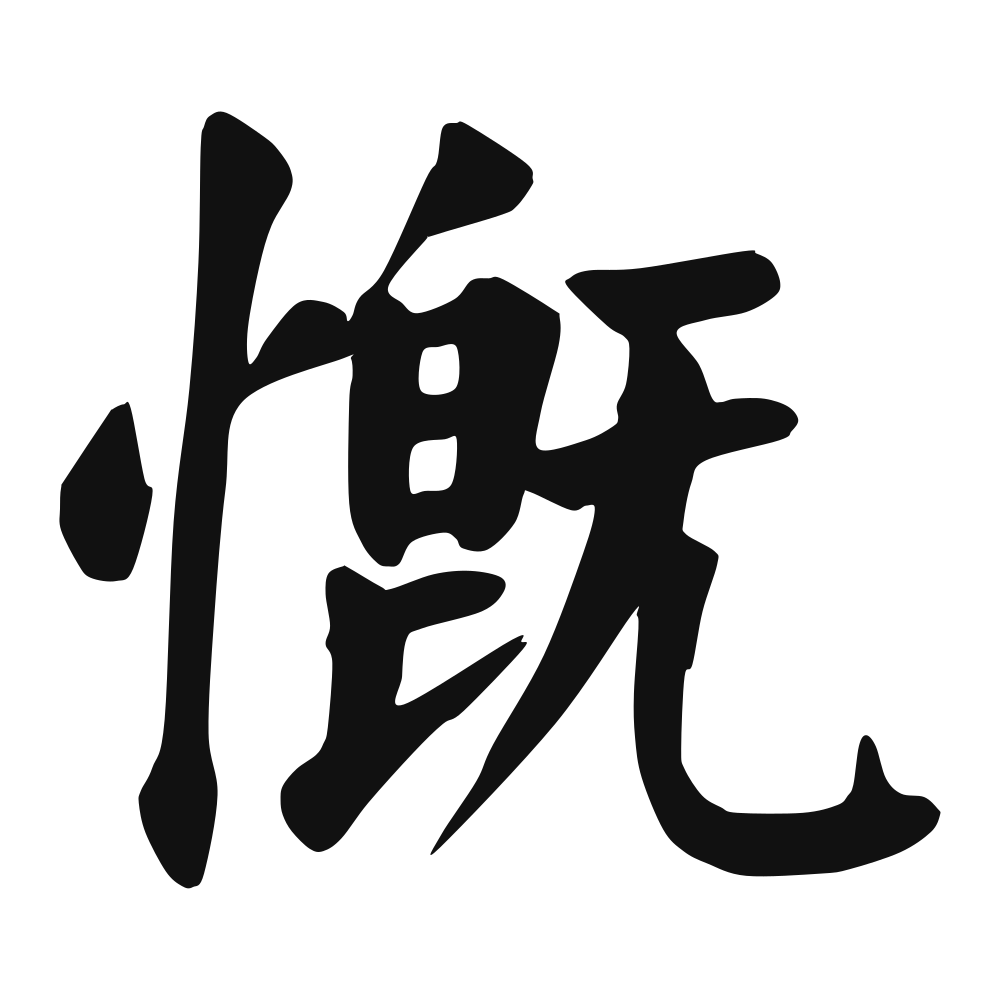
慨
(archaic) to sigh; (bound form) impassioned; deeply affected (esp. with indignation or sorrow); (bound form) generous; magnanimous
Closest English meanings
sigh·indignant·generous·emotional
The Calligrapher — Ōuyáng Tōng 欧阳通
Tang regular-script master known for powerful, square strokes.
Tang calligrapher (?–691), master of regular script — known for 《道因法师碑》. Tang dynasty
Etymology & Meaning · 字义溯源
2 · The Character: 慨 Kǎi (3rd tone). The Shuowen gives 「慨,忼慨,壮士不得志也。从心既聲」 — a deep, stirring sigh of the thwarted brave, from heart (心) with 既 (jì) for sound. The word split into 慷慨 (impassioned, generous) and 感慨 (moved, sighing). Classical lines: 曹操〈短歌行〉 「慨当以慷,忧思难忘」; 《礼记·檀弓》 「既慨然」; and 陶渊明〈自祭文〉 「慨然寤叹」. Grading: 慨 is stirring and largely positive — 'impassioned / generous / moved' (慷慨) — and stands alone well, though alone it can read as the wistful sigh (感慨) rather than the heroic. Disclose both halves: the generous resolve and the melancholy sigh. A strong standalone for 'with feeling'.
Cultural Story
慨 is the sigh that carries weight. Cao Cao opened his 短歌行 with 慨当以慷 — solemn and stirring — as he brooded on lost allies and passing time. The heart with 既, already, is feeling surveyed and released in a breath. It is the emotion of the man who has seen enough to sigh.
Where a Western reader can stand: Where a Western reader can stand: 慨 is 'to sigh with feeling' — the Latin suspiro with weight — and the Shuowen fixes it as the brave man's pent-up breath. Honest caveat: the word splits two ways, 慷慨 (generous, impassioned resolve) and 感慨 (a moved, wistful sigh), and worn alone it may land on the sigh; pair it (慷慨) for the hero. Ouyang Tong's sharp, assertive 'little Ou' regular script is the most unsoft of upright hands — it argues for the stirred resolve rather than the lonely exhale, but give it size or the points close up.
Common words & phrases
- 感慨 sigh with emotion · reflect
- 慷慨 generous · vehement · impassioned
- 慨叹 sigh with regret · lament
- 慨然 generously · with a sigh · readily
Read the story behind the character
慨 is the emotional and the generous: 感慨 the toast that turns reflective, 慷慨 the donor and the speech, 慨叹 the historian's rue. 慨然 is the yes given without calculation. It names the feeling that spills into action, the sigh that opens the wallet or the door.
Why this character belongs on skin
To sigh over life — the long exhale the old poets left between the lines of their best work. This is the heart stirred by impermanence itself: standing at a friend's grave, or hearing a song from your twenties in a grocery store, or watching your child sleep and understanding, suddenly, the whole machinery of loss that love is rigged into. The Chinese made a precise word for it because they refused to look away; the feeling is grief and gratitude in the same breath, and both are correct, and neither cancels the other. The classical texts call a person of this temper great-souled: someone who feels the transience fully, without anesthetic, and gives anyway, loves anyway, builds anyway. That is the whole character — feeling at full depth. Tattoo it over your heart, where the sighs actually live. You will feel it rise on the hard days, and it will be true.
Own this character
Purchase delivers the original SVG of this glyph, brushed by Ōuyáng Tōng 欧阳通, ready to place on skin, paper, or screen.