
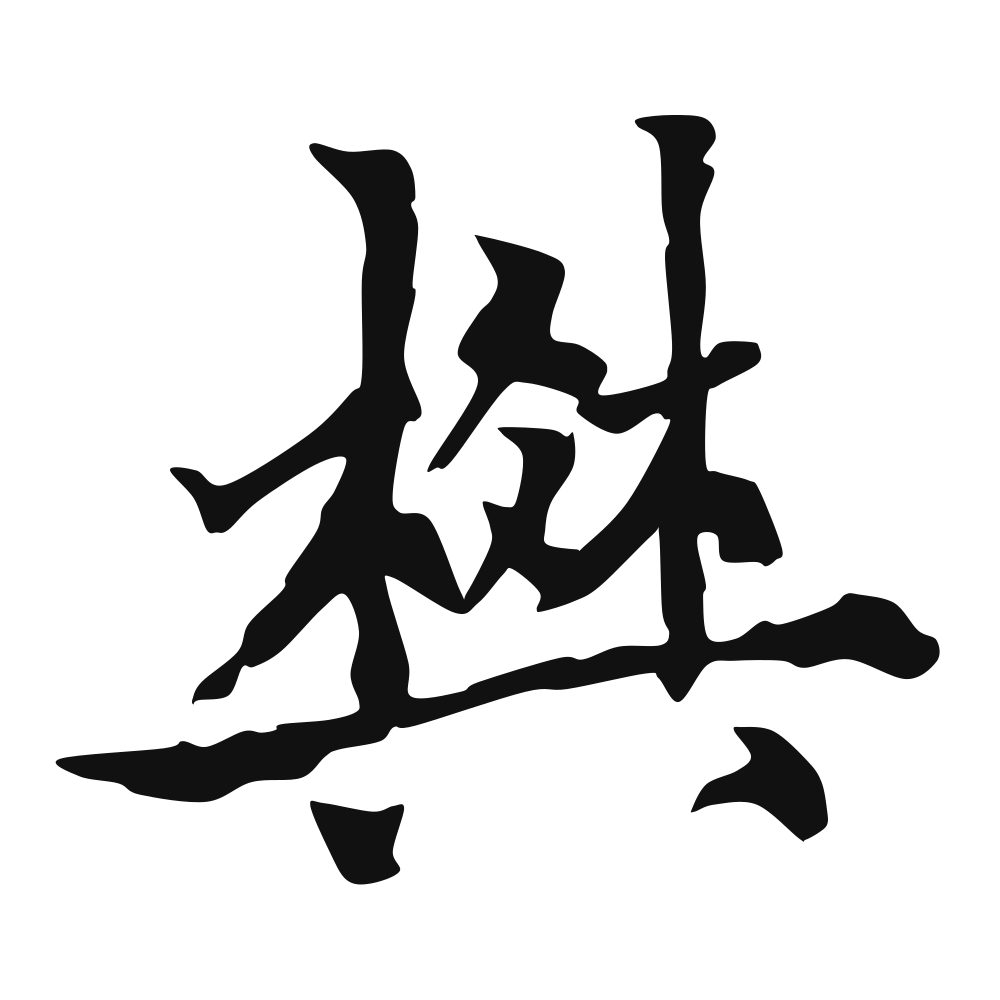
樊
surname Fan; (literary) fence
Closest English meanings
fence·cage·enclosure
The Calligrapher — Ōuyáng Tōng 欧阳通
Tang regular-script master known for powerful, square strokes.
Tang calligrapher (?–691), master of regular script — known for 《道因法师碑》. Tang dynasty
Etymology & Meaning · 字义溯源
### Soundfán — fán (2nd tone). Free-standing morpheme ### Original meaningFán (2nd tone). The Shuowen Jiezi defines it as 「鷙不行也。从𠬜从棥,棥亦聲」 — 'held fast, unable to move'; Duan Yucai emends 鷙 to 騺, a heavy horse that will not go forward, and glosses the sense as 沈滯不行, 'sunk and stalled'. The 棥 inside it is a fence, and 棥 both means and sounds — so the character is a fence that also stops you. From 'cannot move' it runs two ways at once: into the cage, and into the hedge. 《莊子·養生主》 gives the cage: 「澤雉十步一啄,百步一飲,不蘄畜乎樊中」 — the marsh pheasant takes ten steps for a peck and a hundred for a drink, and does not ask to be kept in a 樊. 《詩·小雅·青蠅》 gives the hedge: 「營營青蠅,止于樊」, with Mao's gloss 「樊,藩也」. And 《詩·齊風·東方未明》 uses it as a verb: 「折柳樊圃,狂夫瞿瞿」 — cut willow to fence the garden. The most quoted later line is the wish to be out of it: 陶淵明〈歸園田居〉「久在樊籠裡,復得返自然」. Honest disclosure: 樊 is also one of the common Chinese surnames (from 仲山甫, the 樊侯 of 《詩·大雅》), and 莊子 uses 樊然殽亂 for 'tangled and confused'. Wuxing: the 木 radical and the naming tables agree on Wood (木). ### The structure (會意兼形聲 · 从𠬜从棥,棥亦聲 — the crossed fence (棥) plus the hands that cannot get free; 棥 supplies both the picture and the sound)①棥fánfence, hedgethe crossed woodwork at the core — picture and sound at once②𠬜pānhands pullingthe hands that tug outward and cannot break free③樊籠fánlóngbird-cagethe cage sense, the one Tao Yuanming wanted out of④樊圃fánpǔto fence a gardenthe verb sense from 《诗·齐风》 — willow cut and set as a hedge ### In use todayItemReading / meaningNoteReadingfán (2nd tone)single syllableCore sensefence; cage; to enclose樊篱 barrier, 樊笼 cageGrammarfree morpheme (classical), surname (modern)樊篱, 樊笼, 樊然; overwhelmingly a surname todayTattoo fitcaution — reads as a surname first, and means enclosurethe escape is in the poetry, not in the character ### Closest words in English — and what each misses - Cage — 籠 holds cage on its own; 樊籠 is the compound, and 樊 alone also means the fence and the hedge - Fence / hedge — 籬/藩 are the ordinary words for a fence; 樊 carries the older, more literary and more carceral sense - Protection — 護/保 hold to protect; 樊's Shuowen root is 不行, 'unable to move' — enclosure, not safety - Freedom — 自由 holds freedom; 樊 is what freedom is measured againstAn honest note on grammar. Free morpheme in classical usage with noun and verb senses (樊籠, 樊籬, 折柳樊圃); in modern Mandarin it is far more often encountered as the surname FánWhere a Western reader can stand: 樊 (fán) means fence, hedge, and cage. Xu Shen's definition is blunt — 「鷙不行也」, 'held fast, unable to move' — and Duan Yucai sharp
Cultural Story
樊 meant a fence or hedge, and the Shuowen reads it as a boundary of woven branches. Its deepest echo comes from the poet Tao Yuanming, who sighed that he had long been trapped 久在樊籠里 — inside the bird cage of official life — before escaping back to nature. So 樊 became more than wood and thorn; it stood for any confinement, the 樊籬 of social duty and the 囚樊 of the prison, a wall gentle to look at yet hard to leave.
Where a Western reader can stand: 樊 (fán) means fence, hedge, and cage. Xu Shen's definition is blunt — 'held fast, unable to move' — and Duan Yucai sharpens it to a heavy horse that has stalled. Its most famous appearance is the marsh pheasant in Zhuangzi that would rather walk ten steps for a peck than be kept in a 樊; its most quoted line is Tao Yuanming's relief at getting out. Be aware it is also a common surname.
Common words & phrases
- 樊籠 bird cage · bondage
- 樊籬 fence · barrier
- 囚樊 prison
Read the story behind the character
Today 樊 appears when people speak of being boxed in: a worker feels caged by routine, quoting the old line about the 樊籠 bird cage, or a neighbour puts up a 樊籬 fence to mark his garden. Though rare in casual chat, the character lives in proverbs about lost freedom and in news of someone jailed behind 囚樊. It still carries that ancient ache of a hedge you cannot climb, a boundary drawn around a life.
Why this character belongs on skin
A cage is just a fence that got ambitious. The old character shows twigs woven into a barrier — first for chickens, then, in the poets' hands, for everything that fences a soul: office, duty, reputation, the self you built to be acceptable. Zhuangzi pounced on the image and made it famous: the pheasant in the wilderness walks ten steps for one peck, a hundred for a drink, half-starved and magnificent, but no one would trade that hard-won freedom for comfort in a coop. The bars that hold most of us are made of twigs — someone else's opinion, a fear that expired years ago, a rule nobody is enforcing — and twigs break. That is the scandal and the invitation of this character: captivity at this scale is mostly a decision reviewed too rarely. This is ink as a reminder and a dare. Wear it where it can be seen when you choose, and let it ask its question until you answer with the door.
Own this character
Purchase delivers the original SVG of this glyph, brushed by Ōuyáng Tōng 欧阳通, ready to place on skin, paper, or screen.