
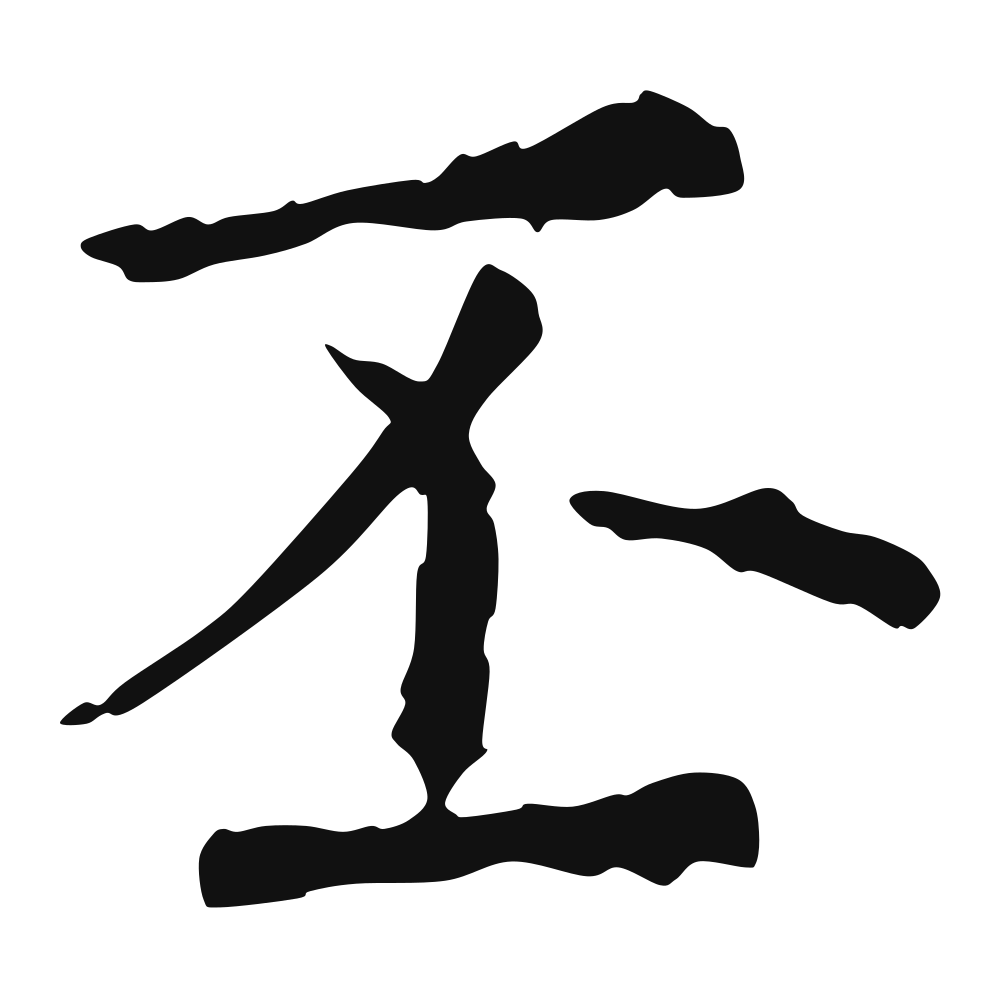
The Calligrapher — Ōuyáng Xún 欧阳询
Tang regular-script master whose 'Ouyang style' is a basic learning model.
Tang calligrapher (557–641), master of regular script/running script — Tang codifier of regular script; crisp, architectural strokes you could measure with a ruler. Tang dynasty
Etymology & Meaning · 字义溯源
### Soundpī — pī (1st tone). Often a bound morpheme — needs a partner word ### Original meaningPī (1st tone). The Shuowen Jiezi defines it in three words: 「丕,大也。从一不聲」 — 'great', a 形聲 graph with 一 as signific and 不 as sound. The philological truth is messier and more interesting: in oracle-bone and bronze writing 丕 and 不 were one graph, and 段玉裁 notes 「丕與不音同,故古多用不爲丕,如不顯卽丕顯之類」 — the famous 不顯 of the Odes and of bronze dedications is really 丕顯, 'greatly illustrious'. Its classical life is as an honorific of royal and ancestral scale: 《書·大禹謨》「嘉乃丕績」 — 'I praise your great achievement'; 《書·大誥》「弼我丕丕基」 — 'uphold my vast foundation'; 《左傳·昭公三年》「昧旦丕顯」 — 'at grey dawn, greatly illustrious'. It also serves as a conjunction 乃 ('thereupon') and as a verb 'to revere, to hold up' (丕承, 丕崇). In practice 丕 is a bound word: it nearly always leans on another syllable (丕業, 丕績, 丕變). ### The structure (形聲 · 从一,不聲 — Xu Shen's analysis; the older truth is that 丕 and 不 were one graph and later split, so bronze 不顯 is 丕顯)①一yīthe one / the ground linethe signific Xu Shen names for 丕②不bùnot (the mother-graph)the sound — and the graph 丕 grew out of③丕pīgreat, illustriousthe honour-word of kings, deeds and ancestors④丕顯pīxiǎngreatly illustriousthe bronze and Odes formula where 不 stands for 丕 ### In use todayItemReading / meaningNoteReadingpī (1st tone)also given as bù in old glossaries as a graphic variant of 不Core sensegreat, grand, illustrioushonorific register; also verb 'to revere' and conjunction 'thereupon'Grammarbound honorific adjective丕業 great enterprise · 丕績 great merit · 丕變 great changeTattoo fitcaution — noble but easily misread as 不pair it (丕業 / 丕顯) if you want the sense to be unmistakable ### Closest words in English — and what each misses - Big — 大 holds plain size; 丕 is the ritual register — greatness attached to a deed, a foundation, an ancestor - Noble — 貴/尊 hold rank and rank-honour; 丕 praises scale and lustre, not birth - Majesty — 丕 is an adjective of praise, never a title; it modifies 業, 績, 基 rather than naming a person - Fame — 名/譽 hold reputation; 丕 can lend lustre to a fame but is not the word for itAn honest note on grammar. Honorific adjective in classical Chinese, in practice bound (丕業, 丕績, 丕顯); also a conjunction 乃 'thereupon' and a verb 'to revere / to hold up' (丕承, 丕崇)Where a Western reader can stand: 丕 (pī) is the classical Chinese adjective for greatness in its public, ceremonial form — the word used for a ruler's achievement, a dynasty's foundation, an ancestor's lustre. It is not 'big' and not 'famous'; it is praise spoken formally. Two honest cautions: it
Cultural Story
丕 is 不 with a longer top stroke, not small, therefore great. The 書經, in the 尚書, hails 丕顯 and 丕承, the great brilliance and great inheritance of virtuous kings. Zhou bronze inscriptions praise a ruler's 丕基, his founding work. The word is courtly and antique, the adjective a hymn writer reaches for when 大 feels too plain for the ancestral temple.
Where a Western reader can stand: 丕 (pī) is the classical Chinese word for greatness in its public, ceremonial form — used for a ruler's achievement, a dynasty's foundation, an ancestor's lustre. It is one stroke away from 不 'not', and readers do confuse them, so it is best worn paired (丕業, 丕顯). Ouyang Xun's exact, law-bound script makes that grandeur ordered rather than boastful. As a tattoo it reads as solemn, old, inherited scale.
Common words & phrases
- 丕業 great enterprise
- 丕顯 greatly manifest
- 丕變 great change
- 丕基 great foundation
Read the story behind the character
丕 is almost extinct in speech. Its compounds, 丕業, 丕顯, 丕變, 丕基, live only in formal eulogies, corporate mission statements translated from the classical, and the occasional solemn speech. You will not hear it at a market. It is a museum word, preserved the way Latin survives in mottoes: grand when used, puzzling when met cold, a reminder that Chinese keeps its ceremonial register intact.
Why this character belongs on skin
丕 is greatness in its most ancient voice—a particle of amplification from the bronze inscriptions, where kings recorded 丕显, greatly bright, the shining ancestors whose merit hung over the dynasty like weather. It is the character Cao Pi chose when he founded the Wei kingdom and took the name Emperor Wen: 丕 as an inheritance title, greatness claimed in a single syllable. The classics use it almost tenderly—丕承, to greatly carry forward; 丕业, the great unfinished work. This is not the bombast of modern ambition but genealogical greatness: what you carry forward, enlarge, and hand on. The Greeks had kleos, the glory heard in the telling; the Confucians had this—a greatness measured in fidelity to a line. If you are building on your ancestors' foundations rather than pretending the ground began with you, 丕 is your seal. Ink it where the collarbone meets the shoulder: the place a yoke, or a crown, would rest.
Own this character
Purchase delivers the original SVG of this glyph, brushed by Ōuyáng Xún 欧阳询, ready to place on skin, paper, or screen.