
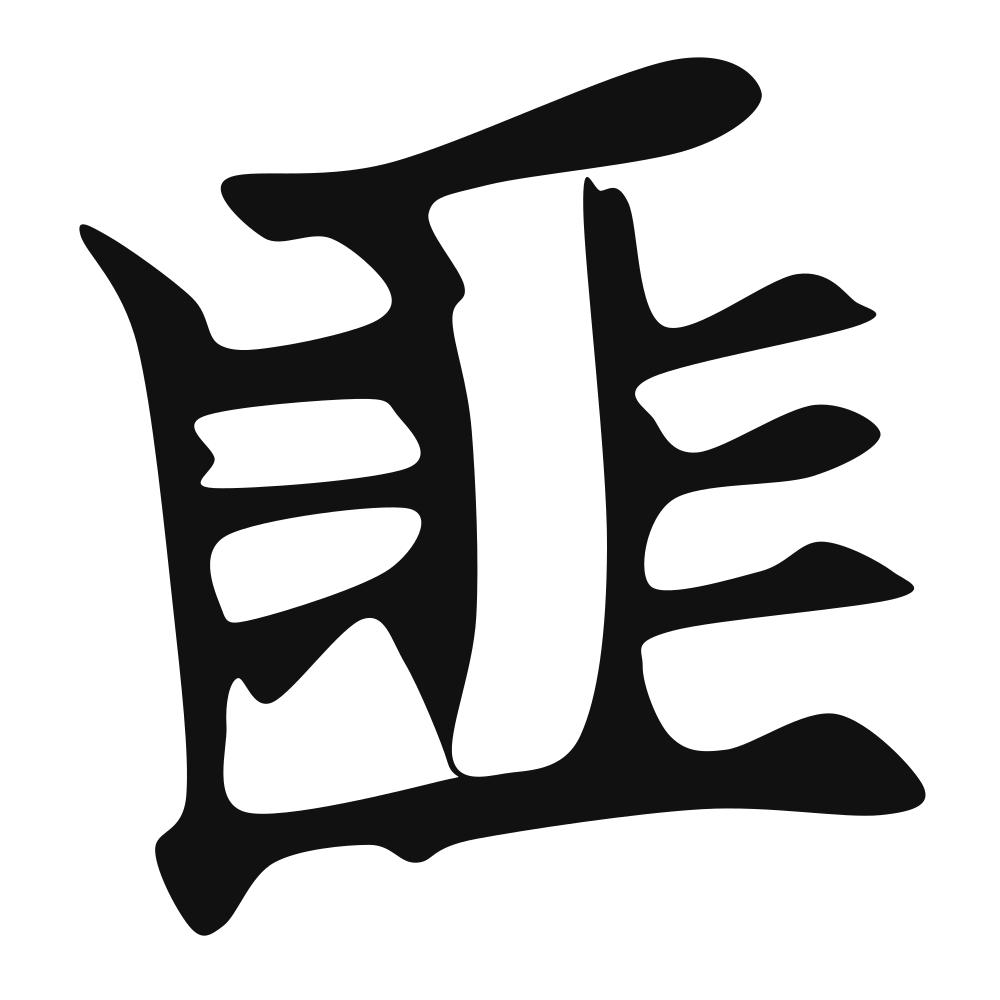
匪
bandit; (literary) not
Closest English meanings
bandit·robber·not
The Calligrapher — Ōuyáng Xún 欧阳询
Tang regular-script master whose 'Ouyang style' is a basic learning model.
Tang calligrapher (557–641), master of regular script/running script — Tang codifier of regular script; crisp, architectural strokes you could measure with a ruler. Tang dynasty
Etymology & Meaning · 字义溯源
2 · The Character: 匪 匪 (fěi, 3rd tone) is one of Chinese's great shape-shifters. The Shuowen Jiezi: 器似竹箧。从匚非声 — 'a vessel like a bamboo chest; from 匚 and 非 as phonetic,' and the Yizhou shu is quoted: 实玄黄于匪 — 'fill the bamboo chest with dark and yellow [silks].' In the Shijing, Weifeng·Qiao Yu, it is lent to 斐: 有匪君子,如切如磋 — 'the elegant gentleman, as if cut and polished' (匪 = 斐, refined). Yet 匪 also serves as the negative adverb 'not' (匪夷所思). Honest disclosure — the trap: to modern Chinese ears 匪 screams 土匪 / 匪徒, 'bandit, gangster.' A lone 匪 tattoo risks reading as 'outlaw.' Reclaim it only through its classical senses (有匪君子 = the refined gentleman) and pair it so the bandit reading is defeated. Kangxi: 10 strokes, 匚部; Wuxing: Water (水).
Cultural Story
The Odes play a trick with 匪: “匪来贸丝” means not “she came to trade silk” but “she did not” — the character once read as a plain “not.” Later it hardened into 土匪, the armed robber of the hills. 匪夷所思, “beyond the compass of thought,” keeps the older sense of what lies outside the expected frame.
Common words & phrases
- 土匪 bandit · brigand
- 匪徒 bandit · gangster
- 匪帮 bandit gang · gang
- 绑匪 kidnapper · abductor
- 匪夷所思 inconceivable · unimaginable
Read the story behind the character
A 土匪 appears in the period drama a family watches at dinner; 绑匪 is the word on a police alert no one wants to read. 匪徒 names the gang in a court report, and 匪夷所思 the comment under a video of a stunt no one can explain. The word now splits between old westerns and the inexplicable feed.
Why this character belongs on skin
The outlaw rides the ridge at dusk, and the word for him is this — yet the same character, in the old books, simply means not, as in things beyond imagining. So the bandit is the man who refuses the law, and the impossible is the thing that refuses the mind. There is a freedom in both refusals. The warrior-poets of the mountains were outlaws not because they loved violence, but because they would not bow. To mark yourself with this glyph is to hold two truths: that you are not tamed, and that you are not what others name you. The state draws its borders; you draw yours elsewhere. Let the ink be the line no map contains. You are the road that does not arrive, the story that will not be explained.
Own this character
Purchase delivers the original SVG of this glyph, brushed by Ōuyáng Xún 欧阳询, ready to place on skin, paper, or screen.