
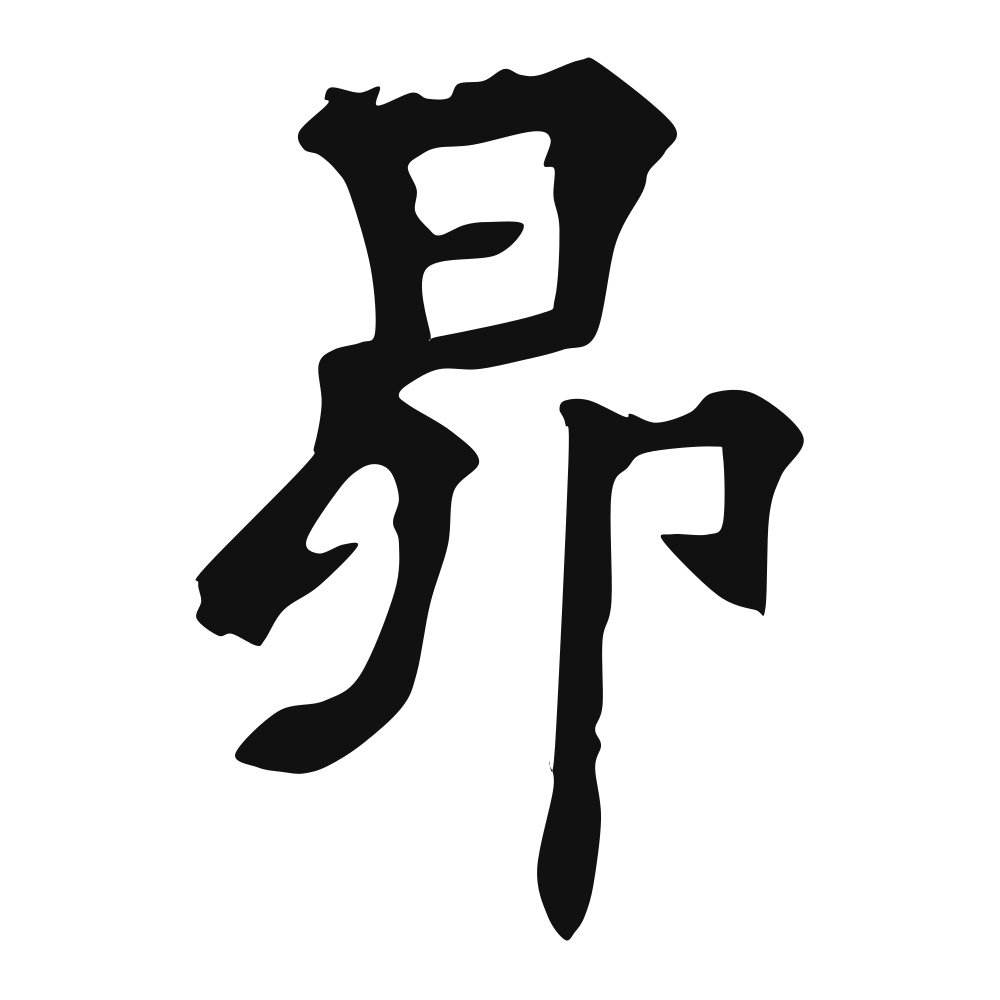
The Calligrapher — Ōuyáng Xún 欧阳询
Tang regular-script master whose 'Ouyang style' is a basic learning model.
Tang calligrapher (557–641), master of regular script/running script — Tang codifier of regular script; crisp, architectural strokes you could measure with a ruler. Tang dynasty
Etymology & Meaning · 字义溯源
### Soundmǎo — mǎo (3rd tone). Often a bound morpheme — needs a partner word ### Original meaningMǎo (3rd tone). The Shuowen Jiezi is unusually terse: 「昴,白虎宿星。从日,卯聲」 — 'the White Tiger's mansion-star', from 日 with 卯 as phonetic. It is the name of one of the twenty-eight lunar mansions — the fourth of the western White Tiger group — and in practice the Chinese name for the Pleiades. 《詩·召南·小星》 puts it in the mouth of someone walking to work before dawn: 「嘒彼小星,維參與昴」 — 'tiny, those little stars: Orion and the Pleiades'. 《尚書·堯典》 uses it as a calendar: 「日短星昴,以正仲冬」 — when the day is shortest and 昴 culminates at dusk, the middle month of winter is fixed. 《爾雅·釋天》 records its alternate names: 「大梁,昴也;西陸,昴也」, with the note 「昴,西方之宿,別名旄頭」. 段玉裁's commentary keeps the old sound-gloss from the 元命苞: 「昴之爲言留也」 — 昴 speaks like 留, 'to hold back', because things are 'brought to completion and held there'. Honest disclosure: 昴 is the west, autumn and the White Tiger, so in Chinese sky-lore it is a martial, autumnal star — 旄頭 is a war-banner — not merely a pretty cluster. Kangxi 9 画 (日部 + 5); naming tables disagree on the element: Water, Fire and Wood all appear, while the classical direction of the mansion is west, which is Metal. ### The structure (形聲 · 从日,卯聲 — sun / day-class (日) with 卯 as phonetic; the graph is a star-name written in the 日 series)①日rìsun / daythe classifier the star-name is written under②卯mǎothe second earth-branchthe phonetic; 卯 is also the east, so the phonetic is not the meaning③昴宿mǎoxiùthe Hairy Head mansionthe fourth mansion of the western White Tiger④旄頭máotóuthe banner-headthe mansion's other name — a martial image, not a pastoral one ### In use todayItemReading / meaningNoteReadingmǎo (3rd tone)single syllableCore sensethe Pleiades; the White Tiger's fourth mansiona star name, used as suchGrammarproper noun / bound in compounds昴宿 · 昴星團 · 參昴 (Orion and the Pleiades)Tattoo fityes-standalone — a named star, clean and unmistakablecold and astronomical rather than emotional ### Closest words in English — and what each misses - Star — 星 holds 'star' generally; 昴 is one specific cluster with a fixed place in the calendar - Seven sisters — the Greek name is mythological; 昴's Chinese lore is calendrical and martial, with no sister-myth attached - West — 西 holds the direction; 昴 is the western mansion, not the word for west - Winter — 冬 holds the season; 昴 only marks it — 日短星昴 fixes the solstice month, it does not mean winterAn honest note on grammar. Bound morpheme in practice — 昴宿 (the mansion), 昴星團 (the Pleiades cluster); it stands alone only as a proper nam
Cultural Story
昴 is the Pleiades, the hairy star-cluster the farmers watched. 昴宿 the 'Hairy' mansion of the lunar lodge, whose rising warned of frost; 昴星 the same seven. The word is the sky as an almanac — the cluster that told the sowing and the soldier the hour. The Book of Songs already names it; the calendar kept its rising.
Where a Western reader can stand: 昴 (mǎo) is the Chinese name of the Pleiades, and one of the twenty-eight houses the old sky was divided into. It sits in the west, in the White Tiger's quarter — autumn, metal, the martial direction — and the oldest calendar fixed mid-winter by watching it culminate at dusk. As a tattoo it reads as cold, exact and navigational: a star you steer by, not a star you wish on. It is a real astronomical object, which makes it one of the safest choices in this set.
Common words & phrases
- 昴星 Pleiades
- 昴宿 Pleiades mansion
Read the story behind the character
昴 lives in 昴星 the astronomy page and 昴宿 the lodge of the old zodiac. You will not say it at night. It is a constellation of the farmer's sky and the astrologer's chart, the seven hairs of light that once cued the planting and now cue only the trivia question and the telescope's label.
Why this character belongs on skin
昴 is the Pleiades—the tight knot of sister-stars the Chinese called the Hairy Head, one of the twenty-eight lunar mansions by which farmers planted and kings timed their wars. Every culture has loved that little cluster: the Greeks called them seven daughters placed in the sky to escape pursuit; the Japanese, Subaru; sailors steered by them for three thousand years. The character carries the sun radical, daylight and starlight bound together. There is something achingly human about the Pleiades—they are young stars, still wrapped in the blue mist of their own birth, a nursery hanging in the winter dark. To wear 昴 is to claim a guiding cluster: to say your course has been set by something older and higher than the road. Sister-stars, seven points of ink, and suddenly you are navigating.
Own this character
Purchase delivers the original SVG of this glyph, brushed by Ōuyáng Xún 欧阳询, ready to place on skin, paper, or screen.