
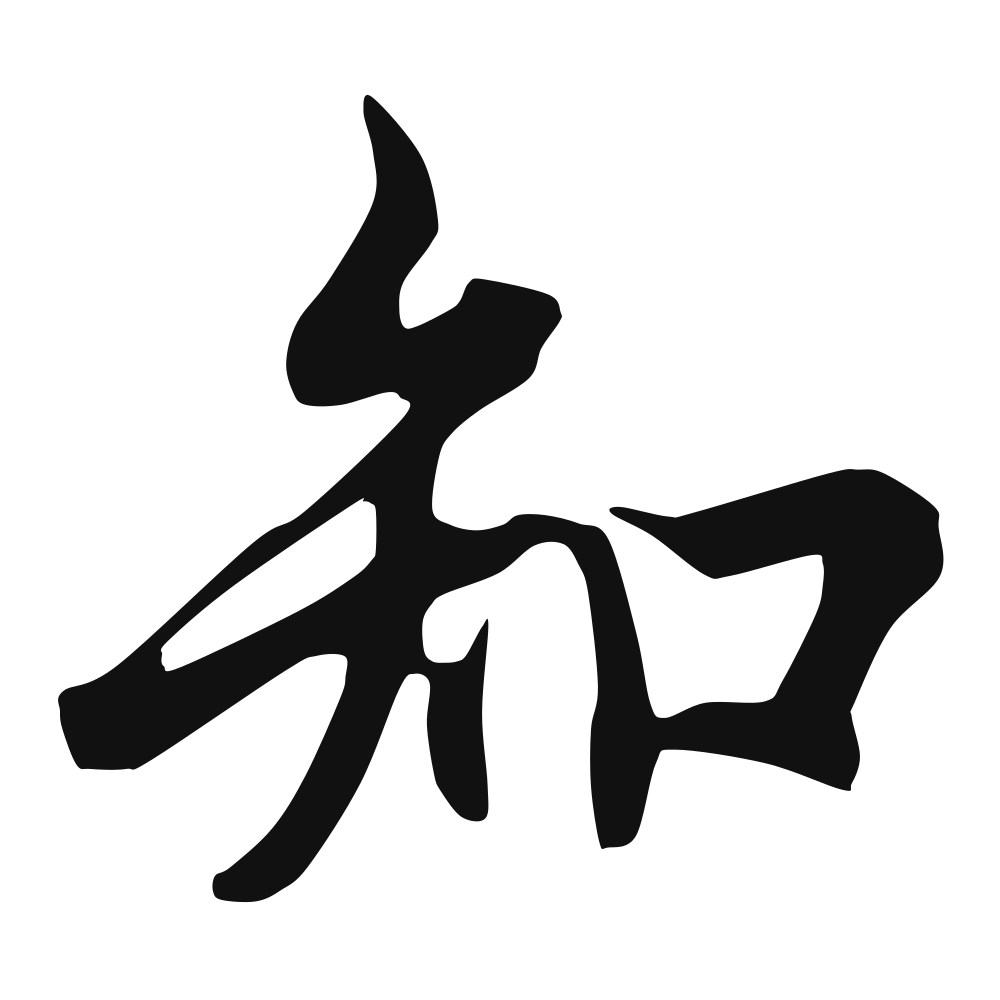
知
to know; to be aware
Closest English meanings
know·be aware·knowledge·understand·inform
The Calligrapher — Ōuyáng Xún 欧阳询
Tang regular-script master whose 'Ouyang style' is a basic learning model.
Tang calligrapher (557–641), master of regular script/running script — Tang codifier of regular script; crisp, architectural strokes you could measure with a ruler. Tang dynasty
Etymology & Meaning · 字义溯源
2 · The Character: 知 Zhī (1st tone; read zhì it equals 智, wisdom) is to know. The Shuōwén Jiězì gives '知,词也。从口从矢' — 'words; from 口 (mouth) and 矢 (arrow).' Duan Yucai explains: 'understanding is quick, so what issues from the mouth is swift as an arrow.' The Lúnyǔ (为政) makes it the root of honesty: '知之为知之,不知为不知,是知也' — 'to know what you know and what you do not: that is knowledge.' The Yìjīng (系辞上) elevates it: '乾知大始' and '知周乎万物而道济天下' — 'qián initiates creation; knowledge encompasses all things and aids the world.' Mèngzǐ (尽心上) locates an innate '良知' — 'innate knowing.' The Chǔcí (九歌) cherishes '乐莫乐兮新相知' — 'no joy like a new friend who knows you.' A lone 知 reads as knowing, wisdom, or kindred understanding (知音). Honest note: it never means 'eternity'; as a verb it can also mean 'to inform' (通知) or 'to administer' (知县).
Cultural Story
知 puts an arrow 矢 at the mouth's door: words that fly straight and hit the mark. The Analects builds ethics on it — 知之为知之,不知为不知,是知也, 'to know what you know and to know what you do not know: that is knowing.' From Boya's lyre and Zhong Ziqi's listening came 知音, the friend who truly hears you — and 知己, the one who understands without being told.
Common words & phrases
- 知道 know · be aware · realize
- 知识 knowledge · learning · erudition
- 知己 close friend · bosom friend · confidant
- 不知 not know · unaware · ignorant
- 知音 understanding friend · bosom friend · soulmate
- 知名 well-known · famous · renowned
Read the story behind the character
Knowing is the daily currency of apps. You tap 知道 (know, be aware) to dismiss a notification; students binge 知识 (knowledge) videos before an exam; Zhihu, the Q&A platform named for the character, crowdsources answers to everything. Close friends call each other 知己 (confidants); the soulmate who instantly gets your jokes is your 知音 (understanding friend). And fame is quantified: a 知名 (well-known) blogger is measured in followers.
Why this character belongs on skin
The arrow flies straight because it knows its target; the word leaves the mouth because it knows its truth. 知 is to know, not the cold knowledge of facts but the warm recognition of one mind meeting another. The Chinese treasure the 知己, the friend who knows you, the rare soul who needs no explanation because they have already arrived where you are. Confucius put 知 at the root of virtue: know what you know and know what you do not. To wear 知 is to value being understood over being admired, to keep a place inside for the one who sees clearly. It is intimacy as a discipline. Let it lie near your heart, a small character that says you have been known, and that knowing, once given, is the one thing the world cannot take back, the one debt that pays the bearer simply by being owed.
Own this character
Purchase delivers the original SVG of this glyph, brushed by Ōuyáng Xún 欧阳询, ready to place on skin, paper, or screen.