
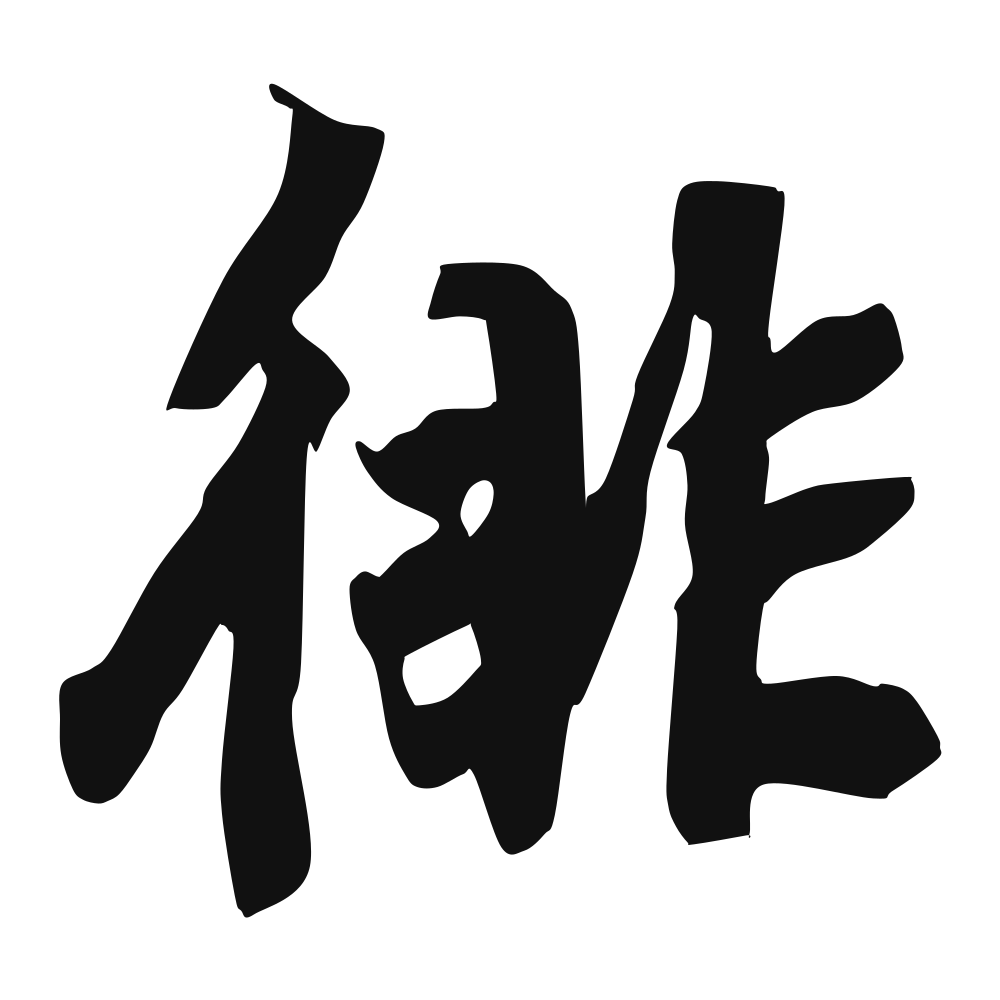
徘
usually seen in: to pace back and forth (徘徊)
Closest English meanings
pace·wander·hesitate
The Calligrapher — Shì Huáirén 释怀仁
Tang monk who compiled Wang Xizhi's script into the Sacred Teachings stele.
Tang calligrapher (), master of running script — known for 集王羲之行书《圣教序》. Tang dynasty
Cultural Story
徘 shares its pacing with 徊 — the walk that will not decide. The old poems leave the lover 徘徊 at the gate, going and returning, and 徘 carries only this, the feet in argument with the mind. A character born to hover, with no other business than the back-and-forth.
Common words & phrases
- 徘徊 pace to and fro · hesitate · linger
Read the story behind the character
徘徊 is the line an analyst draws when a number will not move, the buyer in the aisle, the thought you circle and will not land. The gate is a chart; the pace is unchanged. We still tread the small indecision, mostly about a purchase or a person, and call the standing-still motion.
Why this character belongs on skin
To pace is to think with the feet, to walk and return and walk again before a door you cannot yet open. This character lives only in the pair, the back-and-forth, the hesitation that is not weakness but weighing. To pái is to linger at the edge of a decision, a lover outside the window, a soldier outside the village he burned, a soul outside the grace it seeks. The Buddhists call such turning the restless mind, and the cure is to step, finally, in one direction. Yet the pause has its own honor, the respect of one who will not rush a thing that matters. A man inked with this carries his indecision like a lantern, admitting he stood in the threshold and felt the full weight of choosing. Let it mark the instep, the part that steps, and say simply: I lingered, because what lay beyond was worth the fear of entering.
Own this character
Purchase delivers the original SVG of this glyph, brushed by Shì Huáirén 释怀仁, ready to place on skin, paper, or screen.