
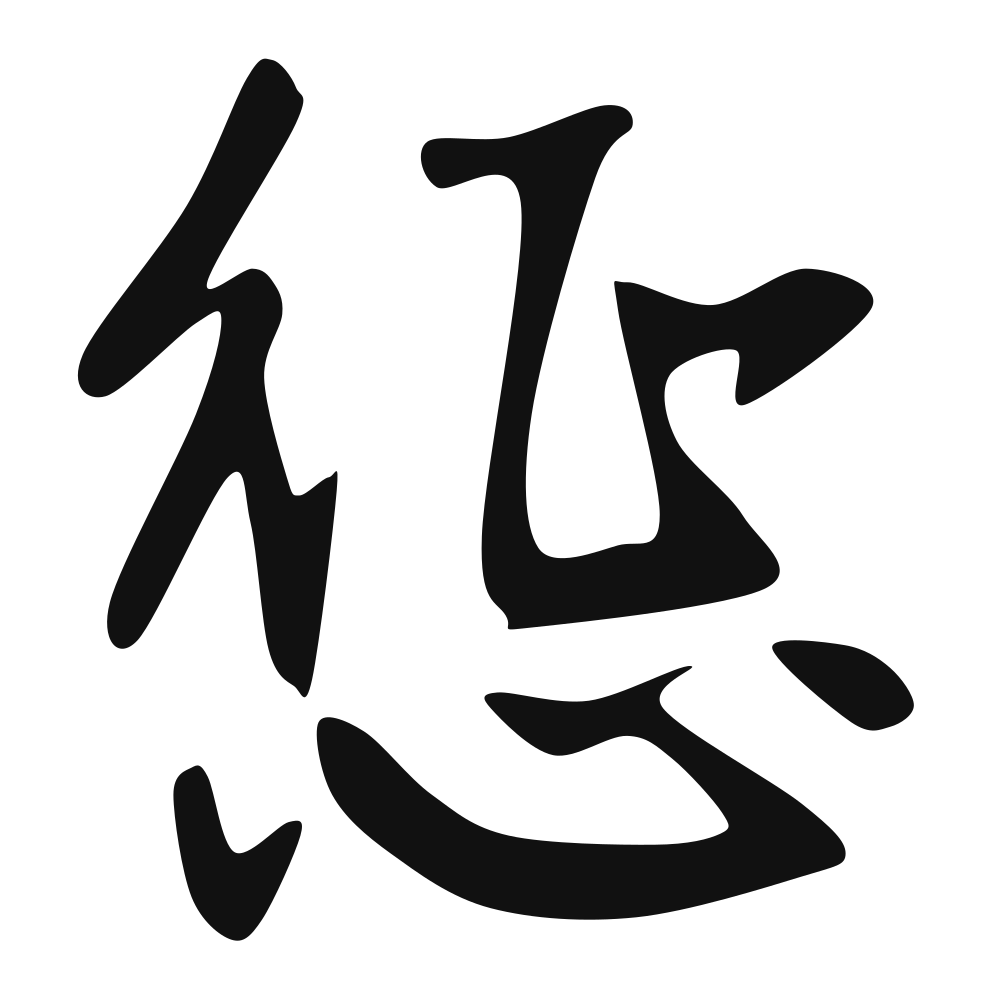
惩
to punish; to reprimand; to warn
Closest English meanings
to punish·to warn
The Calligrapher — Shì Huáirén 释怀仁
Tang monk who compiled Wang Xizhi's script into the Sacred Teachings stele.
Tang calligrapher (), master of running script — known for 集王羲之行书《圣教序》. Tang dynasty
Etymology & Meaning · 字义溯源
2 · The Character: 惩 Chéng (2nd tone). The Shuowen: 「惩,㣻也。从心徵聲」 — to take warning, from heart (心) with 徵 (zhēng) for sound; the form is 懲. The sense is 'learn a lesson / punish so as to warn': 《诗经·小雅·节南山》 「不惩其心」 (he will not mend his heart); 《左传·成公十四年》 「惩恶而劝善」 (punish evil and encourage good); 《楚辞·离骚》 「虽体解吾犹未变兮,非余心之可惩」 (not even dismemberment can warn my heart off). Grading: 惩 alone means 'punish / take warning' and leans corrective, not celebratory; it is safe only as a paired motto (惩前毖后 — learn from the past to avoid future error). Disclose the punitive root. Wearers wanting 'discipline' are better served by 戒 (self-restraint) or 勉 (exhort); 惩 carries the sting of punishment.
Cultural Story
惩 is the sting that teaches. The 詩經 warns 予其惩而毖后患 — I will be punished and so take care against future harm, the root of the idiom 惩前毖后. The heart with 徵, to go forth, is correction that walks ahead of the next mistake. It is the whip understood as a lesson.
Where a Western reader can stand: Where a Western reader can stand: 惩 means 'to punish' or 'to take warning' — closer to Latin punire than to any gentle 'discipline' — yet its one safe tattoo use is the paired motto 惩前毖后, 'learn from the past to avoid future error'. Honest caveat: alone it leans punitive and unwelcome; pair it, and let Shi Huairen's assembled Wang Xizhi forms lend the sting the poise of the scholar-god's brush. If you want self-restraint, 戒 or 勉 read far cleaner on the skin.
Common words & phrases
- 惩罚 to punish
- 惩戒 to discipline
- 惩治 to punish and cure
- 惩办 to punish
Read the story behind the character
惩 is the institutional word: 惩罚 the school's detention, 惩治 the court's sentence, 惩戒 the firm's warning letter. 惩办 is what the bulletin promises the corrupt official. It has moved from the bruise to the procedure, the pain now administered by a form and a stamp.
Why this character belongs on skin
There is a certain gravity in knowing you must pay for what you've done. 惩 means to punish, to discipline — the heart radical beneath a taskmaster's mark, conscience weighed against consequence. The ancients understood that punishment was never meant to break a person but to correct the path, the way a warrior's bruised ribs teach him to guard them. Buddhism calls this karma; the West calls it consequence; your grandmother called it getting what's coming to you. What makes this character beautiful rather than bleak is its promise: wrongs are answered, accounts are settled, and justice — cold as it sometimes feels — is a form of love for the world's order. To wear it is to accept accountability as a discipline, to say you'd rather carry the scar than the lie. A quiet, severe tattoo for someone who answers for their life.
Own this character
Purchase delivers the original SVG of this glyph, brushed by Shì Huáirén 释怀仁, ready to place on skin, paper, or screen.