
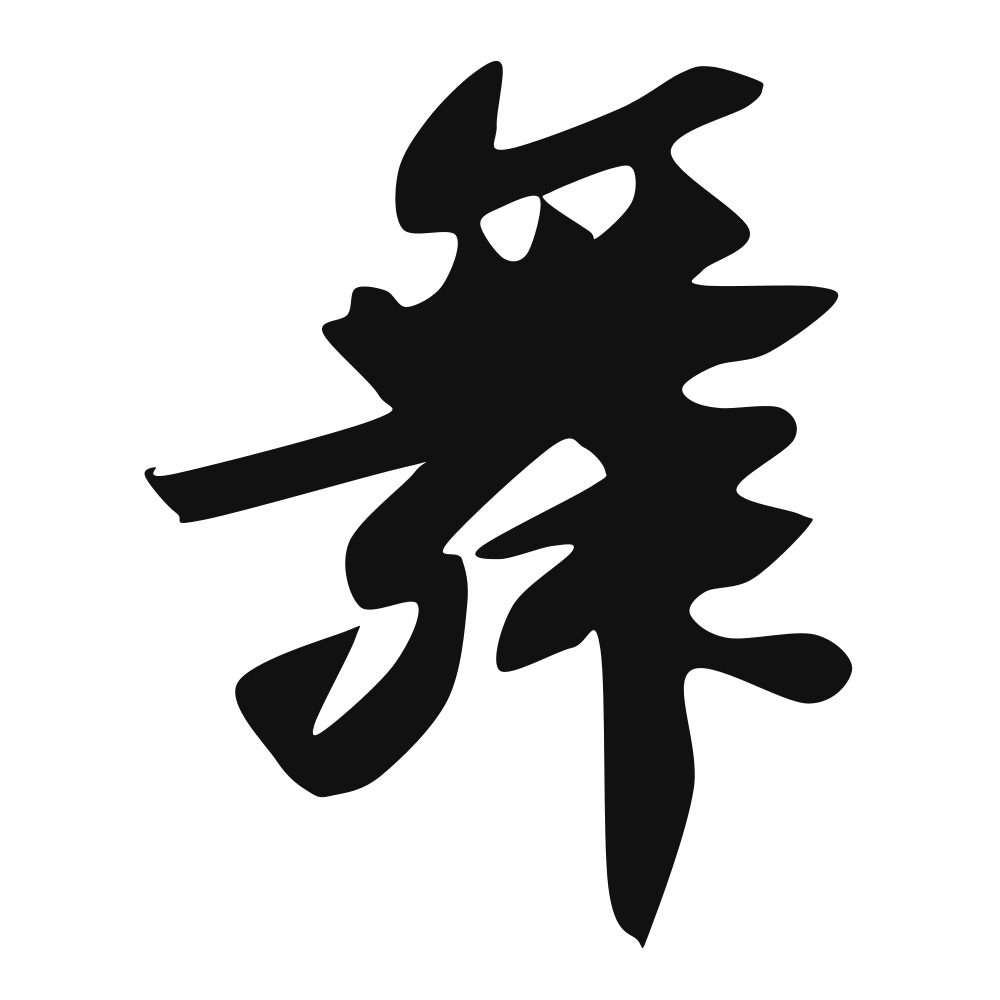
舞
to dance; to wield; to brandish
Closest English meanings
to dance·dance
The Calligrapher — Sū Shì 苏轼
Song literatus whose spontaneous running script shaped the literati ideal.
Song calligrapher (1037–1101), master of running script/regular script — Song poet-statesman and polymath whose expressive running script made personality, not rules, the point. Song dynasty
Etymology & Meaning · 字义溯源
2 · The Character: 舞 Wǔ (3rd tone). 舞 is to dance. 《說文解字》: 『舞,樂也。用足相背。从舛,無聲』 (『music; the feet move opposite; from 舛, 無 sound』), two feet in counter-step. 《詩經·小雅·賓之初筵》 shows the joy: 『屢舞僊僊』 (『again and again they dance, light as air』). 《左傳·隱公五年》 gives its dignity: 『夫舞所以節八音而行八風也』 (『dance orders the eight timbres and moves the eight winds』) — dance as cosmic harmony. In state ritual it was the 佾 (yì) rows of dancers. Honest disclosure: 舞 also means 『to wield, to flourish』 a weapon (舞刀) and, in 舞文弄墨, 『to juggle words』 — a shade of trickery. As a tattoo 舞 reads 『rhythm, joy, harmonious motion』, a bright standalone, but pair with 風/樂 if you want the celestial-dance sense rather than the 'wield' one.
Cultural Story
The oldest form of 舞 shows a figure with both arms raised, holding plumes or ox-tails, dancing — the character is the dance itself. Ritual music made dance an act of state, and the 尚书 tells of beasts and phoenixes joining the rhythm, 百兽率舞. Tang courts perfected the 霓裳羽衣舞, while proverbs distilled both flattery and danger into 长袖善舞, long sleeves dance well.
Common words & phrases
- 跳舞 to dance · dancing
- 舞蹈 dance
- 舞台 stage · arena
- 舞会 dance party · ball
- 飞舞 to dance in the air · to flutter
- 鼓舞 to inspire · to hearten · encouraged
Read the story behind the character
Friday night means 跳舞 — dancing — at the studio, where your 舞蹈, dance, class is learning a hip-hop routine. Your mother joins the square-dancing grannies in the plaza, and their stage, their 舞台, is any lit patch of pavement. The company party becomes a 舞会, a proper ball, and the CEO's awkward speech somehow 鼓舞, heartens, everyone before the music starts; by midnight the confetti is 飞舞, fluttering through the air.
Why this character belongs on skin
Before there was writing there was movement — bodies telling the gods what words could not. 舞 shows a dancer in the ancient glyphs, arms lifted, sleeves flying, and in its oldest form it held an ox tail and antlers: shaman and beast, flesh and spirit, spinning together until the boundary thinned. The Daoists said the sage moves like water, which is simply dance described soberly. David danced before the ark with everything he had and was not ashamed. This character is the body's argument that joy is a discipline, that abandon has structure, that the most religious thing you can do sometimes is move until you forget your own name. A tattoo of 舞 belongs on the side of the ribs, where the breath rises and falls, so the character literally dances with you. Let it be your vow: never to let the music pass you by untouched.
Own this character
Purchase delivers the original SVG of this glyph, brushed by Sū Shì 苏轼, ready to place on skin, paper, or screen.