
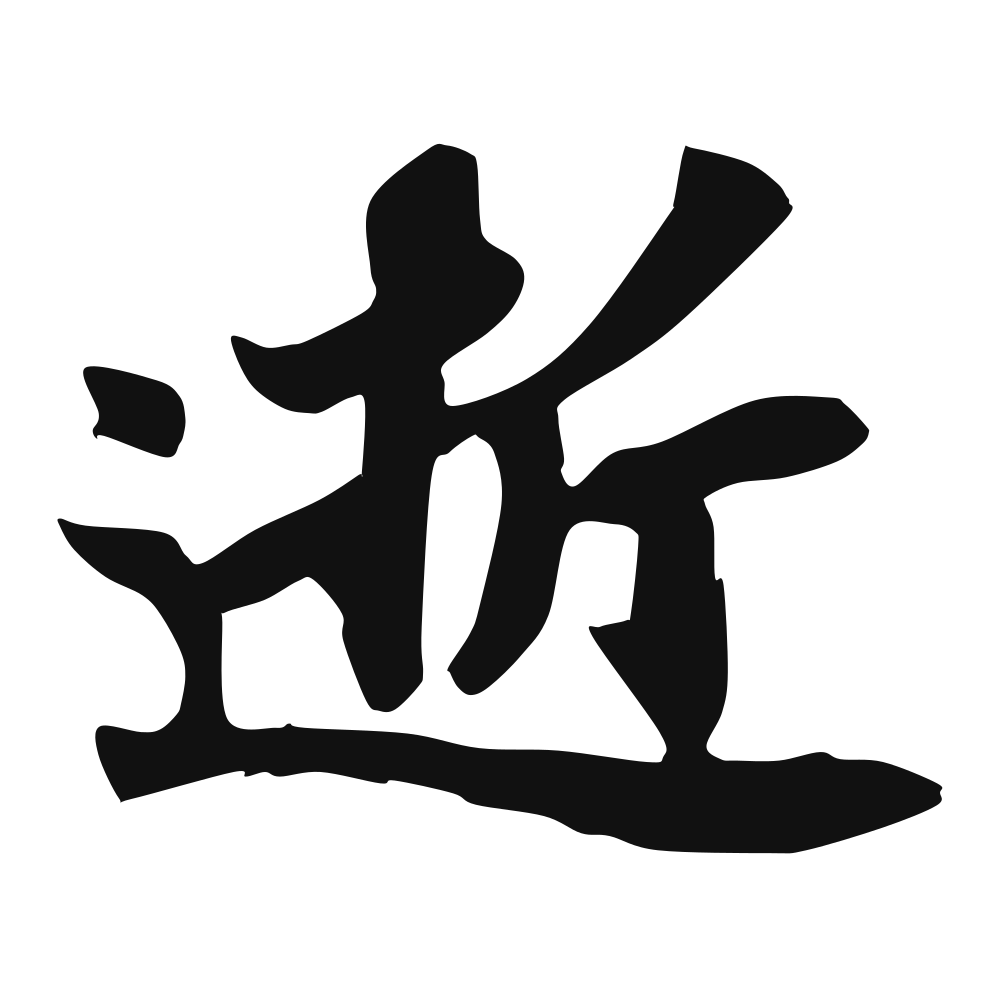
逝
(of flowing water or time) to pass by; to pass away; to die
Closest English meanings
pass away·elapse·depart
The Calligrapher — Sū Shì 苏轼
Song literatus whose spontaneous running script shaped the literati ideal.
Song calligrapher (1037–1101), master of running script/regular script — Song poet-statesman and polymath whose expressive running script made personality, not rules, the point. Song dynasty
Etymology & Meaning · 字义溯源
### Soundshì — shì (4th tone). Free-standing morpheme ### Original meaningShì (4th tone). The Shuowen Jiezi defines it as 「往也。从辵折聲。讀若誓」 — 'to go', a phonogram on 辵 (walking) with 折 as phonetic, and Xu Shen adds that it is read like 誓 'to swear'. Duan Yucai notes it is a Qin–Jin dialect word (《方言》: 「逝,秦晉語也」). The classical citations run from plain motion to death: 《詩·陳風·東門之枌》「穀旦于逝」 (on a fine morning he goes), 《楚辭·九歌·少司命》「倏而來兮忽而逝」, 《詩·魏風·碩鼠》「逝將去女,適彼樂土」 (where 逝 stands for 誓, 'I swear I will leave you'), and above all 《論語·子罕》「子在川上曰:逝者如斯夫!不舍晝夜」 — the Master by the river said, all that passes goes on like this, night and day unceasing. The Kangxi entry adds the sense 「亡也」 with 《漢書·司馬遷傳》「長逝者魂魄」 — the soul of the long-gone one. Kangxi counts 14 strokes (辵部+7); naming tables give 金 and, unusually, mark the character 凶 (inauspicious) for names. Honest disclosure: 逝 is the classical word for flowing away, and its modern everyday use is death — 逝世 to pass away, 仙逝, 長逝. The Confucian line is genuine and beautiful; the single character alone still reads as a death word. ### The structure (形聲 · 从辵折聲,讀若誓 — walking (辵) + the phonetic 折 (zhé); Xu Shen notes the homophone 誓)①辵chuòto walk / gothe motion radical; 逝 is a going-word②折zhéto break (phonetic)supplies the sound shì③逝shìto pass onthe Shuowen gloss is one word: 往,to go④誓shìto swearthe homophone Xu Shen cites; the Odes borrow 逝 for it ### In use todayItemReading / meaningNoteReadingshì (4th tone)single syllableCore senseto pass; to pass awaymodern everyday use is deathGrammarbound morpheme (modern)逝世 to die, 流逝 to elapse, 消逝 to vanishTattoo fitcaution — ink the phrase, not the bare graph逝者如斯 carries the Confucian sense; 逝 alone reads death ### Closest words in English — and what each misses - Die — 死 holds 'to die' plainly; 逝 is the softer honorific word - Pass — 過 holds 'to pass by'; 逝 carries the sense of not returning - Flow — 流 holds flowing water; 逝 is what the water does to time - Leave — 去 holds 'to leave'; 逝 is leaving as vanishingAn honest note on grammar. Free verb in classical Chinese; bound in modern use — 逝世 to die (honorific), 流逝 to elapse, 消逝 to vanish; in the Odes it also stands for 誓 'to swear'Where a Western reader can stand: 逝 (shì) means 'to go by, to pass away'. Its Shuowen gloss is simply 往, 'to go'. The famous line is Confucius at the river — 逝者如斯夫,不舍晝夜, everything passes like this, without stopping day or night — and that line is about time, not death. But in modern Chinese the character's everyday job is death: 逝世 'to pass away', 仙逝. So the honest advice is to ink the phrase rather than the
Cultural Story
Shi is passing beyond recall. Confucius, standing by a river, gave the character its eternal frame: 'What passes is like this water — never ceasing day or night.' Ever since, shi has meant time, water, and life flowing one way.
Where a Western reader can stand: 逝 (shì) means 'to go by, to pass away'. Its Shuowen gloss is simply 往, 'to go'. The famous line is Confucius at the river — everything passes like this, without stopping day or night — and that line is about time, not death. But in modern Chinese the character's everyday job is death: 逝世, 'to pass away'. So the honest advice is to ink the phrase 逝者如斯 rather than the single graph, or to choose 流 if flowing water is what you mean.
Common words & phrases
- 逝世 pass away · die
- 消逝 vanish · fade
- 逝去 pass away
- 長逝 pass away forever
Read the story behind the character
Shi carries modern grief and elegance: shishi (pass away) in the obituary, xiaoshi (fade away) sounds of the demolished street, shiqu (gone) childhood summers in a friend's nostalgic post. The classical echo survives in everyday speech too — 'time shi like water' — the river Confucius watched still flowing past.
Why this character belongs on skin
The river does not stop to mourn the leaf it carries; this is the passing, the slipping away of what we thought would stay — a season, a parent's voice, the heat of a particular afternoon. The ancients watched the water and named all loss with the same current. Buddhism says everything that arises passes; the grief is in the clutching, not the going. Yet to pass is also to journey onward, the dead said to have gone elsewhere with dignity. To ink this is to make peace with the current, to wear the truth that nothing is held forever and that the holding was the gift. Let the skin carry the passing — not as despair but as the only honest map of a life: everything moves, everything means, everything goes.
Own this character
Purchase delivers the original SVG of this glyph, brushed by Sū Shì 苏轼, ready to place on skin, paper, or screen.