
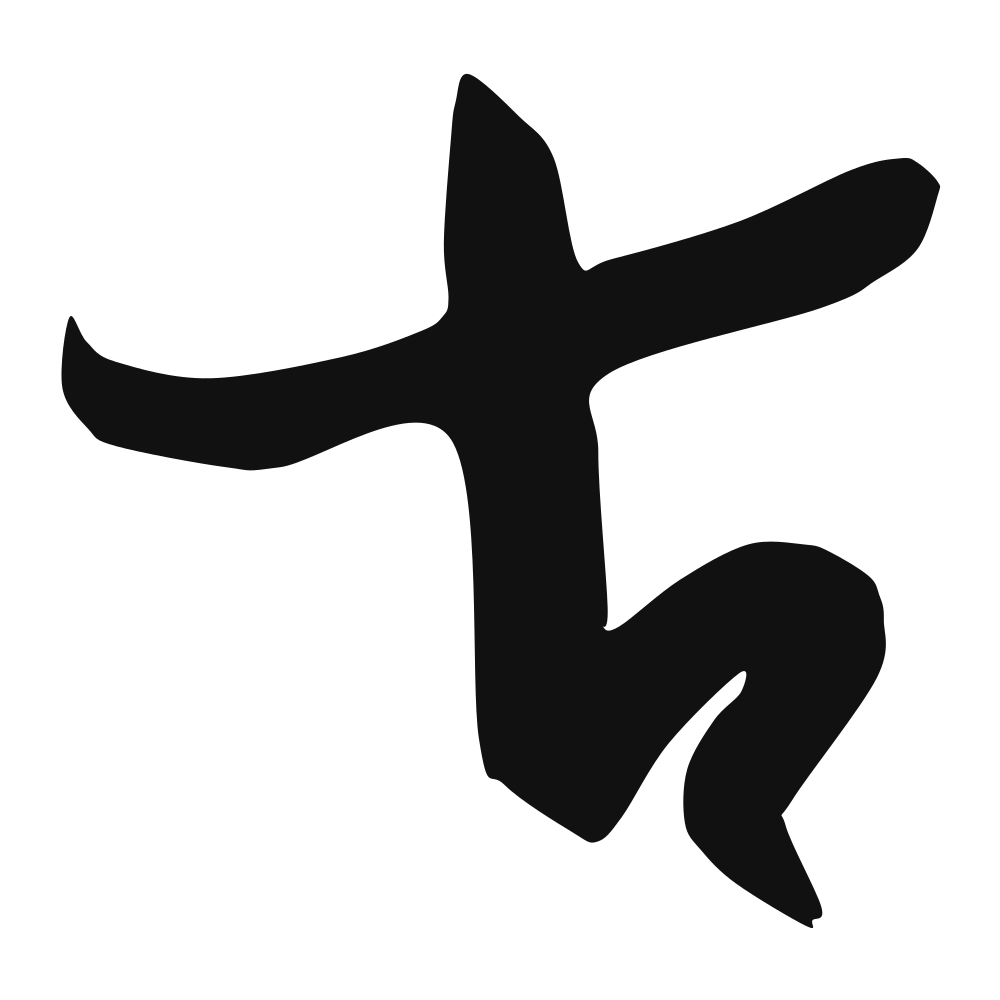
古
surname Gu; ancient; paleo-
Closest English meanings
ancient·old·former·antique
The Calligrapher — Sūn Guòtíng 孙过庭
Tang cursive master and author of the key treatise 'Shu Pu'.
Tang calligrapher (约646–691), master of cursive script — known for 《书谱》. Tang dynasty
Etymology & Meaning · 字义溯源
2 · The Character: 古 Gǔ (3rd tone). 《说文·十部》: 「古,故也。从十、口。识前言者也。」 — 'ancient; from ten and mouth: one who knows the words spoken before.' Ten mouths in succession, each passing the sentence on, so antiquity is defined as successful transmission rather than as elapsed time. Confucius makes it a working discipline, not nostalgia: 《论语·述而》 「述而不作,信而好古」 — 'I transmit and do not invent; I trust and love the ancient.' 《诗经·大雅·烝民》 gives it ritual form: 「古训是式,威仪是力」 — the old teachings are the model. 古 is a free morpheme with a wide, healthy range: 古今 (then and now), 千古 (through all ages), 考古 (archaeology), 古朴 (unadorned, plain-good). Honest disclosure: it can also simply mean out-of-date — 古板 is 'stiff and priggish', 老古董 is 'an old fogey'. Do not confuse it with 故 (gù), which in 故人 can mean the deceased; 古 itself carries no funeral register.
Cultural Story
古 was the old. Ma Zhiyuan's lyric set a traveler on "an old road, west wind, a lean horse" -- 古道西风瘦马 -- at dusk's end. The 古诗十九首 sang of parting and impermanence; the 古迹 are the stones those singers knew. The word reached backward to what had already aged, the road and the ruin and the verse that outlasted both.
Where a Western reader can stand: Sun Guoting (c. 646–691) wrote the Shu Pu — the founding treatise of Chinese calligraphic theory — in his own modern cursive, so the manual is also the masterpiece. His 古 comes from the scroll that has been the standard model for learning cursive for thirteen centuries: a hand a specialist recognises as correct, expressive but unmistakably literate. As a tattoo, 古 means 'ancient / of old / time-tested,' tattoo-friendly and authoritative. His disciplined, Wang-tradition cursive gives you a 古 that reads as elegant, flowing antiquity. Honest notes: 古 can mean 'stiff' (古板), it is a surname, and it is not 故 (deceased) — 古 itself has no funeral sense. Element Wood (木).
Common words & phrases
- 古代 ancient · ancient times · antiquity
- 古老 ancient · old · time-honored · aged
- 古人 ancient people · the ancients · forefathers
- 古典 classical · classic · traditional
- 古迹 historic site · relic · ancient remains
- 古书 ancient book · old book · ancient text
Read the story behind the character
A tour bus stops at the 古迹; a collector bids on a 古书 at the auction. The 古典 concert sells out; a student reads 古人 to learn the old measures. The 古代 wing of the museum stays crowded through the holiday. The word does the work of antiquity -- the site, the book, the music, the people long dead -- gathered under one plain sign of age.
Why this character belongs on skin
古 is old — ancient, the time before memory, the ten joined to the mouth that speaks what the ancestors said. To wear 古 is to lean into the deep well, to admit you are younger than the things you love. The Confucian honored it; the Daoist dissolved into it. There is a comfort in the ancient, a relief from the pressure to be new. We are obsessed with the next thing; this character points the other way, to the stone tools, the first fires, the long quiet that made us. To carry 古 is to say your roots matter, that you are the late chapter of a very old book. Place it where you feel small against time. Let it steady you: nothing you face is unprecedented. The old ones endured. So you will, in your turn, become ancient too.
Own this character
Purchase delivers the original SVG of this glyph, brushed by Sūn Guòtíng 孙过庭, ready to place on skin, paper, or screen.