
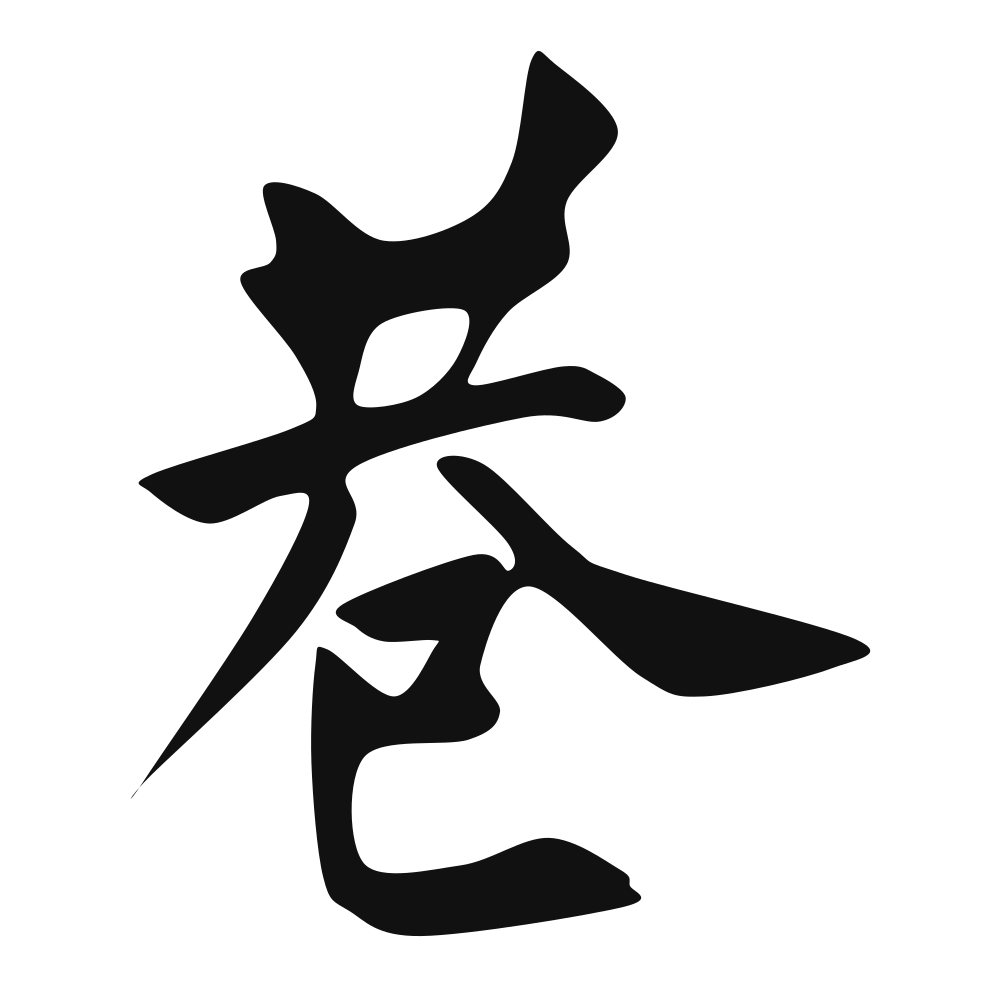
The Calligrapher — Wáng Duó 王铎
Late-Ming cursive master of monumental, turbulent brushwork.
明末清初 calligrapher (1592–1652), master of cursive script/running script — late-Ming master of wet-ink, falling-and-rising running cursive. late Ming–early Qing
Etymology & Meaning · 字义溯源
2 · The Character: 巷 Xiàng (4th tone). The Shuowen Jiezi defines 巷 socially, not spatially: 「巷,里中道。从𨛔从共。皆在邑中所共也」 — 'the road inside the ward; from 邑 and 共, because it is what everyone in the settlement holds in common.' A lane is not just a narrow street; it is shared property. 《诗经·郑风·叔于田》 uses it for emptiness: 「叔于田,巷无居人」 — 'Shu has gone hunting; there is no one left in the lane.' And Confucius makes it the setting for his favourite disciple's poverty: 《论语·雍也》 「一箪食,一瓢饮,在陋巷,人不堪其忧,回也不改其乐」 — 'one basket of rice, one gourd of water, in a shabby lane; others could not bear the misery, but Hui never let it spoil his joy.' Disclosures: 陋巷 means slum, 巷战 means street fighting, and 花街柳巷 is the old word for a red-light district. 巷 is humble, not grand. Element tables assign Water (水).
Cultural Story
巷 means a narrow lane within a settlement, and the Analects honor Yan Hui for dwelling 'in a humble lane' (在陋巷) without losing his joy - making the word a symbol of quiet poverty and contentment. The Shijing speaks of lanes emptied of people, and old capitals like Pingyao were woven from such alleys. Walls on either side, footsteps echoing, a well at the end: the 巷 was the intimate spine of neighbourhood life long before wide boulevards existed.
Where a Western reader can stand: Where a Western reader can stand: 'a lane' — the road a whole ward holds in common; Yan Hui kept his joy in the shabby lane. Honest caveat: 巷 is humble — alone it can read as slum, combat (巷战), or red-light district (花街柳巷). Wang Duo's flooding ink gives it weight, but name his contested loyalty (served Ming, then Qing).
Common words & phrases
- 小巷 alley · lane
- 巷子 lane · alley
- 街巷 streets and alleys
- 巷口 mouth of the alley
- 陋巷 humble lane
- 巷战 street fighting
Read the story behind the character
Every Chinese city still breathes through its 巷. You turn off the main road into a 小巷, a tiny alley, or a 巷子 where a noodle seller steams breakfast. 街巷 - streets and alleys - fill with evening walkers, and the 巷口, the alley mouth, is where neighbours gossip. Poets linger in a 陋巷, a humble lane; news reports speak of 巷战, street fighting, when peace breaks down. The lane is both home and history.
Why this character belongs on skin
The narrow lane closes behind you like a held breath. Walls on both sides, damp with a century of rain, and somewhere ahead a single lantern. In the old cities of China, the alley was not a road but a life: where neighbors leaned from doorways, where a child learned the sound of a stranger's footsteps, where love was whispered low so the walls wouldn't tell. To walk a lane is to choose the path that doesn't lead to the market but to the self. The Daoists knew it, the soft way, the narrow way, the one that bends. A warrior learns to move through alleys, unseen. To carry this mark is to say you have walked the quiet road and come out changed, that you keep a hidden passage in your chest where no one follows. Some men wear the broad avenue on their skin. You will wear the lane. Let it be inked where only you can find it, a private country you return to.
Own this character
Purchase delivers the original SVG of this glyph, brushed by Wáng Duó 王铎, ready to place on skin, paper, or screen.