
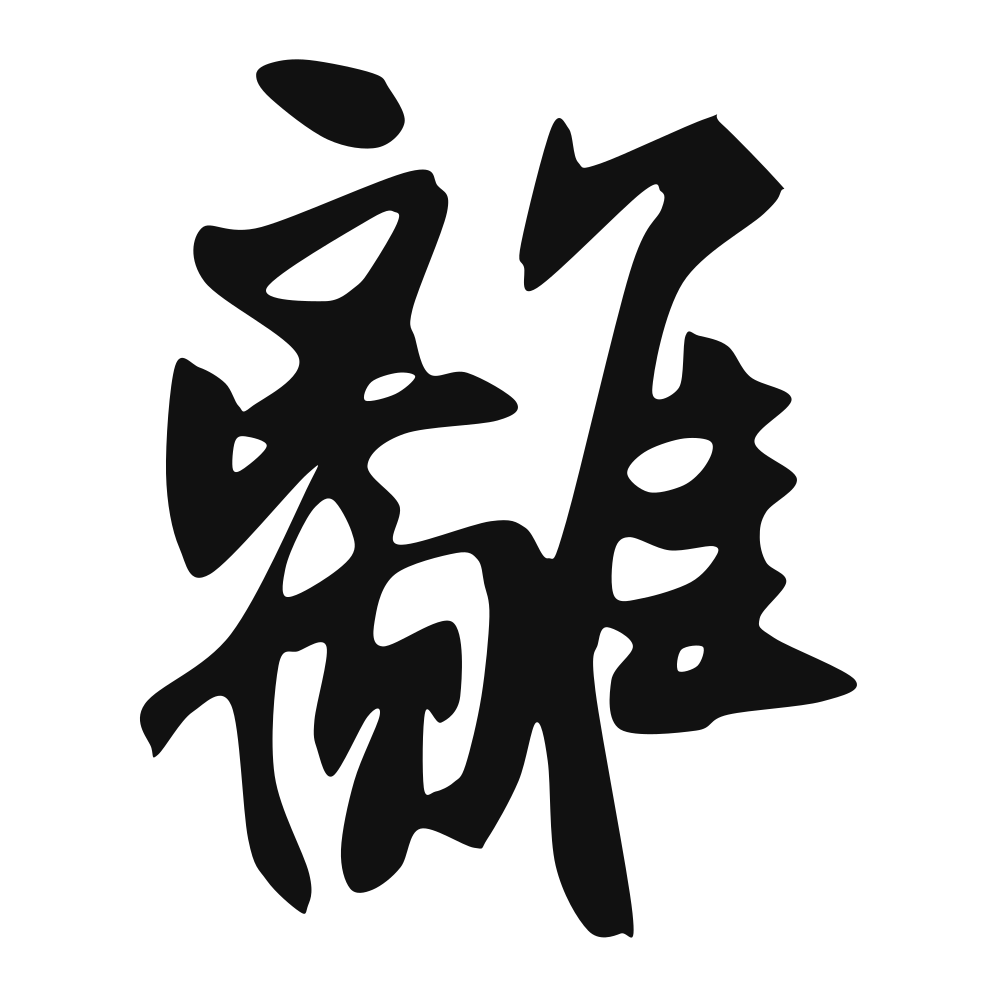
离
mythical beast (archaic); surname Li; to leave; to part from; to be away from; (in giving distances) from; without (sth); independent of; one of the Eight Trigrams 八卦[ba1 gua4], symbolizing fire; ☲
Closest English meanings
to leave·apart from·to part
The Calligrapher — Wáng Duó 王铎
Late-Ming cursive master of monumental, turbulent brushwork.
明末清初 calligrapher (1592–1652), master of cursive script/running script — late-Ming master of wet-ink, falling-and-rising running cursive. late Ming–early Qing
Cultural Story
The word 离 names parting’s oldest ache: Qu Yuan titled his great poem Li Sao — falling into sorrow — and from that root grew the whole tradition of 离别 poetry. Travelers wrote farewell verses at pavilions and willows; separation was the genre’s beating heart.
Common words & phrases
- 离开 to leave · to depart from
- 离别 to leave · to part · farewell
- 分离 to separate · to part · separation
- 距离 distance · to be apart
- 离婚 to divorce · divorce
- 偏离 to deviate · to depart from
Read the story behind the character
Modern sentences lean on it daily: the train 离开, leaves, at six; 离别, parting, filmed at the station gate; navigation calculates 距离, distance, in minutes; a couple signs for 离婚, divorce; and any experiment that 偏离, deviates from, the plan gets flagged.
Why this character belongs on skin
Flame does not cling; it leaps and is gone, and the air where it burned is warmer for the having. The same character names both the parting of lovers and the fire that lights the southern sky in the old hexagrams. To leave is to burn a little, to carry the heat of what you walked away from. The Daoists knew separation is not the enemy of love but its proof — two flames are not one because they touch, but because each remembers the other's light. Wear it where a departure once taught you how much you could feel. Let the ink keep the warmth of the leaving, a quiet ember that says: I was set free, and I was set burning.
Own this character
Purchase delivers the original SVG of this glyph, brushed by Wáng Duó 王铎, ready to place on skin, paper, or screen.