
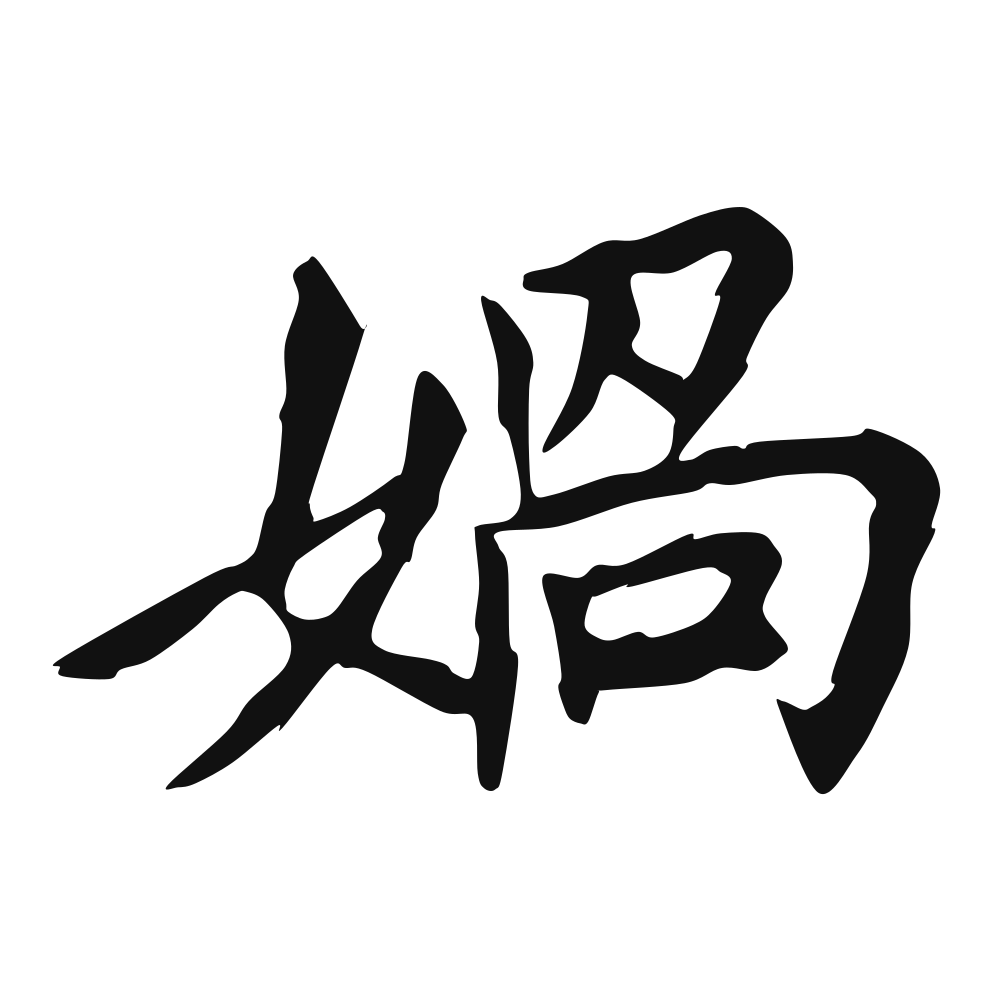
娲
surname Wa; sister of legendary emperor Fuxi 伏羲[Fu2 xi1]
Closest English meanings
Nüwa·goddess
The Calligrapher — Wáng Xiànzhī 王献之
Son of Wang Xizhi and pioneer of wild cursive who pushed brush freedom further.
Eastern Jin calligrapher (344–386), master of running script/cursive script — seventh son of Wang Xizhi who broke his father's rules for a more fluent, emotional running script; together they are 'the Two Wangs'. Eastern Jin dynasty
Etymology & Meaning · 字义溯源
### Soundwā — wā (1st tone). Often a bound morpheme — needs a partner word ### Original meaningWā (1st tone). The Shuowen Jiezi defines it as 「古之神聖女,化萬物者也。从女咼聲」 — 'the holy woman of old antiquity, who transformed the ten thousand things'; a 形聲 word, 女 (woman) for the sense, 咼 (wō) for the sound. Duan Yucai notes the pun that carries the theology: 「媧化疊韻」 — 媧 and 化 (to transform) are rhyming cognates, so the creatress's name is built from the verb for making. She is the repairer, not only the maker: 《列子·湯問》「女媧氏練五色石以補天闕」 and 《淮南子·覽冥訓》「於是女媧煉五色石以補蒼天,斷鼇足以立四極」 — she smelted the five-coloured stones to patch the torn sky and cut the legs of the great turtle to set up the four poles. She is also the patron of music: 《禮記·明堂位》「女媧之笙簧」. And she is a title before she is a person — the old commentators insist 「女媧在大庭柏皇前,亦古皇之號,非必婦人也」, 'Nüwa precedes the Dating and Bohuang rulers; it is the title of an ancient sovereign, not necessarily a woman.' That correction matters: the Shuowen says 神聖女, but the ancient sources may be recording a ruler's name, not a goddess's. ### The structure (形聲 · 从女咼聲 — woman (女) + wō (咼) as phonetic; Duan notes 媧化疊韻, the name rhymes with 'to transform')①女nǚwomanthe radical: Shuowen calls her 神聖女②咼wō(phonetic)the sound-side of the graph③化huàto transform段注: 媧化疊韻 — her name is built on making④女媧NǚwāNüwathe only form in which the character appears ### In use todayItemReading / meaningNoteReadingwā (1st tone)bound syllable; surname use also recordedCore senseNüwa, the creatress who mended the sky《说文》古之神聖女,化萬物者也Grammarbound proper-name morpheme女媧 only; a lone 娲 does not readTattoo fitcaution — wear it as 女媧, never as 娲 aloneone of the strongest myths in the language ### Closest words in English — and what each misses - Goddess — 神/女神 hold deity; 娲 is not a generic divine word — it is one name, and only inside 女媧 - Mother / Mother Earth — 母/地母 hold motherhood; the texts give Nüwa making and mending, not harvest or fertility - Creation — 創/造 hold creating; 化 is the verb Duan links her to — transformation, less architectural - Repair / Heal — 補/療 hold mending and healing; 補天 is her act, but 娲 does not mean 'to mend' on its ownAn honest note on grammar. Bound proper-name morpheme — 娲 never appears alone in text; it exists only as the second syllable of 女媧, and as a surnameWhere a Western reader can stand: 娲 (wā) is the second half of 女媧, Nüwa — the figure who, in Chinese myth, smelted five-coloured stone to patch a torn sky and set the four poles of the world on a turtle's legs, and who is credited with the first reed-pipes. The Shuowen calls her 'the hol
Cultural Story
In the classical tradition 娲 is 女媧, the goddess who molded humans from yellow clay and, when the sky cracked, melted stones to mend it and cut a turtle's legs to prop the heavens. The 淮南子 tells her deeds; later piety called her 媧皇, a sovereign mother of humankind.
Where a Western reader can stand: Nüwa (女媧) is the creatress of Chinese myth: the Shuowen calls her the holy woman of old who transformed the ten thousand things, and the 淮南子 says that when the sky tore she smelted five-coloured stone to patch it and set the four poles on a turtle's legs. Note that 娲 does not stand alone — it is only ever the second half of her name. As a tattoo it means repair, craft and primordial industry; some old commentators even doubted she was a woman at all.
Common words & phrases
- 女媧 Nüwa (goddess)
- 媧皇 Empress Nüwa
Read the story behind the character
In the modern world 女媧 remains a cultural icon. A children's book retells how she made people; a game features 女媧 as a creator-heroine, and the title 媧皇 appears in temples dedicated to her. Her myth surfaces in art and animation, a goddess who still "mends" the world in stories parents tell their kids.
Why this character belongs on skin
Before anything had a name, there was a woman kneeling at the edge of a yellow river, pressing mud into the shape of a child and laughing when it opened its eyes. Nüwa is the mother in the character 娲 — the goddess who mended a broken sky with five-colored stones, who made human beings from riverbank clay because the silence of the world bothered her. Every tattoo is a small act of that creation: pigment pressed into skin until something new looks back at you from the mirror. The ancients gave the female radical to this name because creation, in their telling, was never a thunderclap. It was patient, feminine work — mending, shaping, refusing to let the heavens leak. Carry 娲 and you carry the premise that you were kneaded on purpose, by hands that loved the material. Let it sit close to the pulse, where the first heartbeat of a clay child might have started.
Own this character
Purchase delivers the original SVG of this glyph, brushed by Wáng Xiànzhī 王献之, ready to place on skin, paper, or screen.