
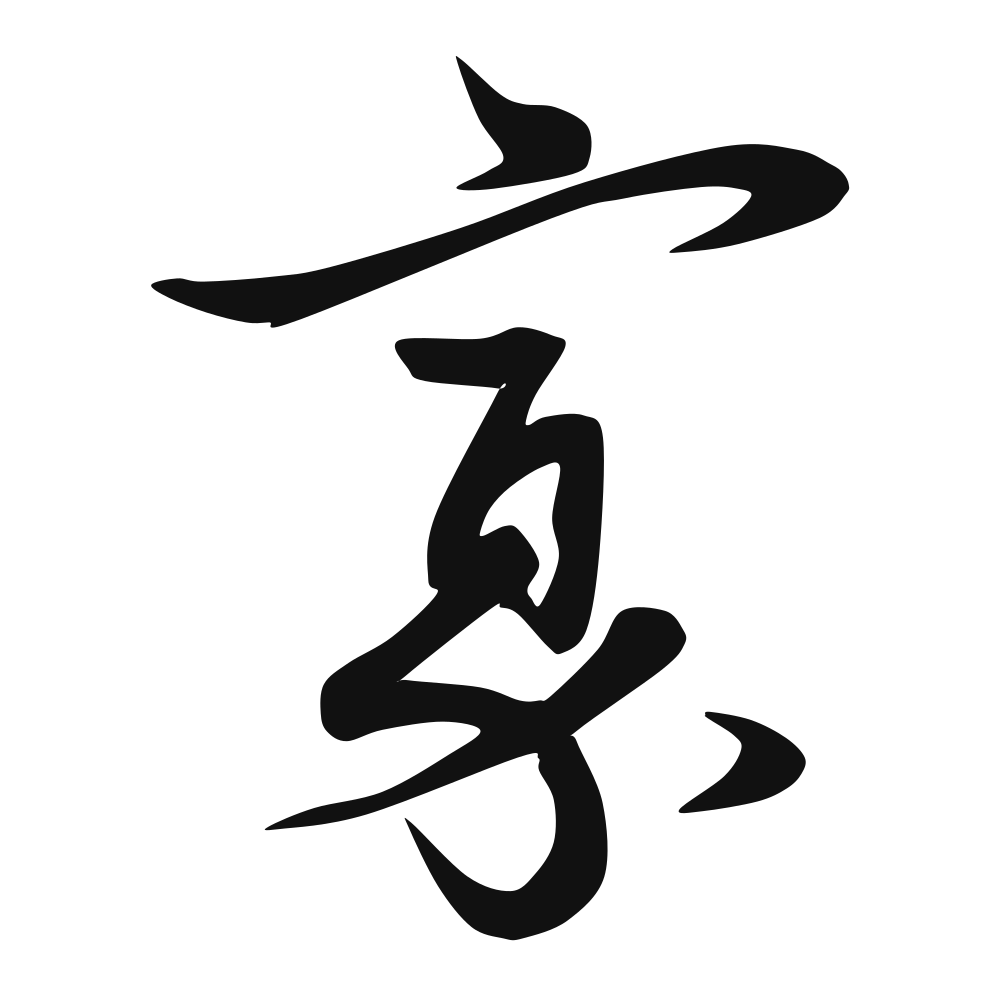
寡
few; scant; widowed
Closest English meanings
few·widow·sparse·scant·alone
The Calligrapher — Wáng Xīzhī 王羲之
The 'Sage of Calligraphy'; his running script has set the standard for 1,700 years.
Eastern Jin calligrapher (303–361), master of running script/cursive script/regular script — the Sage of Calligraphy; his Orchid Pavilion Preface is the most celebrated work in the tradition, and nearly every later master traces lineage to his hand. Eastern Jin dynasty
Cultural Story
寡 originally showed a widow — a woman alone — and the Shuowen links it to few and solitary. Rulers humbly called themselves 寡人, the solitary one, in Zhou bronze inscriptions. Confucius praised 寡言 (few words) as a sign of restraint, and the Yijing speaks of 寡过, having few faults. A 寡妇 (widow) was a figure of deep classical pity.
Common words & phrases
- 寡妇 widow · widowed · bereaved · woman
- 寡人 I (king) · solitary · lonely ruler · monarch
- 寡言 taciturn · reserved · silent · few words
- 寡头 oligarch · tycoon · monopolist · boss
- 多寡 amount · quantity · number · how many
Read the story behind the character
After a breakup your group chat goes 寡言 (taciturn) and quiet. Society measures wealth by 多寡 (quantity) of likes and cash, while an 寡头 (oligarch) controls whole industries behind closed doors. We pity the 寡妇 (widow) in the news, and a 寡人 (I, the king) joke makes you feel like ruler of your tiny apartment for a second.
Why this character belongs on skin
Laozi said the wisest among us know寡—fewness. Few words, few wants, few masters. The character originally pictured a person alone under a roof, and yes, it became the word for widow, for the empty side of the bed. But solitude and sparseness are not the same as loss. The sparse pine on the cliff is the one the painters fight to render; the few true friends outweigh the crowded room; the widow's quiet can hold more than a market's noise. There is grief in this character—honesty demands saying so—but there is also a door. Want less and the world grows vast. Keep few things and everything you keep shines. Wear your fewness like an heirloom. Ancient kings called themselves 寡人, the man of few—because rule was understood as a kind of solitude, and humility a crown you put on before the real one. It was never poverty.
Own this character
Purchase delivers the original SVG of this glyph, brushed by Wáng Xīzhī 王羲之, ready to place on skin, paper, or screen.