
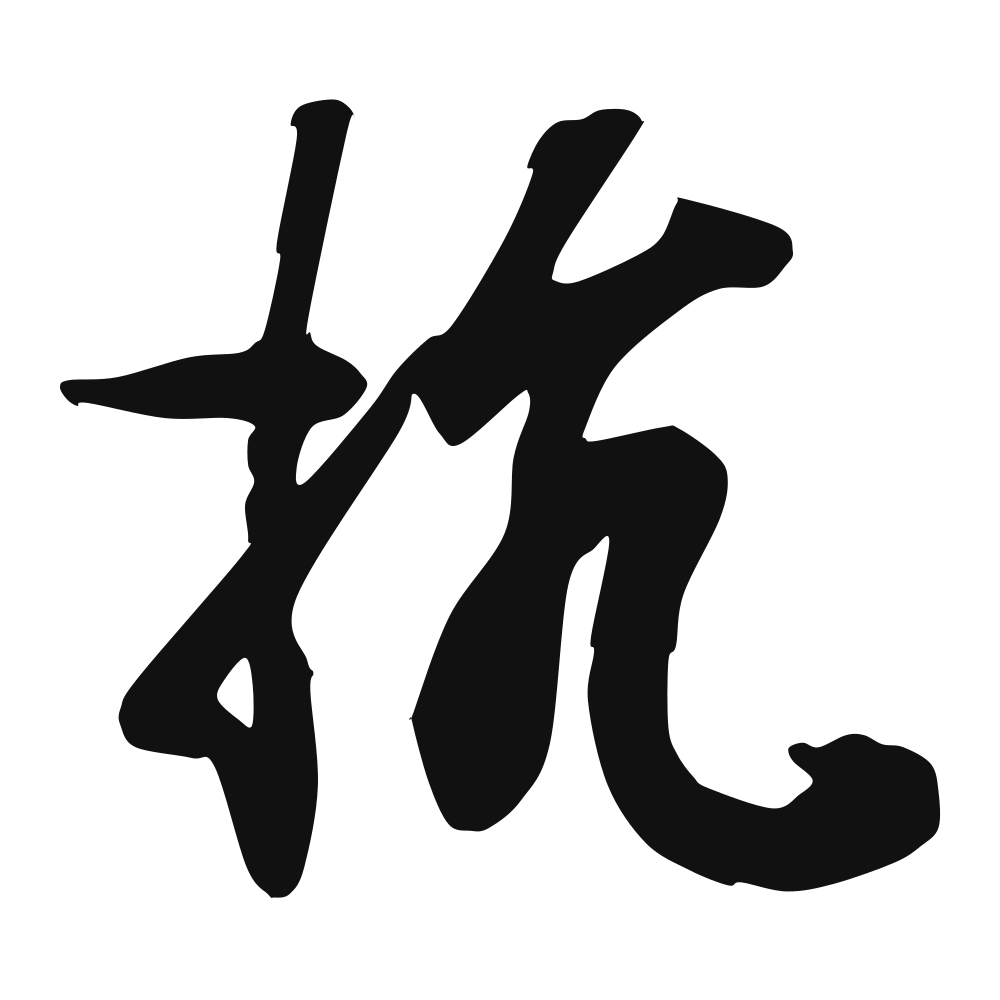
抗
to resist; to fight; to defy; anti-
Closest English meanings
resist·oppose·fight·defy·withstand
The Calligrapher — Wáng Xīzhī 王羲之
The 'Sage of Calligraphy'; his running script has set the standard for 1,700 years.
Eastern Jin calligrapher (303–361), master of running script/cursive script/regular script — the Sage of Calligraphy; his Orchid Pavilion Preface is the most celebrated work in the tradition, and nearly every later master traces lineage to his hand. Eastern Jin dynasty
Cultural Story
抗 is to stand against. The strategists used it for the border held and the appeal refused, and the word always implies a line drawn. The hand with 亢, the throat raised, is resistance spoken from the raised neck. It is the opposition that lifts its head.
Common words & phrases
- 抵抗 resist · withstand · oppose
- 抗议 protest · demonstrate
- 反抗 rebel · resist · oppose
- 抗拒 resist · defy · refuse
- 抗战 war of resistance
- 抗衡 contend against · rival
Read the story behind the character
抗 is the against-word: 抵抗 the defense, 抗议 the placard, 反抗 the revolt, 抗拒 the refusal. 抗战 is the War of Resistance every textbook names, 抗衡 the rival that matches. It names the opposition from the street to the history, the standing-up that defines a side.
Why this character belongs on skin
Some weights are meant to be borne, and some to be refused. 抗 holds both truths—to carry on the shoulder, and to rise against, to resist what would bend you flat. Its hand pushes back against the press of the world. We honor this in every language: the dissident, the patient who fights the diagnosis, the child who says no to the inheritance of cruelty. 抗 is not anger alone; it is the dignity of the upheld spine. To wear it is to mark a line you would not cross, a burden you would not accept, a stand you took when standing cost something. The ink sits like a shoulder under load, or a palm against a door. Either way it says you met the force and did not wholly yield. Resistance, made permanent, quiet, and yours.
Own this character
Purchase delivers the original SVG of this glyph, brushed by Wáng Xīzhī 王羲之, ready to place on skin, paper, or screen.