
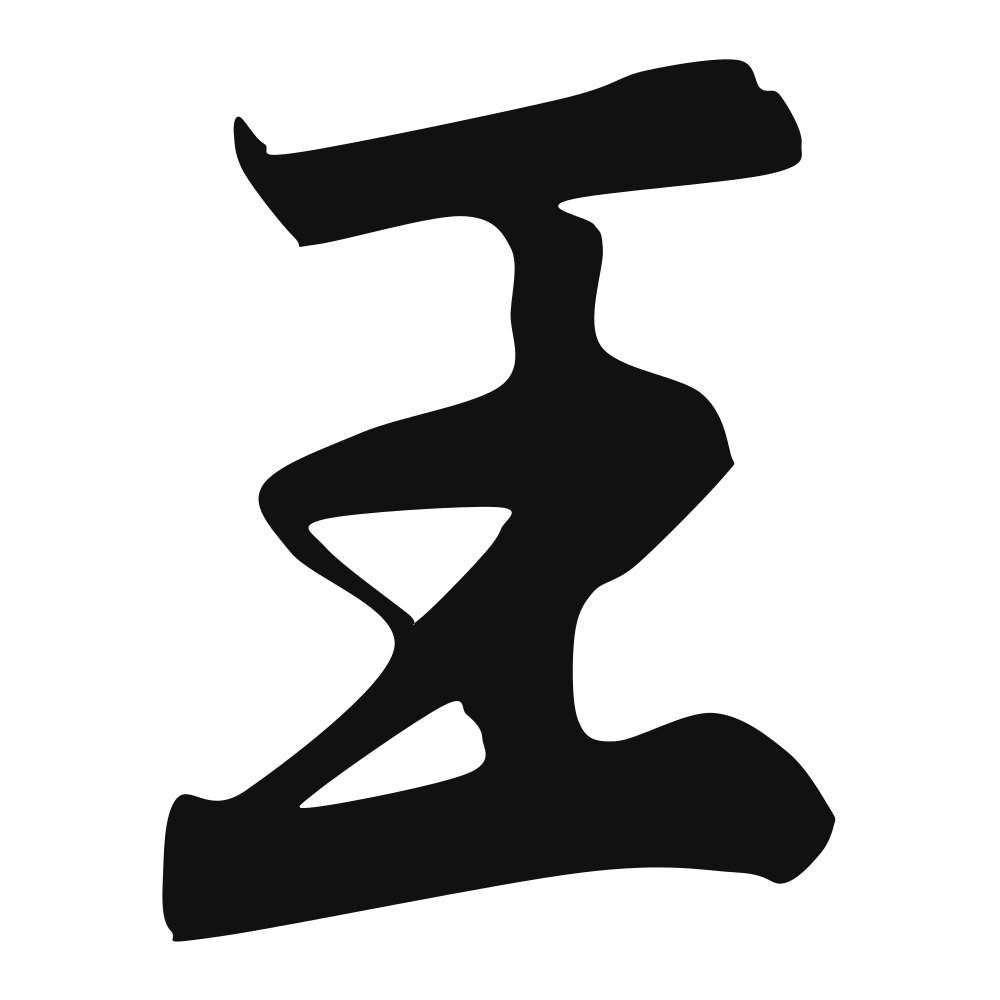
王
surname Wang; king or monarch; best or strongest of its type; grand; great; (literary) (of a monarch) to reign over (a kingdom)
Closest English meanings
king·prince·Wang (surname)·monarch·ruler
The Calligrapher — Wáng Xīzhī 王羲之
The 'Sage of Calligraphy'; his running script has set the standard for 1,700 years.
Eastern Jin calligrapher (303–361), master of running script/cursive script/regular script — the Sage of Calligraphy; his Orchid Pavilion Preface is the most celebrated work in the tradition, and nearly every later master traces lineage to his hand. Eastern Jin dynasty
Etymology & Meaning · 字义溯源
2 · The Character: 王 王 (wáng, 2nd tone) is defined in the Shuowen Jiezi through two quotations: 「王,天下所歸往也。董仲舒曰:古之造文者,三畫而連其中謂之王。三者,天、地、人也,而參通之者王也。孔子曰:一貫三為王」 — the king is 'the one all under heaven turns toward'; the three horizontal strokes are Heaven, Earth and Humanity, and the vertical is the one who threads them together. Modern palaeography disagrees: the oracle-bone graph most plausibly depicts the blade of a great axe set edge-down — authority as weapon (verify; this is the mainstream current reading, e.g. Wu Qichang and Lin Yun). 《詩·小雅·北山》 states the political claim baldly: 「溥天之下,莫非王土;率土之濱,莫非王臣」. Grammatically 王 is a free morpheme (wáng = king; wàng in classical usage = to reign). Honest disclosure with teeth: 王 is the most common surname in China. A standalone 王 reads to most Chinese speakers as 'Mr Wang' long before it reads as 'King', and worn as a boast it can look brash rather than regal.
Cultural Story
王 is the king, written in oracle bone as a line through the three realms, heaven, earth, and man. The 說文 says the 王 connects them. 詩經 and histories recount 国王 and 女王 who rose and fell, and 大王 was a title of awe from Chu to Qin.
Common words & phrases
- 国王 king · monarch · sovereign
- 王子 prince · son of a king · prince royal
- 大王 great king · monarch · chief
- 女王 queen · female monarch · queen regnant
- 王国 kingdom · realm · domain
- 王后 queen · consort · king's wife
Read the story behind the character
Kids read of a 国王 (king) in fairy tales and a 女王 (queen) on the throne; a 王子 (prince) seeks his bride. A company 大王 (great king) dominates the market, and a 王国 (kingdom) of fans forms around a star. Wang 王 is also one of China's common surnames.
Why this character belongs on skin
Three horizontal strokes crossed by one vertical: heaven, earth, and humanity pierced and held by a single will. Wáng is the king, the ruler—not by conquest but by the ancient belief that a true sovereign is the axis where all three realms meet and are governed with balance. The West imagines crown and throne; this glyph imagines responsibility, the person who stands at the center and owes harmony to everything around him. To wear wáng is not to claim dominance but to accept command over yourself—the kingship of self-mastery, the only throne worth occupying. It is a mark of sober authority, for the one who has stopped obeying everyone but the order he chooses. Let it rest at the center of the chest, a quiet character that remembers a king was first a man who learned to rule the small kingdom of his own nature, and never abdicated.
Own this character
Purchase delivers the original SVG of this glyph, brushed by Wáng Xīzhī 王羲之, ready to place on skin, paper, or screen.