
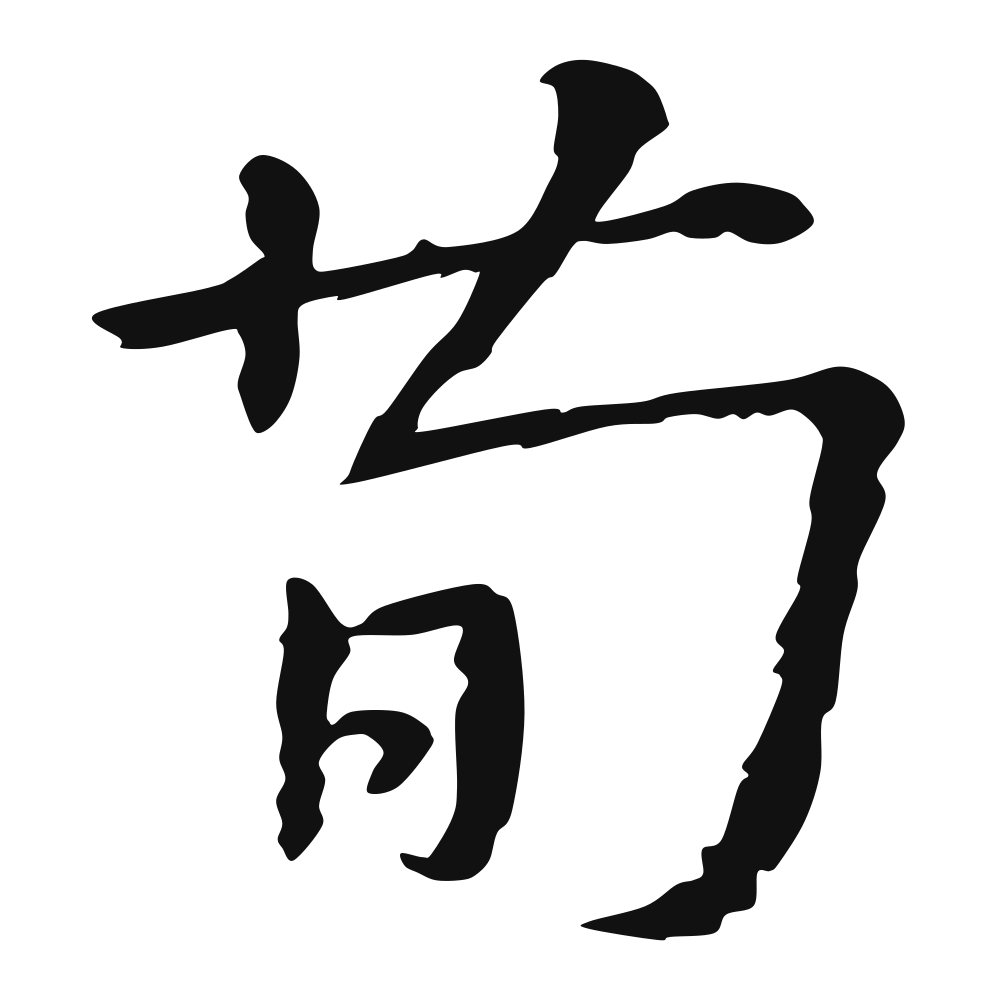
荀
surname Xun; (archaic) name of a plant mentioned in ancient texts; name of a state that existed during the Zhou dynasty in present-day Shanxi
Closest English meanings
surname Xun·Xun
The Calligrapher — Wáng Xīzhī 王羲之
The 'Sage of Calligraphy'; his running script has set the standard for 1,700 years.
Eastern Jin calligrapher (303–361), master of running script/cursive script/regular script — the Sage of Calligraphy; his Orchid Pavilion Preface is the most celebrated work in the tradition, and nearly every later master traces lineage to his hand. Eastern Jin dynasty
Cultural Story
荀 is one of China's ancient surnames, borne by a clan in Jin territory during the Zhou dynasty and by thinkers who shaped the Warring States. Its greatest name is 荀子, the philosopher Xun Kuang, who taught that human nature is raw and must be polished by ritual and study — a deliberate counterpoint to Mencius. His students included legalists and reformers, and his essays on learning remain school staples two thousand years on.
Common words & phrases
- 荀子 Xunzi (philosopher)
- 荀姓 the Xun surname
Read the story behind the character
High schoolers memorize Xunzi's line that learning must never stop, blue dye taken from the indigo plant, and then meet 荀子 again in university philosophy seminars, arguing his case for discipline against Mencius's optimism. The 荀姓 itself has grown rare; a student introducing herself on roll call still braces for the teacher's pause, then smiles when classmates jokingly bow and call her 'sage' — history's long shadow in a homeroom.
Why this character belongs on skin
荀 is a surname first— borne by Xunzi, the great Confucian realist who taught that human nature is rough and becomes good only through discipline, ritual, and long study. Against Mencius's tender optimism, Xunzi insisted on the harder, more adult faith: the crooked wood needs the straightening board; the dull blade needs the whetstone. Civilization, he argued, is not our starting point but our achievement—earned, maintained, always capable of being lost. The character also names an obscure herb, so it carries green things and grim doctrine in the same strokes. 荀 is for anyone who has made themselves: who looked at their own raw material honestly and chose the slow work of refinement over the comfortable lie of being born fine. It is self-improvement without sentimentality, virtue as carpentry. Ink it where you can see it in the morning—forearm, shoulder—so the old teacher's question meets you daily: what did the whetstone make of you today?
Own this character
Purchase delivers the original SVG of this glyph, brushed by Wáng Xīzhī 王羲之, ready to place on skin, paper, or screen.