
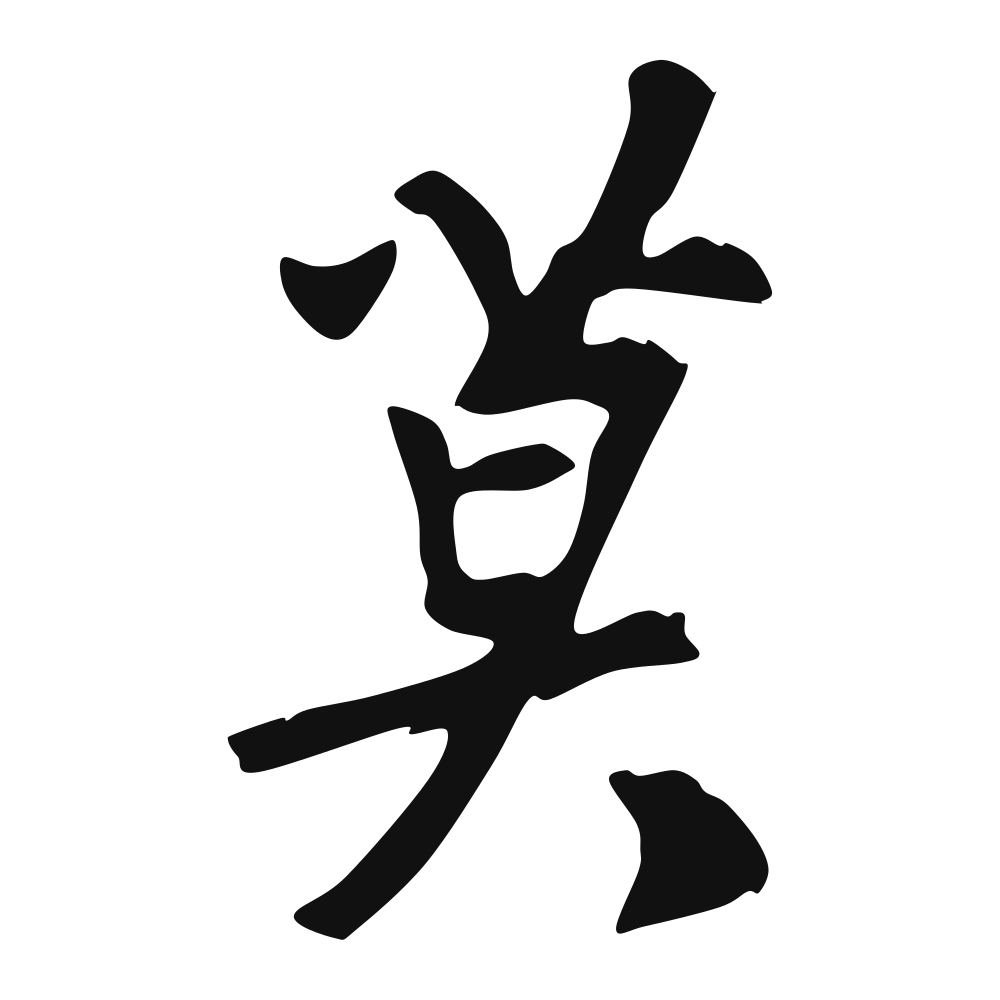
莫
surname Mo; do not; there is none who
Closest English meanings
do not·none·no one
The Calligrapher — Wáng Xīzhī 王羲之
The 'Sage of Calligraphy'; his running script has set the standard for 1,700 years.
Eastern Jin calligrapher (303–361), master of running script/cursive script/regular script — the Sage of Calligraphy; his Orchid Pavilion Preface is the most celebrated work in the tradition, and nearly every later master traces lineage to his hand. Eastern Jin dynasty
Etymology & Meaning · 字义溯源
2 · The Character: 莫 莫 (mò, 4th tone; anciently mù) is a sunset that turned into a negation. Shuowen Jiezi, chapter 1, 茻部: 莫,日且冥也。从日在茻中 — 'the sun about to go dark; the sun set inside the grass', with Duan Yucai adding 茻亦聲. It is the original graph of 暮, dusk, and the classics still use it that way: 《詩·齊風·東方未明》 不能辰夜,不夙則莫 — 'he cannot keep the hours; either too early or too late' — and 《論語·先進》 莫春者,春服既成, 'in late spring, the spring clothes being finished.' Borrowed as a universal negative, it then produced the most quoted sentence about sovereignty in Chinese: 《詩·小雅·北山》 溥天之下,莫非王土;率土之濱,莫非王臣 — 'under the wide heaven there is no land that is not the king's.' Zhuangzi uses it for scale: 天下之水,莫大於海. Strokes: 10 in modern counting; Kangxi files it under 艸部 部外7, and naming tables count 13 by reading 艹 as the full 艸. Honest disclosure: standing alone, 莫 is read first as a bare prohibition — 'do not' — or as 'there is none'. It is a function word that points at what it refuses to name. It is also a surname.
Cultural Story
莫's oldest picture is sunset: the sun sinking into grassland, 日 among 茻. That image was borrowed away for the sense 'none, no one, do not', and the dusk meaning had to re-spawn as a new character, 暮. Classical usage made 莫 the great negative — 'no one can withstand it', 'do not speak of it' — and it seeds dozens of idioms about the unknowable: 莫测, unfathomable; 莫名, beyond naming.
Where a Western reader can stand: Where a Western reader can stand: 莫 began as a picture of the sun sinking into grass (日且冥也,从日在茻中), the original graph for dusk; the words 'there is none' and 'do not' grew out of that sunset. Its most famous use is tender rather than stern — 莫失莫忘, 'lose it not, forget it not', inscribed on the jade in Dream of the Red Chamber. Wang Xizhi's spontaneous running hand suits a character whose power is atmosphere rather than grammar. Honest caveats: 莫 is a function word, so alone on skin it reads to a Chinese speaker as an unfinished sentence, a bare 'do not'; its archaic reading is 暮, dusk, placing it in the twilight register alongside 日暮途窮 ('the sun sets, the road ends'); and it is a common surname.
Common words & phrases
- 莫非 could it be · surely
- 莫大 greatest · utmost
- 莫测 unfathomable · inscrutable
- 莫如 better than · might as well
- 莫名其妙 incomprehensible · odd
Read the story behind the character
An odd notification arrives at midnight — 莫名其妙, she mutters, blocking the sender. A detective drama's trailer whispers 莫非 he knew all along?, the old interrogative doing suspense work. Your roommate, offered two internships, concludes that 莫如 take both interviews first. And a chess streamer caps a brilliant move with '妙到莫大', grammar bent by excitement in the live chat.
Own this character
Purchase delivers the original SVG of this glyph, brushed by Wáng Xīzhī 王羲之, ready to place on skin, paper, or screen.