
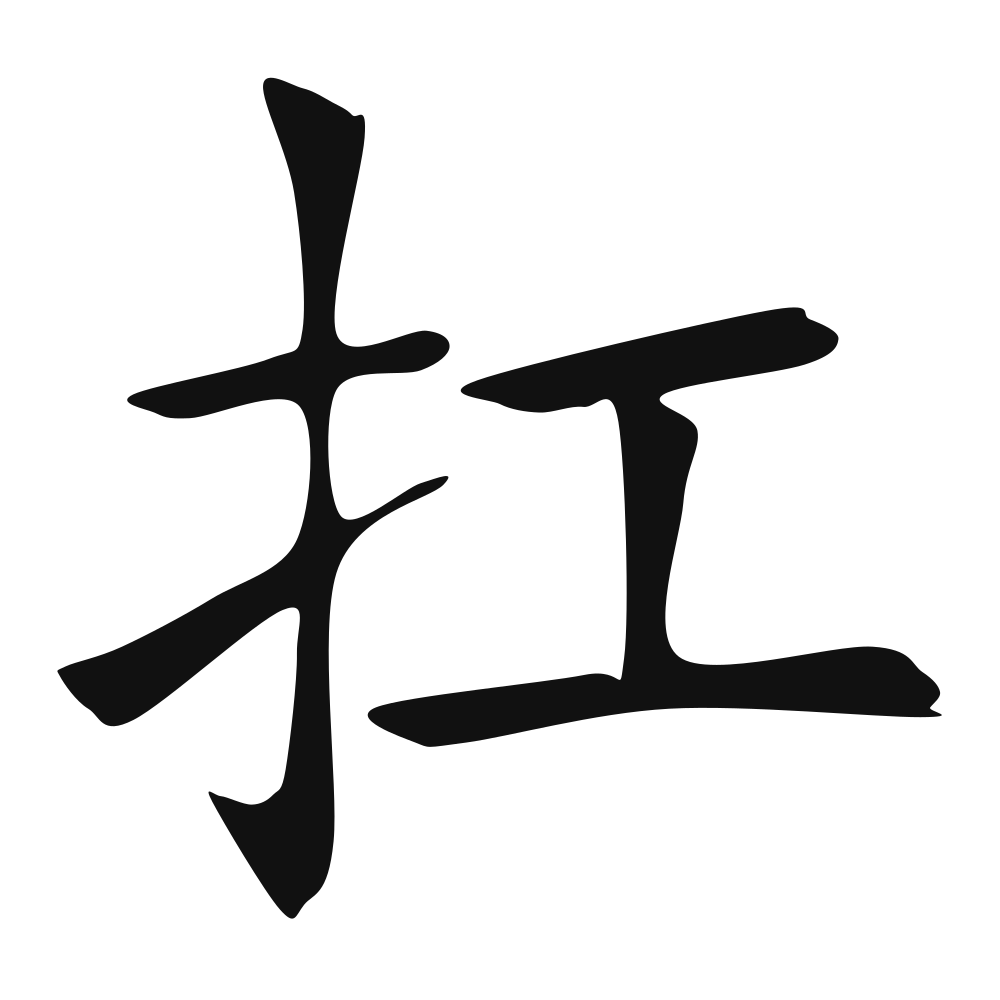
扛
to raise aloft with both hands; (of two or more people) to carry sth together; to carry on one's shoulder; (fig.) to take on (a burden, duty etc)
Closest English meanings
carry on shoulder·lift
The Calligrapher — Wèi Héng 卫恒
Jin calligrapher and theorist; author of the Four Script Forms and Their Force (Siti Shushi).
Jin calligrapher (), master of seal script/clerical script — known for 《四体书势》. Jin dynasty
Cultural Story
扛 is to shoulder a weight. The 史記 says Xiang Yu could 力能扛鼎 — lift a cauldron with his strength — and the phrase became the measure of impossible vigor. The hand with 工, a load, is the body taking the burden on its frame. It is the lift that proves the man.
Common words & phrases
- 扛着 carrying on shoulder
- 扛枪 carry a gun
- 扛活 work as laborer
- 扛鼎 lift a cauldron
Read the story behind the character
扛 is the carry and the grind: 扛着 the pole on the shoulder, 扛枪 the conscript's rifle, 扛活 the day-laborer's work. 扛鼎 is the gym boast and the historical feat. It names the load taken on the body and the labor that wears it, the strength made visible.
Why this character belongs on skin
There is a particular human humility in the shoulders — not the back that carries, but the káng, the load taken up and borne across the frame of the body itself. It is the farmer with his pole, the soldier with his mate, the child who learns that love is mostly weight you agree to hold. To shoulder is to choose the burden rather than set it down, to make your body the bridge another walks across. We glamorize the light and the free; the marked one knows the dignity of the carried load. To wear káng is to confess you have shouldered things and would again. Let it rest on the actual muscle that has borne the most, a quiet testament that you were strong enough, that the weight did not, in the end, drop you.
Own this character
Purchase delivers the original SVG of this glyph, brushed by Wèi Héng 卫恒, ready to place on skin, paper, or screen.