
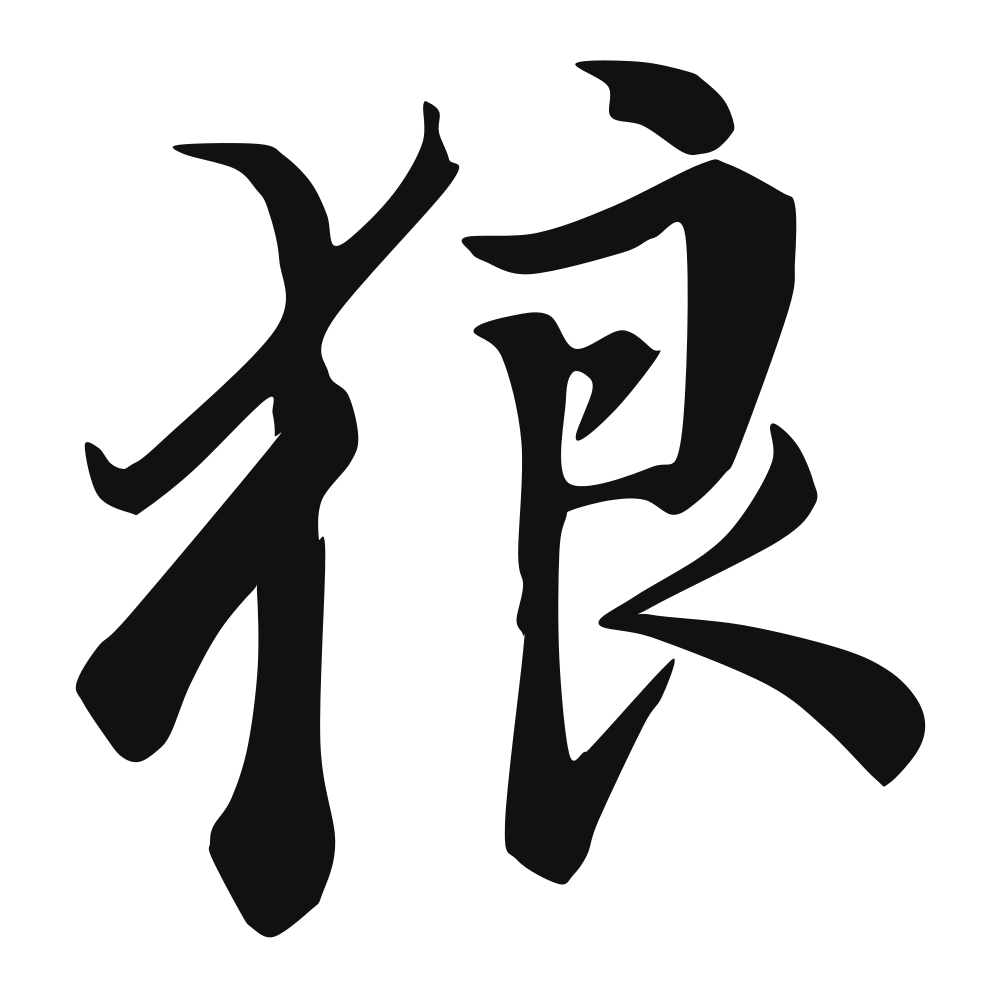
The Calligrapher — Wèi Héng 卫恒
Jin calligrapher and theorist; author of the Four Script Forms and Their Force (Siti Shushi).
Jin calligrapher (), master of seal script/clerical script — known for 《四体书势》. Jin dynasty
Cultural Story
狼 haunted the Chinese imagination as a greedy, ruthless beast; 詩經 cries '狼跋其胡' of a stumbling wolf, and 中山狼 became the proverbial ingrate who bites the hand that saves him. Wolves symbolized danger on the frontier, where 狼烟 (wolf-smoke) signal fires warned of raids.
Common words & phrases
- 狼狗 wolfdog
- 狼狈 in a difficult position
- 狼群 wolf pack
- 豺狼 jackals and wolves
- 色狼 pervert
Read the story behind the character
A guard 狼狗 (wolfdog) patrols the depot, and a hiker caught in a storm feels 狼狈 (in a difficult position), muddy and stranded. News warns of 豺狼 (jackals and wolves) in politics, while a 狼群 (wolf pack) hunts on a nature show. Sadly, 色狼 (pervert) is slang no one wants near a child.
Why this character belongs on skin
The wolf gets a bad name from those who fear the wild, but the Chinese knew it differently — as the one who loves its pack beyond reason, who runs for the ones behind it, who howls not in loneliness but in allegiance. 狼 is loyalty sharpened into instinct. To wear this character is to honor the part of you that belongs to your people and would bleed for them without a second thought. The lone wolf is a myth; real wolves are family. Carry 狼 and you are saying your fierceness has a direction — it protects, it answers the call, it never turns on its own. There is a noble savagery here, the kind that loves too much to ever be tame. The moon rises. The pack gathers. You are not alone, and you never will be.
Own this character
Purchase delivers the original SVG of this glyph, brushed by Wèi Héng 卫恒, ready to place on skin, paper, or screen.