
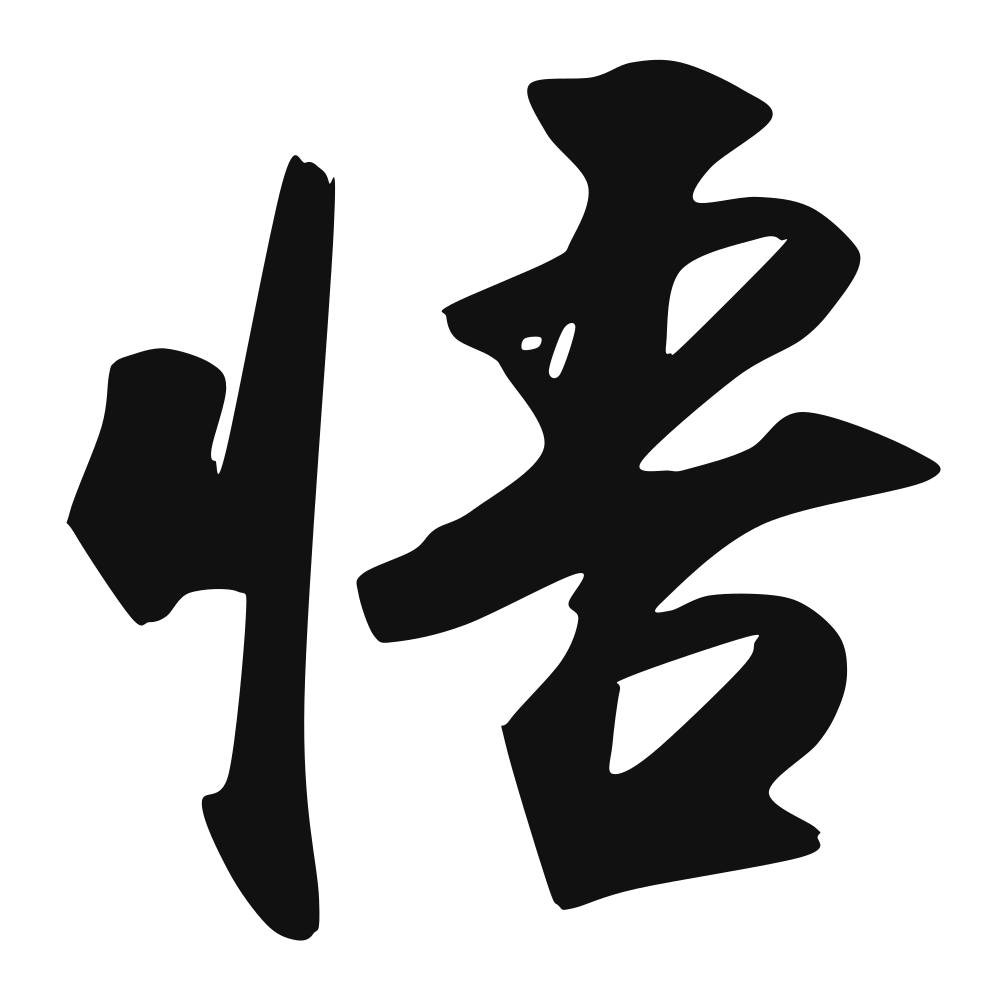
悟
悟 (wù) — to awaken, realize, comprehend. Heart radical 忄 + 吾 (self): the heart recognizing the self. Classical life: Central to Buddhist 悟 (sudden enlightenment) and Chan practice. Grammar: free morpheme — also: to comprehend; to apprehend; to become aware
Closest English meanings
realize·awaken·comprehend·understand·enlightenment
The Calligrapher — Wèi Jì 卫觊
Wei statesman and calligrapher renowned for seal and clerical script.
三国魏 calligrapher (), master of seal script/clerical script — known for 卫氏书派先声. Wei kingdom (Three Kingdoms)
Etymology & Meaning · 字义溯源
2 · The Character: 悟 Wù (4th tone). Shuowen Jiezi defines 悟 as 覺也 — 'to awaken, to realize'. The graph pairs 心 (heart/mind) with 吾 (I), the self coming to its own clarity. The cognate 寤 ('to wake') appears in 楚辭·離騷: 哲王又不寤 — 'the wise king will not wake'. In later tradition the word became central to 佛教: 慧能's 六祖壇經 teaches 迷聞經累劫,悟則剎那間 — 'lost, one wanders eons; awakened, it is but a moment' (Tang dynasty; verify exact wording). The 楚辭 also speaks of sudden clarity of heart. Kangxi counts ten strokes. Honest disclosure: 悟 is a Buddhist/Daoist term of enlightenment (satori); to a Chinese reader it reads as 'to grasp / to wake up', never as 'mistake'. Safe as a standalone tattoo meaning awakening, self-realization, or the instant of insight — pair it with 禪 (chan) or 覺 (awakening) if you want the spiritual frame explicit.
Cultural Story
悟 is the sudden righting of the mind. Buddhism made it central — 悟空, the Monkey King's name, is empty-awakened — and the 六祖慧能 spoke of 顿悟, enlightenment in a flash rather than by study. The heart with 吾, I, is the moment the self recognizes itself. It is the hinge of every Chan story.
Where a Western reader can stand: Where a Western reader can stand: 悟 is the moment of recognition — the self (吾) clarified through the heart (心) — the private instant a mind standardises itself, much as a dynasty standardises its script. Honest caveat: it is a Buddhist/Daoist enlightenment term and the exact homophone of 误 (wù, 'mistake') — opposite sense, same syllable — so pair it (禪, 覺) if the frame must be clear. Wei Ji's clerical is the foundational northern model, but his own hand survives only in the school he founded; you are wearing a described style, not a specimen.
Common words & phrases
- 觉悟 awareness · awakening · realization · consciousness
- 感悟 realize · comprehend · insight · perceive
- 领悟 comprehend · grasp · understand · apprehend
- 醒悟 wake up to · realize · see the light
- 大彻大悟 complete enlightenment · full awakening · sudden enlightenment
- 悟性 comprehension · aptitude · power of understanding
Read the story behind the character
悟 spreads from the cushion to the desk: 觉悟 political awareness, 领悟 the click when a theorem finally makes sense, 醒悟 the addict's turning point. 大彻大悟 is what self-help books promise by page two hundred. The word still carries its religious glow, but now it sells insight to people who have never sat cross-legged.
Why this character belongs on skin
The character joins "my heart" with "to understand" — 悟 is realization arriving not as study but as recognition, the way you know a face in a crowd. Buddhist awakening is sudden: the monk laughs, the bowl drops, and decades of seeking collapse into a single ordinary Tuesday. It is not gaining something new but shedding the forgetting. Wu wei, no-effort, is its cousin; 悟 is the moment the effort stops and the seeing starts. To ink it is to mark the instant you woke — from the grief, the lie, the sleep of going through motions. It is the character for the day you finally understood your own life. Wear it not as a goal but as a tombstone for the person you used to be, and a door for the one still becoming.
Own this character
Purchase delivers the original SVG of this glyph, brushed by Wèi Jì 卫觊, ready to place on skin, paper, or screen.