
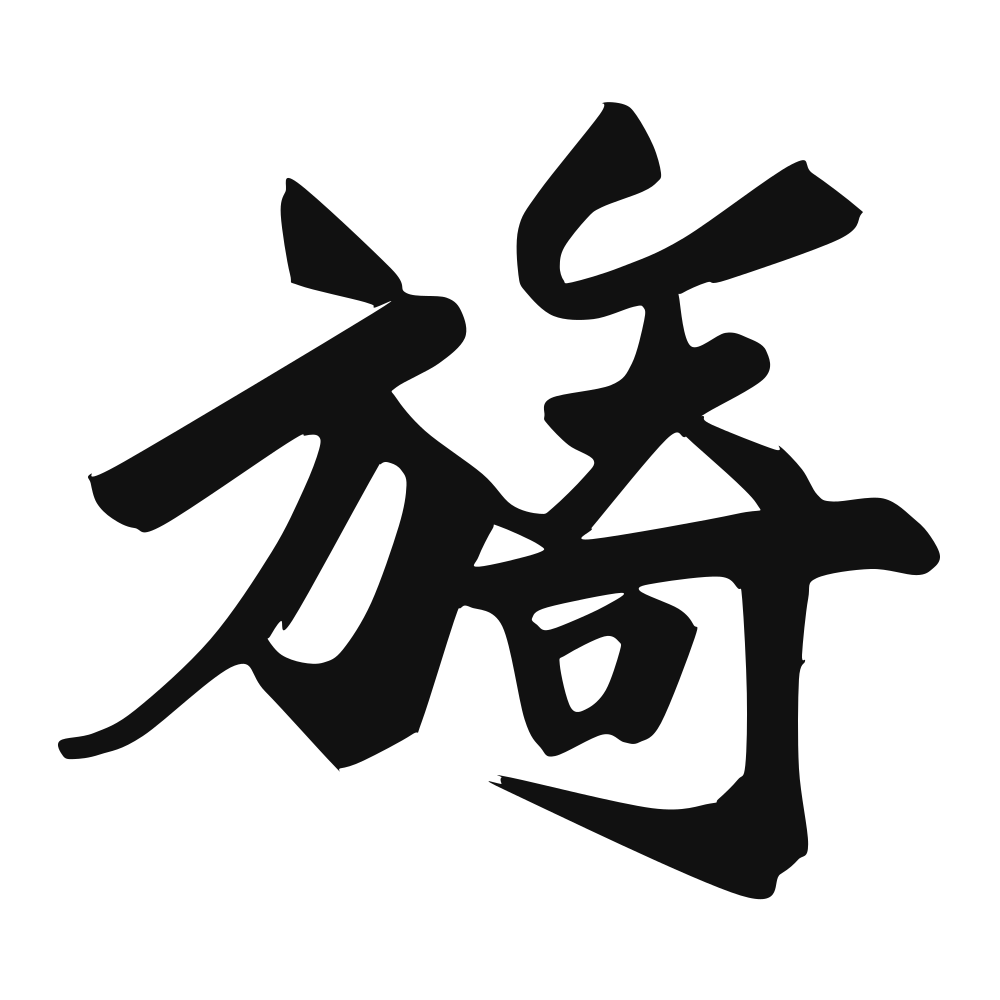
旖
usually seen in: (literary) charming; enchanting; picturesque (旖旎); (idiom) idyllic scenery; picturesque landscape (风光旖旎)
Closest English meanings
graceful·fluttering
The Calligrapher — Wèi Qīwú 魏栖梧
Tang calligrapher of regular script, follower of the Chu Suiliang style.
Tang calligrapher (), master of regular script — known for 《善才寺碑》. Tang dynasty
Etymology & Meaning · 字义溯源
2 · The Character: 旖 Yi (3rd tone). The Shuowen Jiezi reads 「旖, 旗旖施也」 — the soft, swaying appearance of a banner; it is the first half of 旖旎, 'gentle and graceful'. Duan Yucai links it to 施 (streaming). The word lives almost only in 旖旎: the Chuci, Nine Arguments, sings 「纷旖旎乎都房」 (lush and graceful in the capital's bowers), and Yang Xiong's Gan Quan Fu praises 「旖旎光苾」 (graceful, bright, fragrant). Name-lore assigns Earth (土) and fourteen Kangxi strokes (方部). As a free morpheme 旖 is rare and almost never stands alone — it needs 旎. Honest route: a lone 旖 will look incomplete to any Chinese reader; either carve the pair 旖旎 or choose a self-sufficient graceful word. If used, frame it as 'grace in motion', the streaming banner's soft curve.
Cultural Story
旖, like its twin 旎, lives only in 旖旎. The fu poets set 旖旎 on the willow and the dancer's sleeve; the word flutters more than it means. It is pure atmospheric adornment, a syllable for the soft and the swaying, content to do no work but lend its partner a breeze. Alone it is silent.
Where a Western reader can stand: Where a Western reader can stand: 旖 is the banner leaning softly in the wind — half of 旖旎, 'gentle and graceful'. Alone it looks unfinished, a word waiting for its twin. Wei Qiwu's clean Tang stele regular is real, but the honesty that matters is the character's: carve 旖旎 as a pair, or choose a self-sufficient graph.
Common words & phrases
- 旖旎 graceful · charming
Read the story behind the character
旖 is never said except as 旖旎 — the misted cove, the slow song, the hotel's 'graceful' spa. It has no job outside that one pairing. The word is decorative weather, borrowed by copywriters and kept by the anthology, a flutter of sound attached to beauty and to nothing else that stands alone. Beauty, and then the book closes.
Why this character belongs on skin
旖 never travels alone. It lives inside 旖旎, a word for beauty that moves, silk in a draft, willows swaying over slow water, the particular charm of a woman who knows her own effect. The radical is the banner: cloth on a pole, catching wind. So the character is literally loveliness in motion, grace that exists only because it yields. There is a lesson dressed in the flirtation. Laozi says the soft overcomes the hard, that water carves canyons no hammer could score. Charm is a strategy of the same wisdom: influence that never announces itself, power that arrives like perfume. To wear 旖 is to claim that register on purpose, the confidence that doesn't raise its voice, the sensuality that suggests rather than declares. Ink it along the curve of a shoulder blade or the inside of an arm, places that move when you do. Because the character is only true in motion. Stillness fails it. You were made to walk through rooms leaving weather behind.
Own this character
Purchase delivers the original SVG of this glyph, brushed by Wèi Qīwú 魏栖梧, ready to place on skin, paper, or screen.