
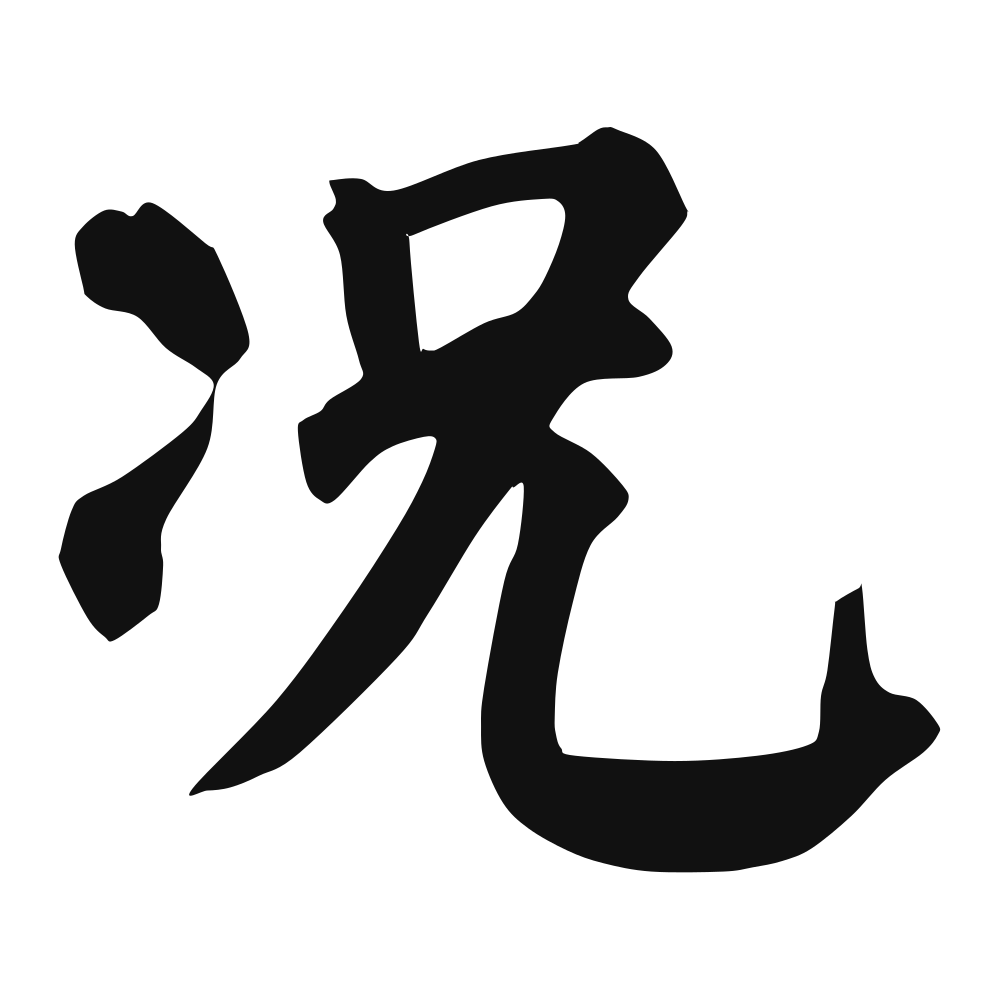
况
moreover; situation
Closest English meanings
condition·situation·moreover
The Calligrapher — Wēi Sù 危素
Yuan scholar and calligrapher of refined regular script.
Yuan calligrapher (), master of regular script — known for 《陈氏方寸楼记》. Yuan dynasty
Etymology & Meaning · 字义溯源
2 · The Character: 况 Kuàng (4th tone). 况 (the simplified form of 況) carries two main senses. The first is 'situation, condition, state of affairs,' as in 情况, 状况, 况且 ('besides, moreover'). The second, older, is the adversative 'all the more / and yet,' as in 何况 ('how much more'), a word that invites the reader to complete a comparison. The Shuowen gives its root as 「況,寒水也。从仌兄聲」 — 'cold water,' built from 仌 (ice) and 兄 (elder brother) as sound. So the character began as a picture of cold water and was borrowed, phonetically, for the abstract 'situation.' Honest disclosure: as a tattoo, 况 is unusual alone — it reads as 'the situation,' which is abstract; wearers usually intend 何况, a quiet contemplative fragment, or pair it (情况, 况且).
Cultural Story
The form set a spring and a shape, 况, a state of things, and 'moreover'. The Odes ask 况 how a friend fares afar. The memos of the Han court opened with 情况, the facts on the ground. To say 何况 was to add weight to a case already made. The word ranked the world before it linked it.
Where a Western reader can stand: Where a Western reader can stand: 况 (kuàng) means 'situation' or 'condition' (as in 情况), and — in the phrase 何况 — 'all the more' or 'and yet besides.' Its written form is a phono-semantic compound: 仌 'ice' for meaning (the Shuowen gives its root as 'cold water') and 兄 'elder brother' for sound. As a tattoo, 况 is unusual on its own: it reads as 'the situation,' which is abstract. Many wearers instead intend 何况 — a quiet, philosophical 'and what is more,' a fragment that invites the reader to complete the thought. Here 况 is set in the composed, archaic regular script of Wei Su (危素, late Yuan–early Ming), the historian-scholar who served both courts and wrote with calm restraint — a scholar's mark rather than a loud statement. Be honest: alone, 况 is not a nature, virtue, or name word; its archaic root 寒水 ('cold water') is not its modern sense.
Common words & phrases
- 情况 situation · circumstances
- 状况 condition · state
- 况且 moreover · besides
- 实况 actual situation · live
- 现状 current situation · status quo
- 何况 let alone · much less
Read the story behind the character
A report states the 情况 plainly; the 状况 of the patient is stable. The note adds 况且, the train is late. The feed shows 实况 of the match; the 现状 of the road is a dig. The word 何况 means let alone; the clerk uses it to close a point no one disputes.
Why this character belongs on skin
And besides — there is the matter of how things actually stand. Kuàng is the deeper condition beneath the surface report, the 'moreover' that corrects a pretty story with a plainer truth. The old scholars used it to press a point home: the river is wide, and moreover, it is cold; the year was hard, and moreover, it was not the hardest. It is the word of someone who insists on seeing the whole weather before speaking. To live with kuàng is to refuse easy comfort, to hold the fuller picture even when it weighs. There is a Buddhist honesty in it — the situation is the situation, and resisting its shape is its own suffering. To carry this character is to vow that you will face the moreover of your life without flinching. Let it lie along the inner arm, where you read your own fortunes, a quiet mark that you looked at the truth and stayed.
Own this character
Purchase delivers the original SVG of this glyph, brushed by Wēi Sù 危素, ready to place on skin, paper, or screen.