
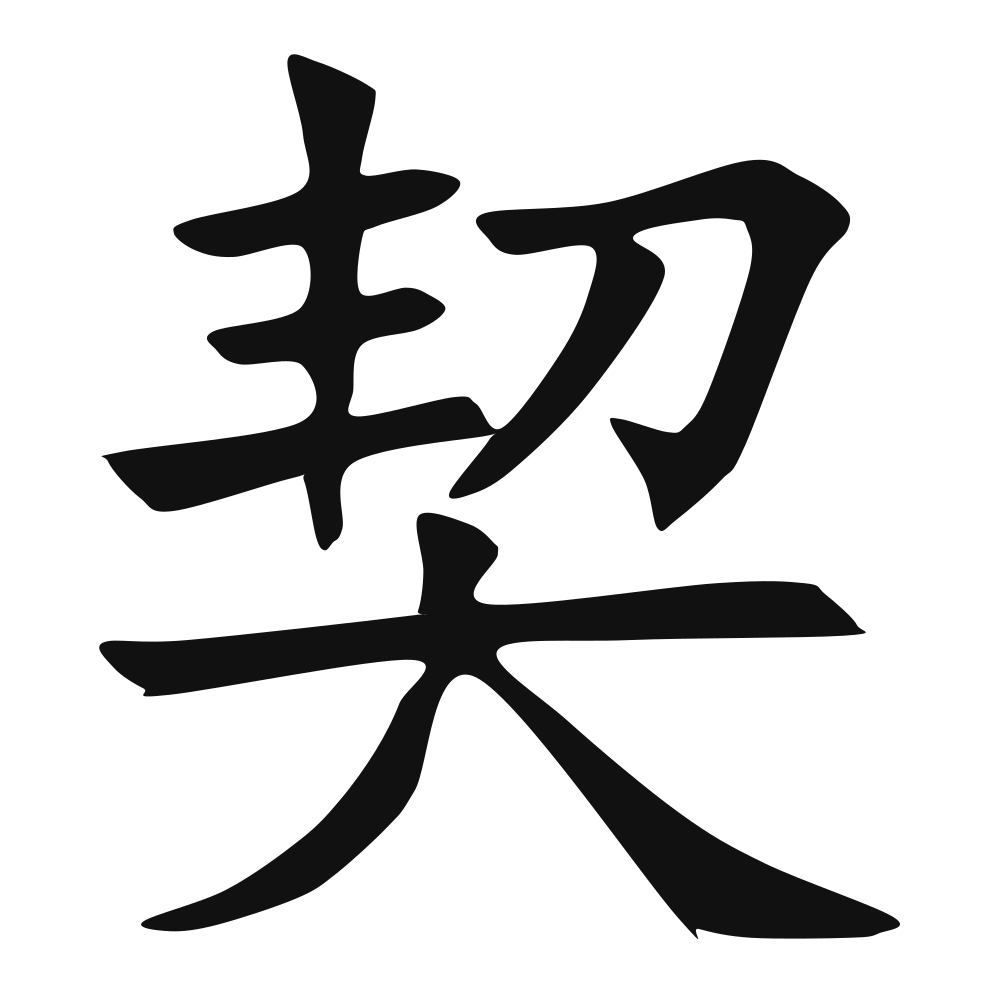
契
to carve; carved words; to agree; a contract; a deed
Closest English meanings
contract·agree·pact·engrave
The Calligrapher — Yà Qī 亚栖
Tang monk calligrapher of cursive script, heir to Zhang Xu's manner.
Tang calligrapher (), master of cursive script — known for 禅僧书家. Tang dynasty
Etymology & Meaning · 字义溯源
2 · The Character: 契 契 (qì, 4th tone). Shuowen Jiezi: 契,大約也。从大从㓞 — 'a great covenant; from 大 and 㓞 (to cut).' The graph remembers the technology: agreements were notched into wood or bone and split, each party keeping a half that could only match one other half. The Yijing dates the practice: 《易·繫辭下》 '上古結繩而治,後世聖人易之以書契' — high antiquity governed by knotted cords; later sages replaced these with written tallies. The Liji shows the etiquette: 《禮記·曲禮上》 '獻粟者執右契' — the grain-giver holds the right-hand tally. From physical matching came 默契, wordless accord, and Tao Yuanming's 高舉尋吾契 — 'I rise to seek my true match.' Honest disclosure: three readings (qì contract, qiè in 契闊, xiè the Shang ancestor); modern 契 first reads as a legal deed (房契, title deed); and its most famous line, 《詩·邶風·擊鼓》 '死生契闊,與子成說', binds it to 死 and to parting.
Cultural Story
契 means a contract and to carve a mark. The 周礼 recorded 契约 (deeds) cut into bamboo slips for the land; the 契丹 (Khitan) founded the Liao dynasty in the north. 默契 (tacit understanding) bonded a 三国 (Three Kingdoms) sworn brotherhood without words; 契机 (turning point) opened a 史记 rise from exile. The character is the mark cut to bind two parties.
Where a Western reader can stand: Where a Western reader can stand: 'covenant' — and especially 默契, the wordless accord that needs no tally, written in the wild cursive of the monk who argued that forms must vary endlessly. Honest caveats: 契 first reads as a property deed, it has three readings, and 死生契阔 sits beside death and parting.
Common words & phrases
- 契约 contract · deed · agreement
- 默契 tacit understanding · rapport · unspoken
- 契机 turning point · opportunity · juncture
- 契合 agree with · suit · tally · match
- 契丹 Khitan · Qidan
Read the story behind the character
A 契约 (contract) signs a lease on the apartment; 默契 (rapport) clicks between teammates in a match. 契机 (turning point) starts a career after one good meeting; 契合 (match) a dating app suggests by interest. Startup decks lean on 契机 to sell the pivot; 契丹 (Khitan) appears in the history class. The word still cuts the bond — legal, personal, historical.
Why this character belongs on skin
契 is the old word for the pact cut into bone — a contract, yes, but deeper, a bond sealed so the two halves fit like broken jade made whole. 契合 is when something aligns so perfectly there is no seam left, no arguing with the fit. You have felt it: the friend who finished your sentence across a crowded room, the lover whose hand in yours felt less like holding and more like recognizing. We queer people are experts in 契 — we forge our truest bonds by choice, not by accident of birth, and we guard them. This character is the vow made visible, the cut that joins instead of wounds. Wear it where only your person will know to look, or where you both do. It says the bond is real, it was chosen, and it was carved to last longer than the things that tried to keep us apart.
Own this character
Purchase delivers the original SVG of this glyph, brushed by Yà Qī 亚栖, ready to place on skin, paper, or screen.