
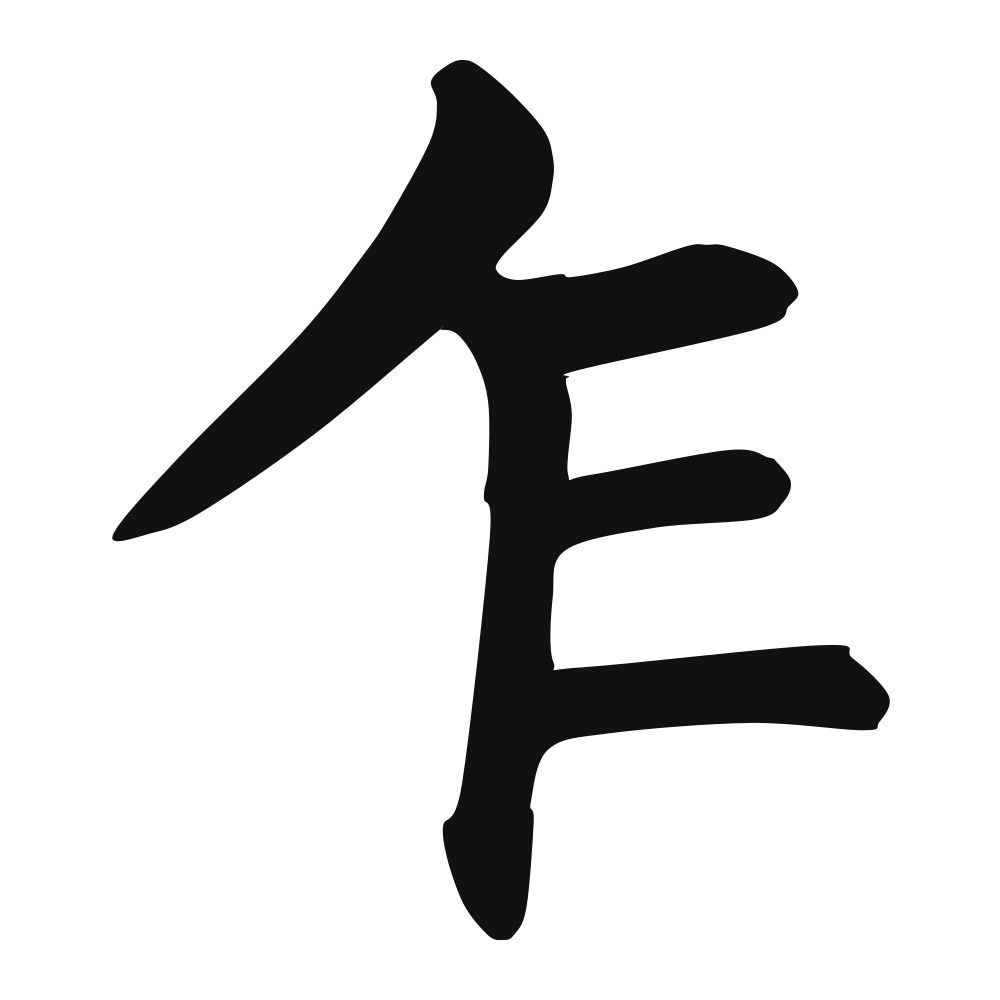
乍
at first; suddenly; abruptly; to spread; (of hair) to stand on end; bristling
Closest English meanings
suddenly·at first·just
The Calligrapher — Yán Zhēnqīng 颜真卿
Tang master of robust regular script; co-creator of the enduring 'Yan style'.
Tang calligrapher (709–784), master of regular script/running script — the Tang moral paragon whose upright, muscular regular script became the model of Chinese integrity in writing. Tang dynasty
Etymology & Meaning · 字义溯源
### Soundzhà — zhà (4th tone). Often a bound morpheme — needs a partner word ### Original meaningZhà (4th tone). The Shuowen Jiezi is visibly uncertain here: 「乍,止也,一曰亡也。从亡从一」, with 徐鍇's gloss 「出亡得一則止,暫止也」 — 'a fugitive who finds something stops; a temporary stop'. 段玉裁 rewrites the entry as 「止亡䛐也」 — 'the exclamation that stops a runaway' — and flatly denies that 乍 ever meant 'to perish': 「乍無亡義」. From that halting comes the sense everyone knows, 《廣雅》「乍,暫也」 — 'sudden, brief'. Its classical home is 《孟子·公孫丑上》「今人乍見孺子將入於井,皆有怵惕惻隱之心」 — 'if a man suddenly sees a child about to fall into a well, his heart is struck with alarm and compassion'. 《左傳》 has 「桓子乍謂林楚」 in the same sense. There is a second, separate fact: on Shang and Zhou bronzes 乍 is 作 — 《集韻》「卽各切。同作。三代鼎文款識,作皆書爲乍」, so every 'made for X' cast on a bronze is written 乍. Kangxi: 5 strokes (丿部 + 4). ### The structure (會意 · 从亡从一 (Shuowen); 段玉裁 reads it as 「止亡詞也」 — the word that halts a runaway; on bronze the same shape is 作, 'to make')①亡wángto flee / to vanishthe component Xu Shen names; 段玉裁 denies it carries its meaning here②一yīthe obstacle「有所礙也」 — the thing that stops the running③乍zhàsuddenly / just nowthe sense used in 孟子, 左傳 and all later prose④作zuòto makethe bronze value of the same graph: 作皆書爲乍 ### In use todayItemReading / meaningNoteReadingzhà (4th tone)bronze/literary reading zuò when it stands for 作Core sensesuddenly; just now; for the first timealso 'to spread / to brace' in colloquial 乍着膽子Grammaradverb (function word)乍冷乍熱 now cold now hot · 初來乍到 just arrived · 乍一見 at first sightTattoo fitcaution — an adverb, not a thingreads as 'suddenly'; pair it (乍見 / 初來乍到) if you want a scene ### Closest words in English — and what each misses - Sudden — 乍 is the adverb, not the quality; 驟/忽 carry 'sudden' as a description of an event - Begin — 初/始 hold 'to begin'; 乍 is a point in time — 'just now, for the first time' — not a beginning in itself - Make — 作 (zuò) holds 'to make', and bronzes do write 乍 for it — but that is a bronze-usage fact, not 乍's meaning in any text - Flee — 亡 holds 'to flee / to perish'; 段玉裁 expressly denies that 乍 means 亡 — it is the word that stops the fleeingAn honest note on grammar. Adverb in classical and modern Chinese (乍冷乍熱, 初來乍到); on bronze inscriptions the same graph serves as 作 (zuò, 'to make'); also a surnameWhere a Western reader can stand: 乍 (zhà) means 'suddenly' — the instant something happens before you have thought about it. Mencius used it for the man who suddenly sees a child at a well edge; you can still hear it in 乍冷乍熱 ('now cold, now hot'). On Shang and Zhou bronzes the
Cultural Story
乍 is an old pictograph of a thing standing out abruptly, suddenly, at the first moment. The 詩經 uses it for the shock of recognition, 乍見. A cook 乍寒 turns the stove down at the first cold. The 說文 reads it as stop, then begin. It is the word for the instant something appears before you have composed yourself, the jump, the first glance, the just-now.
Where a Western reader can stand: 乍 (zhà) means 'suddenly' — the instant something happens before you think. Mencius used it for the man who suddenly sees a child at a well; on ancient bronzes the same shape was written for 作, 'to make'. It is a function word, not an image. As a tattoo it marks a single decisive moment, and it should be worn as part of a phrase, not alone.
Common words & phrases
- 乍看 at first glance
- 乍然 suddenly
- 初乍 at first
Read the story behind the character
乍看 is what you say squinting at a price, at first glance it looks cheap. 乍然 is the sudden rain, the sudden silence. The lone 乍 is rare; it survives glued to these few words, the literary cousin of 突然. You meet it in written descriptions and weather reports more than speech. It still means the unplanned moment, the thing that was not there and now is, before you have decided how to feel.
Why this character belongs on skin
Things begin before we are ready. 乍 is that beginning — the sudden, the first uncertain move, the way a thing appears all at once after a long flat nothing. The old form showed a man stepping out, the first step into the open, tentative and abrupt. It carries the shock of the new: 初乍, the first raw moment of anything. To wear 乍 is to honor the jolt, the mark of a person who has been surprised by life and chose not to look away. We do not ease into most of what changes us. We are struck, we step out, we begin. Ink it where the pulse jumps. Let it remember the instant everything shifted — and the strange, brave relief of knowing the stillness is over, finally, and the real thing has started.
Own this character
Purchase delivers the original SVG of this glyph, brushed by Yán Zhēnqīng 颜真卿, ready to place on skin, paper, or screen.