
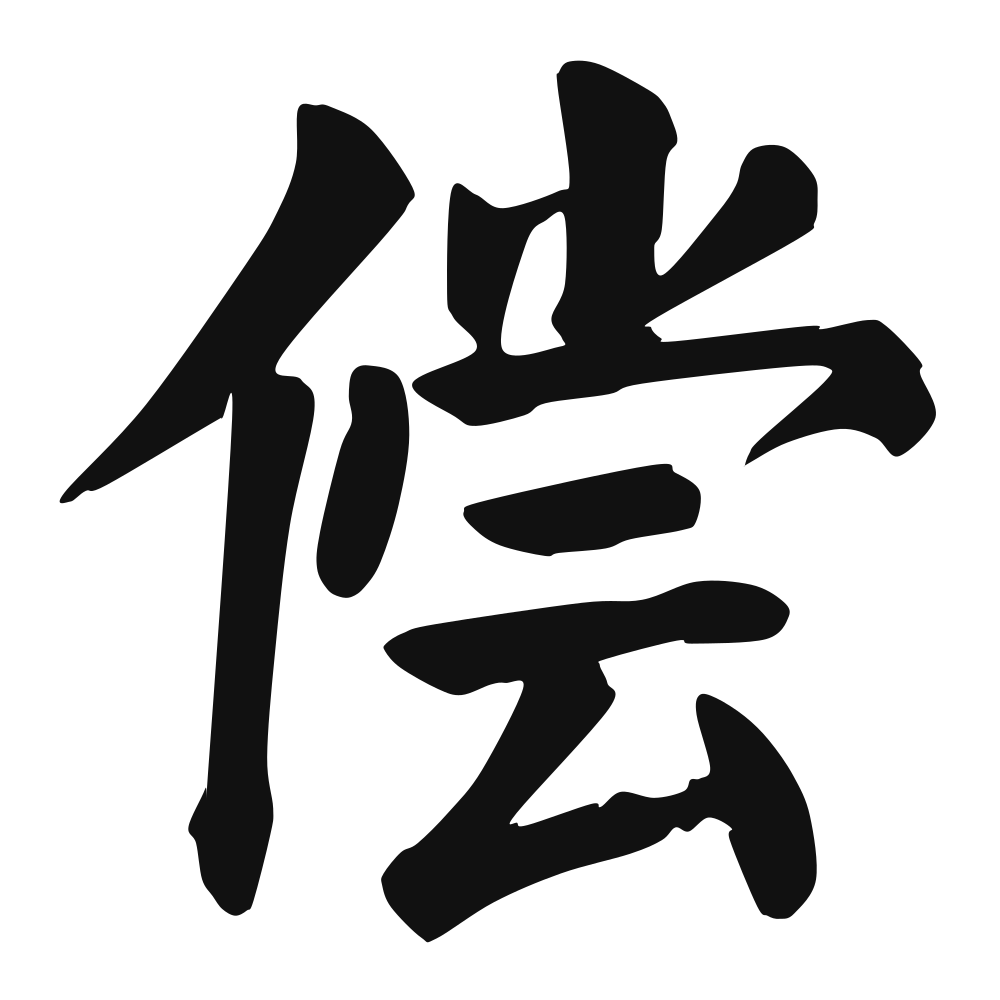
償
to repay; to compensate for; to recompense; to fulfill (hopes etc)
Closest English meanings
repay·compensate·recompense
The Calligrapher — Yán Zhēnqīng 颜真卿
Tang master of robust regular script; co-creator of the enduring 'Yan style'.
Tang calligrapher (709–784), master of regular script/running script — the Tang moral paragon whose upright, muscular regular script became the model of Chinese integrity in writing. Tang dynasty
Etymology & Meaning · 字义溯源
### Soundcháng — cháng (2nd tone). Often a bound morpheme — needs a partner word ### Original meaningCháng (2nd tone). The Shuowen Jiezi defines it as 「還也。从人賞聲」 — 'to give back', a person radical with 賞 as phonetic; the phonetic carries its own meaning, since 賞 is 'to bestow'. Duan Yucai's gloss points straight at the classical usage: 「《廣雅》曰:復也。《左傳》:西鄰責言,不可償也。杜云:不可報償」. That line is 《左傳·僖公十五年》 — 'the neighbour to the west has words of blame that cannot be answered' — and it sets the tone of the character: 償 answers. It answers a debt (《戰國策·齊策四》「使吏召諸民當償者悉來合券」 — the clerk calls in every debtor to match tallies), it answers an injury (《史記·廉頗藺相如列傳》「相如視秦王無意償趙城」 — Xiang Ru saw the king had no intention of handing over the promised cities), and it answers a wish (償願, 如願以償 — the vow fulfilled, 'as one wished, so it was repaid'). The Han anecdote the Kangxi quotes is charming and exact: 「《前漢·雋不疑傳》:不疑爲郎,或誤持同舍郎金去……不疑買金償之」 — a man wrongly accused of taking gold simply bought gold and replaced it. There is nothing mystical in this character. It is accounts, kept honestly. ### The structure (形聲 · 从人,賞聲 — 'to bestow' with a person beside it; the character for giving back what was bestowed)①人rénpersonsomeone owing, someone answering②賞shǎngto bestow / rewardthe phonetic, itself a word for giving③償chángto give backthe Shuowen headword: 還也④償願chángyuànto discharge a vowthe warm use — the vow paid off rather than merely wished ### In use todayItemReading / meaningNoteReadingcháng (2nd tone)single syllableCore senseto repay; to compensate《廣雅》: 復也 — to answerGrammarbound morpheme (verb)償還 · 賠償 · 如願以償 · 償命Tattoo fitcaution — honest but transactionalfine for 'I pay what I owe'; wrong for a blessing ### Closest words in English — and what each misses - Gift / Generosity — 賜/惠 hold giving freely; 償 is giving back what was owed - Forgiveness — 恕/寬 hold release from debt; 償 assumes the debt still stands - Justice — 義/正 hold rightness; 償 is only the settling, right or wrong - Wish fulfilled — 『如願以償』 really does mean this, but through repayment — the idiom is not a charmAn honest note on grammar. Bound morpheme: 償還 to repay · 賠償 to compensate · 如願以償 to have one's wish fulfilled · 償願 to discharge a vow. Also a rare surname.Where a Western reader can stand: 償 (cháng) means 'to repay' — to answer a debt, a wrong, or a vow. The Shuowen defines it simply as 'to give back', and the classical quotations are all about answering: a state's unanswerable blame in 《左傳》, debtors called in to match their tallies, a bronze no longer needed once gold was quietly replaced. There is a kind use — 償願 and
Cultural Story
The Tang Code set out clauses of 备偿, requiring a wrongdoer to make good the property he damaged or lost — a broken jar, a strayed beast, a burned granary. The magistrate's scale measured the loss and fixed the 償. The word was the law's arithmetic of repair, the settled answer to harm done in coin rather than in kind.
Where a Western reader can stand: 償 (cháng) means 'to repay' — to answer a debt, a wrong, or a vow. The Shuowen defines it simply as 'to give back', and the classical quotations are all about answering: debtors called in to match their tallies, gold quietly replaced under a false accusation. There is a kind use — 償願 and 如願以償, the vow discharged — but even that is warm because an obligation was honoured. As a tattoo it reads as responsibility, not good fortune: the sort of mark worn by someone who pays what they owe.
Common words & phrases
- 補償 compensate
- 賠償 compensate · indemnify
- 償還 repay · return
- 報償 reward · recompense
- 無償 free · gratis
Read the story behind the character
The court orders 賠償 for the spoiled goods; the insurer pays 補償 by Friday. The debtor 償還 the loan, and the win brings a 報償 of praise. The word still means making good — a payout, a refund — the settling of accounts that follows every loss, whether in the contract, the clinic, or the quiet 無償 gift between friends.
Own this character
Purchase delivers the original SVG of this glyph, brushed by Yán Zhēnqīng 颜真卿, ready to place on skin, paper, or screen.