
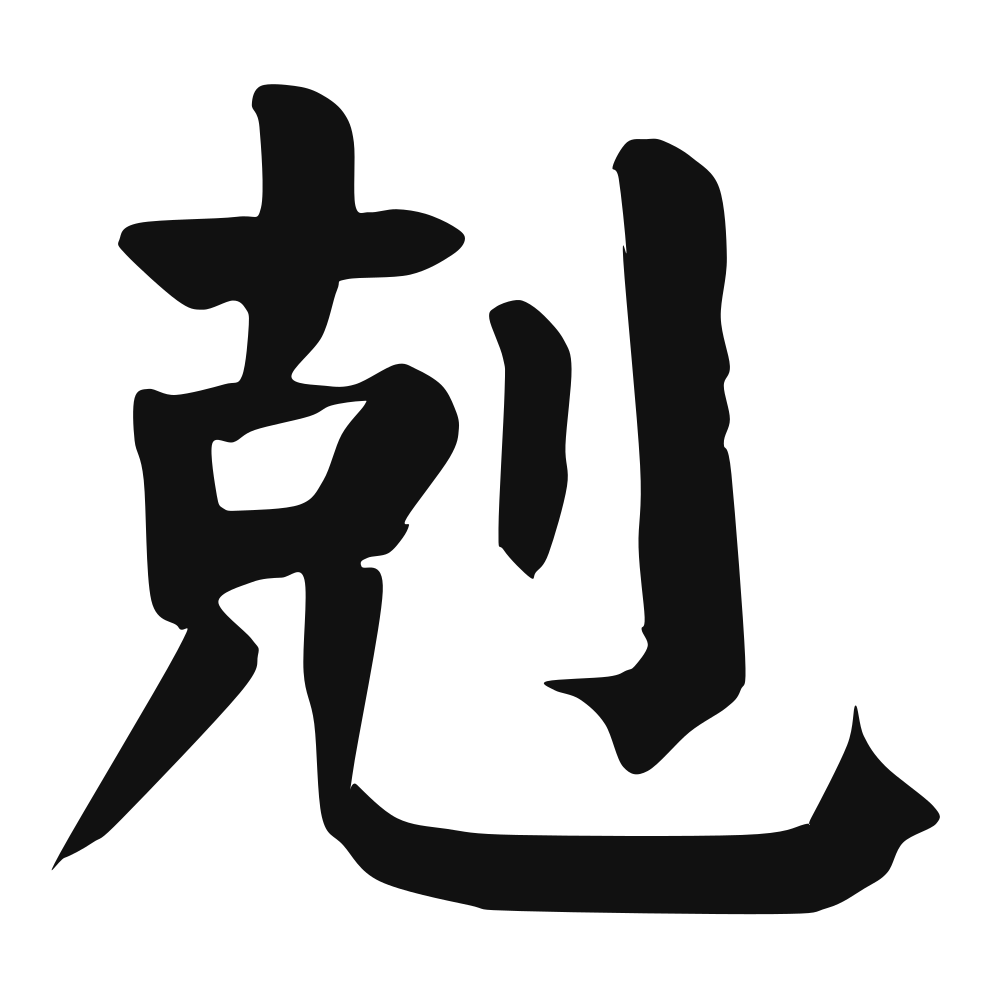
剋
Ke (c. 2000 BC), seventh of the legendary Flame Emperors, 炎帝[Yan2 di4] descended from Shennong 神農|神农[Shen2 nong2] Farmer God; to subdue; to overthrow; to restrain; to scold; to beat
Closest English meanings
overcome·subdue·restrain
The Calligrapher — Yán Zhēnqīng 颜真卿
Tang master of robust regular script; co-creator of the enduring 'Yan style'.
Tang calligrapher (709–784), master of regular script/running script — the Tang moral paragon whose upright, muscular regular script became the model of Chinese integrity in writing. Tang dynasty
Etymology & Meaning · 字义溯源
### Soundkè — kè (4th tone); kēi in colloquial use ('to bawl out / to beat'). Free-standing morpheme ### Original meaningKè (4th tone; also kēi in colloquial Mandarin). 剋 is a variant form of 克 — the dictionaries list 尅 and 勀 beside it — and the Shuowen Jiezi entry belongs to 克: 「克,肩也」 — 'the shoulder'. Xu Xuan's gloss unpacks it: 「肩,任也。任者,又負荷之名也。能勝此物謂之克也」 — the shoulder is what bears a load; to be able to carry this thing is called 克. So the root is not conquest but capacity: the shoulders that can hold the weight. The classical citations follow from that: 《尔雅·释言》「克,能也」; 《书·康诰》「克明峻德」; 《书·洪範》「沉潛剛克,高明柔克」 — the submerged are mastered by firmness, the lofty by softness; 《論語·颜渊》「克己復禮為仁」 — to master oneself and return to ritual is humaneness; 《易·大有》九三「公用享于天子,小人弗克」; 《春秋·隐公元年》「鄭伯克段于鄢」, where 《公羊传》 flatly glosses 「克之者何,殺之也」. Honest disclosure: in modern colloquial Mandarin 剋 means 'to scold' or 'to beat someone up' (挨剋, 剋架), and in 五行 the word 相剋 is the technical 'overcoming' cycle, not a battle cry. The virtue-sense belongs to 克. ### The structure (象形 (per the oracle-bone account, a man bearing a load on his shoulders) · 剋 = 克 + 刀, the variant with the knife added; Shuowen's head is 克: 肩也)①克kèto be able / to bearthe standard form; Shuowen: 肩也, the shoulder②刀dāoknifewhat 剋 adds — and what turns 'able' toward 'beat'③尅kèvariant of 克a third shape of the same word④相剋xiāngkèthe overcoming cycle五行 mechanics: each phase is overcome by another ### In use todayItemReading / meaningNoteReadingkè (4th); kēi colloquiallythe kēi reading carries the rough sensesCore senseto be able; to overcome; to restraincapacity first, conquest secondGrammarbound morpheme in modern Chinese克服 to overcome, 克制 to restrain, 攻克 to storm, 相剋 the cycleTattoo fitcaution — variant form, rough colloquial senseuse 克 if you want the classical virtue ### Closest words in English — and what each misses - Conquer / victory — 勝/征 hold conquest; 克's root is 肩 — being able to carry, of which conquest is one outcome - Win — 贏/捷 hold winning; 克 is capacity and self-mastery, not a result - Strength — 力/強 hold strength; 克 is what strength is for — bearing and restraining - Restrain / forbear — 忍 holds endurance; 克制 is restraining, and it is only one of 克's several sensesAn honest note on grammar. Free verb in classical Chinese (克己, 克明, 弗克); in modern Mandarin a bound morpheme (克服 to overcome, 克制 to restrain, 攻克 to storm) plus the metric 'gram' and the 相剋 cycle; not a surnameWhere a Western reader can stand: 剋 is a variant of 克 (kè), and 克's oldest meaning is not 'conquer' but 'to be able' — Xu Shen defines it a
Cultural Story
(The Analects have Confucius say 克己复礼为仁 — master yourself and return to the rites, and that is goodness; in the south the same idea is written 剋己. The character carries the check laid on the self. It is the restraint that turns a want into a rule kept.
Where a Western reader can stand: 剋 is a variant of 克 (kè), and 克's oldest meaning is not 'conquer' but 'to be able' — Xu Shen defines it as 肩也, the shoulder, the part that takes a load. Yan Zhenqing is the calligrapher who proved that equation with his life, so in his monumental hand the character reads as endurance and quiet resolve. One caveat for a Western wearer: the variant 剋 also means 'to bawl out or beat' in modern slang, and the classical virtue is cleaner spelled 克.
Common words & phrases
- 剋服 overcome
- 剋制 restrain · control
- 攻剋 capture · conquer
- 剋期 set a date
Read the story behind the character
He 剋服 the fear and spoke. She 剋制 the urge to reply. The team 攻剋 the last problem before the demo. The note sets a 剋期 for the reply. The word names the overcoming and the holding-back, as set in the books of the traditional-script reader.
Why this character belongs on skin
The blade enters the character and something yields — this is the grammar of overcoming: a knife radical married to the act of mastering. Not destruction, the old texts insist; discipline. In the five elements, each force checks another — wood parts earth, earth drinks water — an entire cosmology of mutual restraint where nothing wins completely and everything is held. The warrior's secret lives here too: the hardest opponent was never the enemy across the field but the trembling hand, the flinching heart, and the victory is quiet — you, subdued into stillness, made dangerous by calm. This glyph does not celebrate violence; it celebrates the cut that shapes. Inked along the forearm, where a swordsman once measured his blade, it marks the daily small conquests no one applauds — the temptation declined, the fear outwaited. You have been overcome by many things. This one says the ledger has turned, one deliberate stroke at a time.
Own this character
Purchase delivers the original SVG of this glyph, brushed by Yán Zhēnqīng 颜真卿, ready to place on skin, paper, or screen.