
The Calligrapher — Yán Zhēnqīng 颜真卿
Tang master of robust regular script; co-creator of the enduring 'Yan style'.
Tang calligrapher (709–784), master of regular script/running script — the Tang moral paragon whose upright, muscular regular script became the model of Chinese integrity in writing. Tang dynasty
Etymology & Meaning · 字义溯源
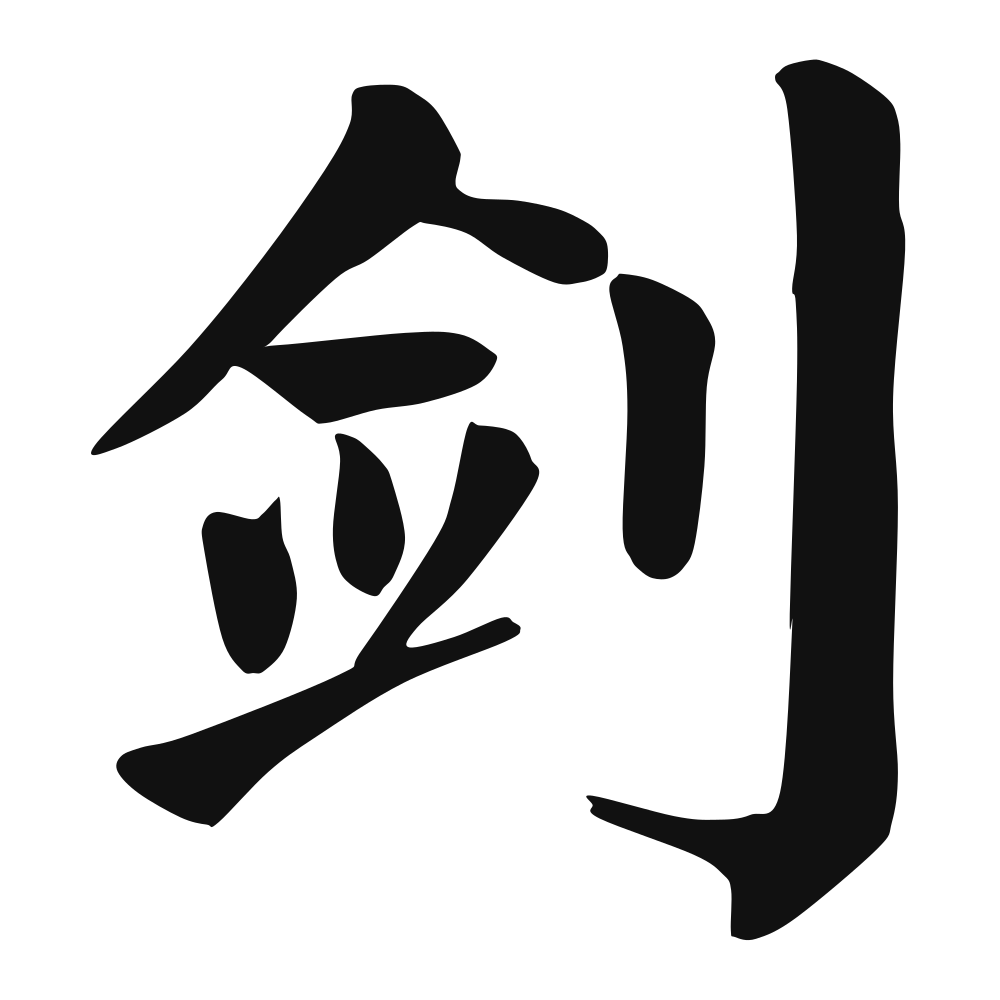
2 · The Character: 剑 Jiàn (4th tone). Traditional 劍, built from 刀 (knife) with 僉 as phonetic. The sword in China is the gentleman's weapon — straight, double-edged, worn at the belt, never drawn casually. The Spring-and-Autumn and Warring States forged the famous blades (干将莫邪, 龙泉), and the knightly ideal made the sword a moral instrument. The knightly compound 剑胆琴心 (a sword's courage and a zither's heart) pairs martial nerve with culture; the Tang poet Jia Dao's 《剑客》 gives the character its patience-image: 「十年磨一剑,霜刃未曾试」 — ten years to grind one sword; the frost-white edge has never been tried. The 《吕氏春秋》 records the sword's way as reading the changes of heaven and earth (「持短兵…必察天地之变」). Modern 剑 is the heroic, chivalric character — courage, skill, and the code of the blade. Honest disclosure: it is a weapon-word — heroic-cool, never gentle; and 剑 is also the first syllable of 剑桥 (Cambridge, the placename), which is a coincidence of sound, not meaning.
Cultural Story
(The bronze sword of King Goujian of Yue, dug from a Chu tomb in 1965, still took a edge after two thousand years; its name is cast in gold along the blade. The 越王勾践剑 sits in the Hubei museum as the proof of a legend. 剑 is the gentleman's weapon, kept bright through defeat.
Where a Western reader can stand: The upright blade: courage forged over a decade, in the most upright hand in Chinese calligraphy. Western readers should hear heroic-cool — the gentleman's weapon, never gentle.
Common words & phrases
- 宝剑 precious sword · fine sword
- 剑客 swordsman
- 剑术 swordsmanship
- 舞剑 sword dance
- 剑法 swordplay · sword art
- 利剑 sharp sword
Read the story behind the character
The coach drills 剑术 at the club. The troupe 舞剑 in the park at dawn. The 利剑 hangs on the wall as a gift. The fencer 击剑 for the school team. The word names the blade, the art, and the exercise that keeps the old stroke alive.
Why this character belongs on skin
Cold steel sings only when drawn. 剑 is that song — the double-edged blade of the Chinese knight-errant, the weapon that was also a poem, carried at the waist like a second spine. The wandering 侠 lived by it and by a code sharper than the edge: defend the helpless, answer insult with justice, never boast. A sword kept sheathed is still a sword; restraint is part of its power. To wear 剑 is to carry that discipline in your own flesh — the readiness, the refusal to be prey. It is sensual in the way all clean lines are, a thin stroke of certainty down the body. Let it lie along a rib or the forearm, and make a vow the ancients would know: I am gentle, and I am not afraid. The blade sleeps. But it is real, and so am I, and the ink is the edge I keep against the dark.
Own this character
Purchase delivers the original SVG of this glyph, brushed by Yán Zhēnqīng 颜真卿, ready to place on skin, paper, or screen.