
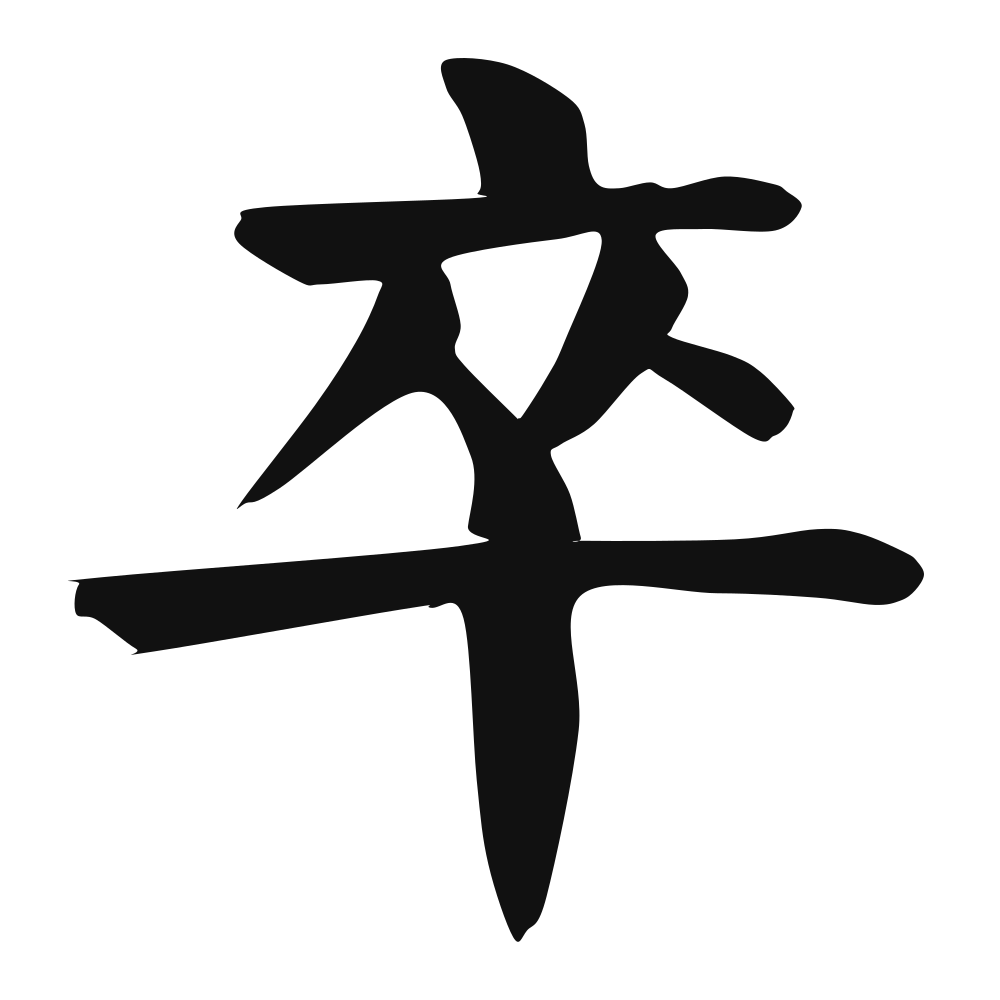
卒
soldier; servant; to finish; to die; finally; at last; pawn in Chinese chess
Closest English meanings
soldier·pawn·die
The Calligrapher — Yán Zhēnqīng 颜真卿
Tang master of robust regular script; co-creator of the enduring 'Yan style'.
Tang calligrapher (709–784), master of regular script/running script — the Tang moral paragon whose upright, muscular regular script became the model of Chinese integrity in writing. Tang dynasty
Cultural Story
The Records name 士卒, the officers and the rank-file who marched the Han campaigns; 卒 was the foot soldier, the pawn that still fronts the board in 象棋. The graph also means “at last” — 卒业, to finish one's study, the end a student walks toward. One stroke holds the march and the close.
Common words & phrases
- 兵卒 soldier · pawn
- 士卒 soldiers
- 卒业 graduate
Read the story behind the character
A 兵卒 holds the line in a strategy game; 士卒 is the word a history doc uses for the conscript. 卒业 is the old term a graduation card keeps, rare now against 毕业. The character meets most readers on a chessboard or in a period film, the common man who moves first and dies first.
Why this character belongs on skin
He was a 卒 — the lowest man in the line, the pawn who walks forward and never back. In the old armies he carried no name worth recording, only the order to hold the pass until the pass held no more. And in the same breath the word means the end: 卒 is how a life closes, how a matter finishes, how the last stroke of ink settles a page. To be a 卒 is to be both the foot soldier and the full stop, to begin in service and end in resolution. There is a dignity the West forgets in its love of generals: the one who simply does not retreat. Wear 卒 where only you can read it, and remember that endurance is its own rank, and that every story earns its period. The quiet pull of the ink is the promise to finish what you start.
Own this character
Purchase delivers the original SVG of this glyph, brushed by Yán Zhēnqīng 颜真卿, ready to place on skin, paper, or screen.